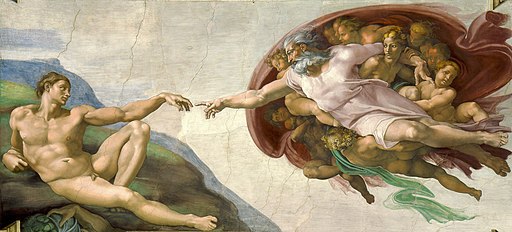
Consider:
1. The Spirit is the Passion of God, the center of His emotional life. His Spirit arouses judges to battle frenzy. In the Spirit, Yahweh regrets creating the world (Genesis 6:3, 6). Yahweh’s soul delights in His Servant (Isaiah 42:1) and rejoices over Israel (Jeremiah 32:41).
Yahweh pours out His Passion on the Servant, which impels Him to carry out Yahweh’s liberating mission (Isaiah 61:1-3). In the Spirit, Yahweh yearns for wayward Ephraim (Jeremiah 31:20).
2. God creates by the Spirit. Specifically, the Spirit is the breath by which the Creator speaks. “The Spirit hovered . . . and God said” (Genesis 1:2-3). God creates by Spirit-filled speech. He creates by impassioned speech.
3. A similar argument from a different angle: The Spirit hovers, birdlike, over the liquid earth. The Father stretches the wing of His Spirit-robe over the waters, still squirming in its blood and afterbirth (cf. Ezekiel 16:6). He claims and forms earth as a bride for His Son.
Before He utters His first fiat, the Creator is to the creature as Bridegroom to bride.
4. Hence: Creation is an act of divine passion. Creation is an act of divine yearning. The Love by which God creates is a passionate love, a yearning love. He creates by a Word charged with the Love that is the Spirit.
God’s yearning isn’t like our yearning. He doesn’t long for what He lacks; His longing is the longing of infinite fullness, undiluted joy, sheer bliss. His longing isn’t the longing to have what is absent, but to share what is superabundantly present.
God creates the world because He yearns in the Spirit for what did not yet have being, and His yearning brings into existence the object of His desire. Make it personal: Long before I existed, He yearned for me. He yearned for you. God created the world because He longed for you to exist.
5. Pseudo-Dionysius claims the highest name of God is “the Good,” which he equates with “love” ( eros ). Dionysius knows it’s a daring move, but he cites Scripture and the Fathers in defense and argues that eros is a better name for God than agape because, in David L. Schindler’s words, “eros brings out the ecstatic, self-transcending, and . . . ‘other-affirming’ character of love.”
To say God is eros is to say He is “ moved by His beloved .” Eros implies reciprocity. If He is eros , God is not merely an object of love, but “is himself a lover.”
Hence, according to Pseudo-Dionysius : “We may be so bold as to claim also that the Cause of all things loves all things in the superabundance of his goodness, that because of this goodness he makes all things, brings all things to perfection, holds all things together, returns all things.
“The divine longing is the Good seeking good for the sake of the Good. That yearning which creates all the goodness of the world preexisted superabundantly within the Good and did not allow it to remain without issue. It stirred him to use the abundance of his powers in the production of the world” ( Divine Names 708B).
Peter Leithart
Peter J. Leithart is President of Theopolis Institute. He is the author of numerous books on theology, literature, and culture, including Theopolitan, Defending Constantine, and Baptized Body.
More from Creation
Continue reading related articles
Creator and Critics
A response to Jordan Ballor’s review of my Creator , which was published at Acton.org on August 12. 1. Ballor says that, to avoid pantheism or panentheism, God’s identity as creator must be “relative, secondary, or conditional.” He rightly says that I argue the opposite: “God is Creator” is the…

In Praise of Thomas
Gotta love ol’ Tommaso d’Aquino, a.k.a. Thomas Aquinas. The margins of my various copies of his works are full of notes of disagreement and question marks, but still: His toss-off arguments are usually deeper than the sustained arguments of lesser theologians. Here’s a pot pourri from the early part of…

All Is Yours
“All things are yours,” Paul says (1 Corinthians 3:21-23). Therefore, writes Thomas Traherne ( Centuries of Meditation ), we should enjoy them as our own possessions: God . . . hath made it infinitely easy to enjoy, by making everything ours, and us able so easily to prize them. Everything…
In Medias Res
Your weekly digest for all things Theopolis.