
D on-John Dugas's recent Shakespeare for Everyman offers a revisionist account of the rise of “authentic” stagings of Shakespeare in the twentieth century. The very meaning of “authentic” changed, as Sally Barnden explains in her TLS review of Dugas's book: “Authentic Shakespeare performance was no longer understood to be that which staged, for instance, The Merchant of Venice in a grand reproduction of sixteenth-century Venice, but that which replicated the conditions of the play's first performance, with limited set, early modern costume, and full (or nearly full) texts.”
Dugas's book challenges the standard narrative of this shift: “Credit for this sea-change has often gone to William Poel—who staged the first quarto of Hamlet without scenery in 1881 and went on to found the Elizabethan Stage Society—and to Harley Granville-Barker, whose Shakespeare productions at the Savoy Theatre in 1912-14 prioritized ensemble acting and replaced naturalistic sets with minimalist, symbolic backdrops. . . . Don-John Dugas argues that Ben Greet, a collaborator of Poel's who popularized some of his methods, especially in the US, was a more significant contributor in this regard than has thus far been recognized.”
Greet's first foray into historically authentic theater was a staging of Everyman: “Although the morality play remained in his repertoire for many years, his company specialized in Shakespeare. They became famous for performing in the ‘Elizabethan Manner'—with relatively light textual cuts and limited sets, often designed to resemble Elizabethan venues such as the Middle Temple Hall.”
Applying the same principles to Shakespeare, Greet revolutionized Shakespearean production using the slogan, “Shakespeare's plays as Shakespeare wrote them,” and his great contribution was “to reinvent the Elizabethan Manner as a business model and to identify lucrative new audiences for Shakespeare performance.”
Peter Leithart
Peter J. Leithart is President of Theopolis Institute. He is the author of numerous books on theology, literature, and culture, including Theopolitan, Defending Constantine, and Baptized Body.
More from Shakespeare
Continue reading related articles
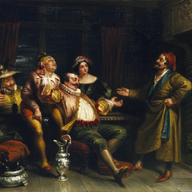
Call Me Malvolio
Call me Malvolio. I was lately the steward of the house of the great and famed Countess Olivia of Illyria. You may have heard of her. I had charge of my Lady’s household retinue, the maids and men who clean, cook, and care for the house. I do my work…
Truth, Love, Lies: Much Ado About Nothing
The following is an excerpt from my Brightest Heaven of Invention , published in the misty days of the mid-1990s. Claudio looks at Hero’s appearance, and concludes she is a maid, a virgin. Because of Don John’s deception, he believes that he has peeled away the deceptive outer layer, the…
Shakespeare the Christian?
W illiam Shakespeare was baptized on April 26, 1564. Baptized , but was he a Christian? The answer partly depends on what we think happens when someone is baptized. Many Christians believe that baptism marks the beginning of life as a Christian. I am one of those Christians. My short…
In Medias Res
Your weekly digest for all things Theopolis.