
P aul begins his first letter to the Corinthians with a scathing denunciation of Corinthian factionalism. He poses several rhetorical questions: Is Christ divided? Was Paul crucified for you? And he brings us baptism: Into whose name were you baptized? Paul's? Peter's? Calvin's? Luther's?
Baptism is a naming ceremony, and it places the same Triune name on all the baptized. Marked by that name, we are all servants of the same master. If I were baptized in the name of Paul, Peter, Calvin, or Luther, then it would be appropriate for me to think of myself as a member of Paul's, Peter's, Calvin's, or Luther's company, a member of one of their bodies. Since we're baptized into Christ, we are “of” Him and of Him alone .
By identifying with an apostle rather than with Christ, individual Corinthians effectively denied their baptism. The church as a whole failed to live in accord with the name that they shared through baptism.
Paul, in short, sees baptism not only as a rite of entry into the body, an engrafting into the death of Jesus, a gift of the Spirit. Baptism is also a standard by which our performance as baptized people, and as a baptized community, are to be measured. Baptism is a canon of Christian living.
This is one of the crucial ways that baptism continues to exert its power throughout life. It is also one of the crucial ways that baptism must be united with the word. When we say a sacrament is word + element + action, we are not talking about a magic formula.
Words are part of the baptismal event itself: “I baptize you in the name of the Father, Son, and Spirit.” But that's not the only time that baptism is united with word. Baptism has continuing efficacy because it is accompanied by a continuing word: “Into whose name were you baptized? Do you not know that those who have been baptized into Christ have put on Christ?” In this sense, baptism has its continuing power because it is not merely water but water and the word.
Peter Leithart
Peter J. Leithart is President of Theopolis Institute. He is the author of numerous books on theology, literature, and culture, including Theopolitan, Defending Constantine, and Baptized Body.
More from Baptism
Continue reading related articles
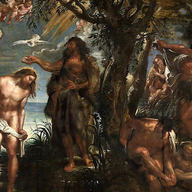
Baptizing Nations
Wes Baker of Peru Mission began his Theopolis Easter Term lectures with a discussion of the connection between the two baptisms in Matthew’s gospel. In Matthew 3, John baptizes Jesus, as the Father speaks from heaven and the Spirit descends in the form of a dove. Through His baptism, Jesus’…
Priesting Aaron and His Sons
Exodus 29 gives instructions about how Aaron and his sons are to be consecrated ( qadash ) in order to “priest” ( kahan ) before Yahweh (29:1). Like the tabernacle and its furnishings, Aaron and his sons will be consecrated. They will become part of the holy house, so they…
Baptists Are Right, Almost
Several essays in the book, Believer’s Baptism , observe the inconsistencies in paedobaptist defenses of infant baptism. In the introduction, editors Thomas Schreiner and Shawn D. Wright focus on the issue of apostasy. If the warning passages in, say, Hebrews are real threats to people within the covenant community, then…
In Medias Res
Your weekly digest for all things Theopolis.