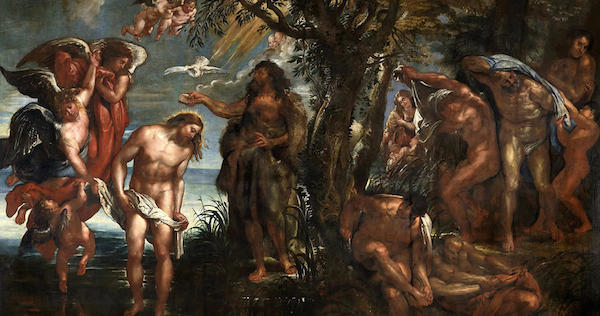
"What shall we say?" Paul asks at the beginning of Romans 6. "Shall we continue in sin that grace might increase?"
This is typically taken as an "antinomian" objection. Paul emphasizes free grace. He's just said that grace abounds where sin abounds. He's heading off the false inference that we can therefore sin abundantly so we can enjoy more abundant grace.
Problem is, that doesn't fit the argument at the end of Romans 5. Paul is describing the impact of the law in a world under the reign of Sin and Death. The law enters, he says, so that transgression might increase (5:20). He's talking about Torah, not some genetic moral principle. And he says the effect in a post-Adamic world isn't to bring righteousness and life but to intensify sin.
This isn't just the actual effect but in some mysterious way the intended effect: Yahweh introduced Torah so that transgressions might increase.
But His aim wasn't to leave Torah-bound Israel in that state. Torah intensified transgression so that in the very space where sin reached its peak, Yahweh could show the power of grace. Torah exposed Sin to be utterly sinful (7:13), but even at their strongest Sin and Death are no match for the gracious Lord.
In other words, the place where grace abounds is the place where Torah intensified the reign of sin. Paul's "shall we continue in sin?" means "shall we continue under Torah?" Or, "Shall we continue in the Adamic world, since the Lord has shown such abundant grace?"
Paul isn't an antinomian. He doesn't think we should go on sinning so we can be forgiven more. But that's not the issue in Romans 6. The issue is whether believers should continue living in the old world of Adam and Torah.
Paul's answer is a firm No. How can we continue in sin - under the reign of Sin, in the realm of Adam, under Torah - when we've already been delivered from that realm into a new realm? How can we continue in the old when we've died to the old and risen to new life in Jesus?
Baptism effects that death to Adam and rising in the Last Adam. The baptized have been "justified from sin" (dikaioo, 6:7), liberated from Sin's realm and the regime of Adam, joined to the life of the risen Christ, so they can walk in that newness of life.
Verse 15 comes closer to the traditional antinomian objection: Now that we're transferred from the mastery of Torah to the mastery of grace, are we free to sin? Paul insists that those who have died in baptism need to keep dying and living: Not letting Sin and Sin's desires rule, but rather presenting ourselves as instruments of righteousness.
Paul's emphasis on the body is remarkable here. We often think that our present experience is one of "spiritual resurrection" while we await "bodily resurrection." For Paul, though, all resurrection is bodily resurrection. The new life we enjoy through baptismal death and resurrection is a bodily life, in which we present our bodies as instruments of the Lord's justice.
And this takes us back to Paul's opening description of the royal gospel of Jesus, which manifests the righteousness of God. How is that justice shown in the gospel? In the cross, surely, but also in lives devoted to justice, in baptized bodies devoted to justice.
Peter Leithart
Peter J. Leithart is President of Theopolis Institute. He is the author of numerous books on theology, literature, and culture, including Theopolitan, Defending Constantine, and Baptized Body.
More from Romans
Continue reading related articles
Zones of Gratitude
Homosexuality is one of the key public issues confronting today'sAmerican pastors. Nearly every pastor will counsel someone battling homosexual desires or actively engaged in a homosexual lifestyle. Compassionate, firm counsel is the least of the challenges. As the gay marriage movement makes headway, there has been subtle but relentless pressure…

God of Hope
Paul concludes his discussion of weak and strong in the church with a benediction: “Now may the God of hope fill you with all joy and peace in believing, so that you will abound in hope by the power of the Holy Spirit” (Romans 15:13). God is “God of hope”…
Strong and Weak in One Body
Romans 14-15 overlaps in several ways with 1 Corinthians 8—10. Both deal with problems about food. In both, Paul talks about the “weak” and the “strong,” and encourages the strong to defer to the weak. The overlap isn’t total. Romans 14-15 isn’t dealing specifically with meat sacrificed to idols, but…
In Medias Res
Your weekly digest for all things Theopolis.