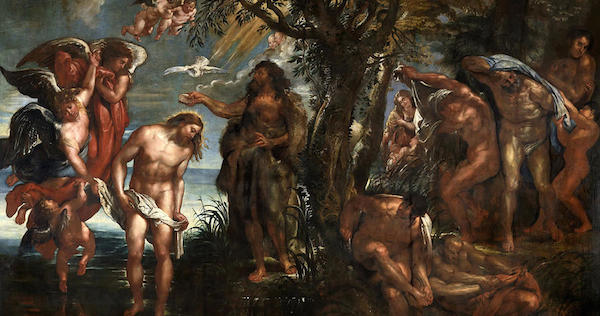
Wes Baker of Peru Mission began his Theopolis Easter Term lectures with a discussion of the connection between the two baptisms in Matthew’s gospel.
In Matthew 3, John baptizes Jesus, as the Father speaks from heaven and the Spirit descends in the form of a dove. Through His baptism, Jesus’ identity as Son is confirmed and He’s commissioned to carry out His Messianic vocation.
At the end of Matthew, Jesus commissions His disciples to disciple and baptize. Because the baptisms performed by the church incorporate the baptized into the one baptism of Jesus, our baptisms have the same double significance as Jesus’ own. We are sons in the Son, beloved in the Beloved, and sent in the Sent One.
Wes emphasized that we oughtn’t separate identity and vocation; vocation is inherent in identity. To be in Christ is to be sent by Christ. Our particular vocation is an aspect of our identity in Christ; our vocations give shape to the human beings we are.
Vocations lend purpose to our lives, and so thrust us forward into the future. Through baptism, that future is folded into the future of the kingdom of God.
Today, Christians and non-Christians think differently about identity and vocation: “My job is what I do , not who I am .”
This splitting of identity and vocation is disastrous. Without vocation, identity collapses. We don’t know who we are unless we know what we’re to do . We don’t know who we are unless we know where we’re going and why – and we know the way only when we know where we’re called.
Our world is founded on the separation between identity and purpose. Secular modernity removes purpose from the natural world. It removes purpose from human nature and relocates it to the realm of will.
As a modern, the only purposes and aims that define me are the ones I choose . This seems liberating, but it’s the opposite. Robbed of given purpose, we drift and wander, incapable of finding secure identity because we cannot be chosen or called toward an unanticipated, un chosen end.
Matthew’s theology of baptismal vocation has political consequences. In baptizing nations, the church incorporates peoples , not just persons, into the baptism of Christ.
When a nation is baptized, the Father calls that nation “Beloved Son,” as He once said “Beloved Son” over Israel (Exodus 4:23). All national sons of God are to be reborn in baptism. As Psalm 87 prophesies, Rahab, Babylon, Philistia, Tyre, and Ethiopia will be claimed as home-born children of Zion: “This one and that one were born in her” (vv. 4, 5, 6).
The other aspect of Jesus’ baptism also applies to nations. In baptizing a nation, the church confers purpose on nations, incorporating them into Jesus’ Messianic mission.
A baptized nation can and must say both “We belong to God” and “We exist to witness to and advance the kingdom of Jesus the Christ.” The church’s mission is to incorporate nations into the mission of Jesus by baptizing those nations into the body of Christ.
Few churches believe this today. Few believe it’s possible for nations to be baptized, or to be beloved sons, or to serve the mission of Jesus. Few churches, in other words, believe that it’s the church’s business to shape national purpose and vocation.
Is it any wonder that the nations rage and wander?
Peter Leithart
Peter J. Leithart is President of Theopolis Institute. He is the author of numerous books on theology, literature, and culture, including Theopolitan, Defending Constantine, and Baptized Body.
More from Baptism
Continue reading related articles
Priesting Aaron and His Sons
Exodus 29 gives instructions about how Aaron and his sons are to be consecrated ( qadash ) in order to “priest” ( kahan ) before Yahweh (29:1). Like the tabernacle and its furnishings, Aaron and his sons will be consecrated. They will become part of the holy house, so they…
Baptists Are Right, Almost
Several essays in the book, Believer’s Baptism , observe the inconsistencies in paedobaptist defenses of infant baptism. In the introduction, editors Thomas Schreiner and Shawn D. Wright focus on the issue of apostasy. If the warning passages in, say, Hebrews are real threats to people within the covenant community, then…
Meeting Us Where We Are
I n his book on The Gospel Commission , Michael Horton includes several insightful pages on baptism. “Like circumcision,” he writes, “baptism is represented in the New testament as God's decision and claim on us. Although it obligates us to respond in faith and obedience, baptism is God's sign and…
In Medias Res
Your weekly digest for all things Theopolis.