
From Nicolas of Cusa: “The more I comprehend that you are incomprehensible, O my God, the more I attain to you, because I attain better the object of my desire . . . . The eternal principle which has given birth to my desire leads it to an unending, infinite end . . . . The end of the intellect is simply to penetrate all things while not penetrating them. It is satisfied neither by the intelligible which it knows, nor by what it does not know; it is satisfied only by him whom it knows to be so intelligible that he can never be totally understood.”
Peter Leithart
Peter J. Leithart is President of Theopolis Institute. He is the author of numerous books on theology, literature, and culture, including Theopolitan, Defending Constantine, and Baptized Body.
More from Theology
Continue reading related articles

In Praise of Thomas
Gotta love ol’ Tommaso d’Aquino, a.k.a. Thomas Aquinas. The margins of my various copies of his works are full of notes of disagreement and question marks, but still: His toss-off arguments are usually deeper than the sustained arguments of lesser theologians. Here’s a pot pourri from the early part of…
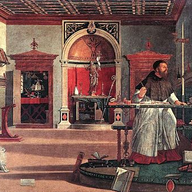
Hoping For Love
In his 2007 encyclical on hope, Spe Salvi , Pope Emeritus Benedict XVI observes that the experience of loving and being loved is a moment of “redemption.” Love gives new meaning, new joy, new energy. Every love is a new birth. We long and hope for love. We want it…

Is All That's In God God?
Divine simplicity is often summarized in the axiom, "All that's in God is God." If this is taken at face value, though, it conflicts with Trinitarian orthodoxy. 1) By this axiom, the Persons are identical with the essence of God. 2) But the Persons have (or are) identifying particularities or…
In Medias Res
Your weekly digest for all things Theopolis.