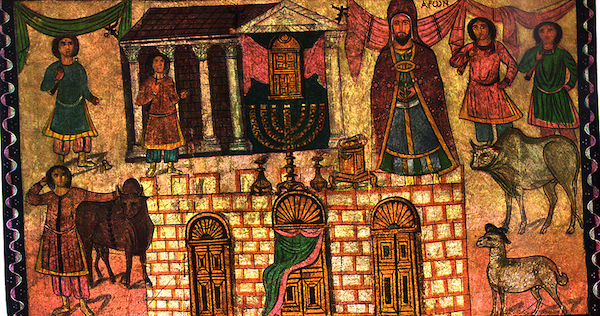
The tabernacle is surrounded by an open space that is bounded by a curtain of white, fine-twisted linen. The curtain is 100 cubits long on the south and north side of the court (Exodus 27:9, 11), held up by twenty wooden pillars, one pillar every five cubits (Exodus 27:10-11).
On the west side, "beyond" the Most Holy Place, the curtain is half as long, 50 cubits (Exodus 27:12), which hangs from ten wooden pillars (Exodus 27:12). The east side of the court is the entrance. On either side are curtains of fifteen cubits, each hung from three pillars (Exodus 27:14-15). The twenty cubits in the middle are covered not by a linen but by a mixed wool-and-linen screen ( masak ) of blue, purple, and scarlet (Exodus 27:16), hung from four pillars.
The mixed-material, mixed-color screen recalls the interior coverings and veils of the tabernacle itself, as well as the clothing of the high priest. Mixed materials are holy, and the screen at the entrance of the court gave all comers a glimpse of the holy place of the interior sanctuary. Lay Israelites and Gentile God-fearers never entered the tent itself, but their entry into the court architecturally gestured toward entry into the tent.
The curtains formed a 100 x 50 x 5 cubit space around the 30 x 10 x 10 cubit tabernacle within (Exodus 27:18). As you approached the tabernacle, you'd see the tent rising up above the surrounding curtains. It was literally twice as high as the court (more, if the tabernacle had a peaked roof, which is most likely).
That literal two-storiedness of the tabernacle was symbolized by the construction of the court pillars and tent boards. The pillars in the court were set into bronze sockets on the ground, and were topped by silver bands and hooks, from which the curtains were hung (Exodus 27:10-11). The gold-plated boards of the tabernacle, meanwhile, were set in sockets of silver (Exodus 26:21, 29).
Architecturally, the tent is stacked on top of the court, and the tabernacle array as a whole moves from bronze (base of court pillars) to silver (hooks of court pillars and bases of tent boards) to gold (covering the boards). That "vertical" ascent in value replicates the horizontal distribution of metals, from the bronze furnishings of the court through the silver cordon of the bases of the tent to the gold furnishings of the tent itself. Further in is further up.
The whole is designed to signify ascent in another way too. From a distance the tabernacle resembles a small hill surrounded by a billowy white cloud. It resembles, in short, the peak of a mountain, of Sinai or Eden in particular. As worshipers entered the court through the holy screen, they symbolically climb to the top of God's mountain, enter the cloud of glory, and stand near the Face of God.
Peter Leithart
Peter J. Leithart is President of Theopolis Institute. He is the author of numerous books on theology, literature, and culture, including Theopolitan, Defending Constantine, and Baptized Body.
More from Exodus
Continue reading related articles
Torah as Promise
This essay was first published in The Theopolitan, a weekly newsletter for Theopolis Partners. To become a Partner, you must donate at least $500 per year or $50 per month. Give here . It’s a truism that each negative commandment in Scripture implies a positive command. “Do not kill” entails…
Israel's Wise Women
Moses informs the congregation of Israel about what’s needed for the tabernacle (Exodus 35:4-19), and the congregation goes off to finds things to contribute (Exodus 35:20). Yahweh speaks to Moses, and Moses acts, bringing the word of Yahweh to fulfillment. Now Moses speaks the word of Yahweh to the people,…
Israel's Wise Men
When Moses demands that Pharaoh let Yahweh’s people go into the wilderness to celebrate a feast, Pharaoh calls for his magicians, sorcery, and wise men (7:11; wise men is chakamiym ). Moses defeats those wise men, and the motif of wisdom goes subterranean for twenty-odd chapters. When it re-emerges, the…
In Medias Res
Your weekly digest for all things Theopolis.