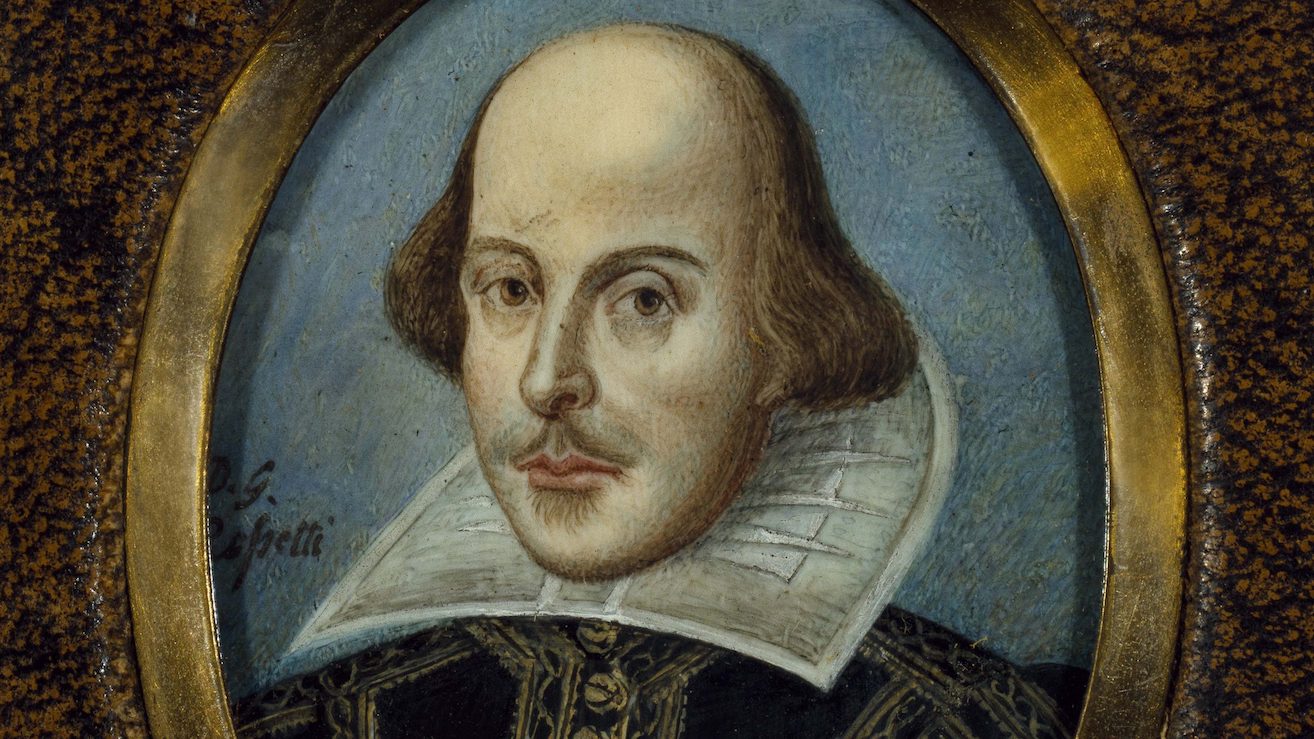
Marjorie Garber has, as usual, some insightful things to say about Merchant of Venice:
1) She describes the play as “Shakespeare’s great play about difference,” pointing to the apparent stark contrasts of Christian and Jew, Venice and Belmont, male and female. Yet, she also notes that the play is busy undercutting those polarities, and showing how the poles of the contrast are more alike than different.
2) Along these lines, the opening scenes establish a parallel between Antonio and Portia. Both are wealthy, but sad, and Garber notes that “sad” in Elizabethan English carried the connotation of “satiated” or “sated.” They have all that they could ask for, yet their satiation does not bring happiness. Happiness in the play comes through risk, through the willingness to give and hazard all. Though Belmont and Venice function in some ways like other nature/civilization contrasts in the comedies, they also have important similarities.
3) The casket plot is a “kind of psychological test” at the same time that it derives from folklore. And Garber notes that the three suitors who choose caskets differ not only in their psychology but in their religion: A Moroccan Moor, a presumably Catholic Spainiard, and the Venetian suitor Bassanio. The key issue in the casket scene is a question of the relation of external appearance and reality; the Prince of Morocco proudly chooses externals and wins death (as, Garber points out, the men in Chaucer’s Pardoner’s Tale); Aragon, also proud, chooses what he thinks he deserves, following (perhaps) a Catholic theology of merit. All choose death in a sense, since the first two condemn themselves to perpetual batcherlorhood. Bassanio, however, chooses death “willingly and self-knowledgeably.” He is distrustful of ornament, and not proud, and rightly chooses the lead.
4) As noted above, the Belmont/Venice contrast is similar to other geographic symbols in the comedies. Belmont is a place of music, of women, of night, of the moon, of magic, of nature; Venice is commercial, masculine, daylight, legal. This geographic contrasts sets up the overall shape of the plot. Peter Saccio describes Shakespearean comedies in terms of flight and invasion, and Merchant is a plot of invasion. The city has come to a standstill over Shylock’s bond, and there is no solution from authority or law. It takes an incarnation of the spirit of Belmont, someone descending from the Beautiful-Mount - Portia in masculine/Venetian disguise - to save the day.
5) Several times Garber compares Shylock to Malvolio. Both are joyless, pleasureless men who take no delight in music or beauty. Both are treated rather brutally, albeit according to their deserts. Both are excluded from the final happiness of the characters at the end. In a comedy, there is no clearer indication that one is a villain that being excluded from the final happiness.
6) Garber describes the play as a hermeneutical comedy (most comedies are), a comedy where interpretation and decipherment are central. This is obviously true in the casket plot, but equally in the bond plot. Quoting 2 Corinthians 3’s distinction between letter and spirit, Garber says that Shylock attempts to “literalize” Paul, insisting on flesh, reading the law according to letter rather than spirit, and is thus “a bad reader.”
7) Garber says that the contrast between the “heartrending scene” in the court and the quite music and romantic comedy of the final Belmont scene is “startling, and it is clearly meant to be.” I don’t think so. I don’t think Shakespeare or his audience saw Portia’s triumph over Shylock as a tragedy; on the contrary, it shows the villain caught in his own net, a perfectly comic outcome. The music of Act 5 is the music that follows when the threat to happiness has been removed - like the music Benedick calls for at the end of Much Ado.
8) Garber neatly suggests that in demanding flesh from Antonio, Shylock is attempt to inflict a forced conversio on him: “I do not suggest that he wants to castrate Antonio, but rather that he wants, symbolically, to circumcise him. To make him a ‘Jew.’” This heightens the comic irony of the outcome, because of the course this plot is turned against Shylock, who is forced to become a Christian. She also hears echoes of Leviticus 16, again with tables turned: Shylock wishes to make Antonio a sacrificial victim, yet is himself excluded, sent out of the camp, as a scapegoat.
Peter Leithart
Peter J. Leithart is President of Theopolis Institute. He is the author of numerous books on theology, literature, and culture, including Theopolitan, Defending Constantine, and Baptized Body.
More from Literature
Continue reading related articles
God's Plenty
A few thoughts on the “General Prologue” to Chaucer’s Canterbury Tales . 1) The Prologue sets the stage for a multi-layered set of tales. The real-life Chaucer is, of course, the author, but in the Prologue, he introduces a fictional version of himself as narrator: It happened in that season…
Violence as Poetry
Paul and Jane Sinclair, protagonists of J.G. Ballard’s 2000 novel Super-Cannes , move from England to the French Riviera to live at a new high-tech business park, Eden-Olympia (!), after Jane’s friend and former lover, Dr. David Greenwood, goes on a killing spree that ends with suicide. Jane, a pediatrician,…

Memento Mori
Virtually all the characters in Muriel Spark’s 1959 novel, Memento Mori , are over 70. They suffer the physical humiliations of aging and the pains of regret. Unexpectedly, hilariously, they’re as competitive and petty as schoolchildren. Well into his 80s, Godfrey Colston scorns the crippled critic Guy Leets for the…
In Medias Res
Your weekly digest for all things Theopolis.