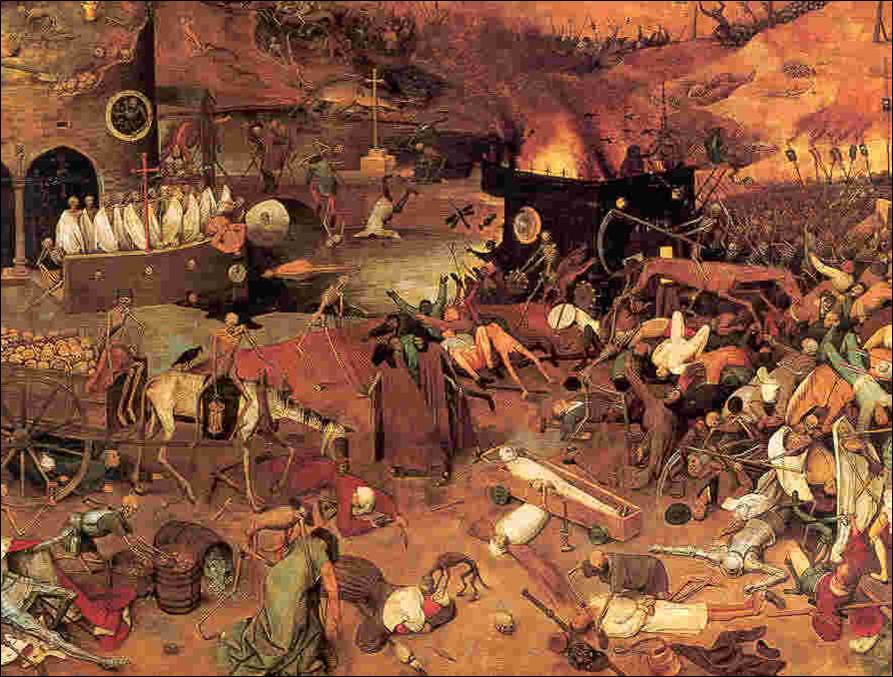
L.M. Sacasas ponders why the coronavirus spooks us. He says it's the pandemic's uncertainty and unpredictability, which destroys our illusions of control. We categorize it as an "accident" because we don't have other categories to wrestle with the unknown. It's a peculiarly modern mental tic.
" To call something an accident is also to presuppose a background of prediction and control. This is all the more apparent when one considers that the concept of the accident has replaced certain older notions: fate, providence, and fortuna.
" What fate, providence, or fortuna determined was necessarily beyond our ken. Each concept gave human beings a way of reckoning with the uncertainties and vagaries of human experience. It is true that they may have sanctioned an unfortunate degree of fatalism and inaction, but they also implied that there were limits to what we could know and what we could control. "
For moderns, limits are temporary. What we can't control now, we will be able to control tomorrow. To put the virus in the category of "accident" thus saves the appearances of modernity.
On the other hand, there's a form of "cognitive relief" in the conspiracy theory that the virus originated in a Chinese lab. From this perspective, "it is not that the modern project can never be completed, it is simply that we screwed up somewhere and need to do better."
Both responses are defense mechanisms. We need to reckon with the fact that "the unpredictable, the unknown, the incalculable, the capricious aspects of our experience will always be with us. The conquest upon which we have staked our hope will never be complete." When we cling to illusions of absolute control, "each phenomenon that makes it impossible for us to ignore this fact will mess with our heads and trouble our hearts."
I'd put a theological gloss on that: God is the unpredictable, unknown, incalculable factor. Our forgetfulness of our vulnerability and weakness is ultimately forgetfulness of Him. As David Field reminded our students in the Theopolis Easter Term course, we are masters at avoiding reality. We've constructed an entire civilization to cushion us from the Reality, to make it natural for us to choose comfort instead of Christ.
God will be known. He is not mocked. When Pharaoh told Moses, "I do not know Yahweh," Yahweh introduced Himself, with a series of plagues that devastated Egypt. Yahweh was merciful, longsuffering, gracious, even to Pharaoh. But He showed Himself as the God of plagues.
"Plague" and "wrath" are at times virtually synonymous in Scripture. "Wrath has gone forth form Yahweh," we find in Numbers 16:46, and then, immediately after, "the plague has begun." As the coronavirus presses us to restore the language of fate and providence to our vocabulary, it should also restore our fear of the wrath of God. If we refuse that, we're still indulging illusions.
At this point, I'm not sanguine about our response to this reality-check. Our fragility hasn't yet hit home, not deeply. We're responding to this massive challenge to our illusion of control by asserting our impressive capacity for control - political, scientific, medical. More of the same, and with churches closed.
Coronavirus may not be the end. The ultimate death toll may still fall far short of the higher estimates. I suspect it will. Even so, the virus has already taken a massive toll in human life, and the virus and the response have already had a massive social and psychological impact.
As we say on the Theopolis Fellows page, "Worlds die." They don't necessarily die all at once, but they do die. Yahweh sent ten plagues before Egypt toppled. Pray that we take this hint from the God of plagues, and avoid following the example of Pharaoh, who enlarged his heart every time Yahweh let up the pressure.
Peter Leithart
Peter J. Leithart is President of Theopolis Institute. He is the author of numerous books on theology, literature, and culture, including Theopolitan, Defending Constantine, and Baptized Body.
More from Medicine
Continue reading related articles
COVID Diagnosis
Whether they intend to or not, parents are training their children by the way they respond to COVID. Pastors are training their churches. There are temptations on every side. Put aside debates about the efficacy of masks, lockdowns, distancing, vaccines, and do some self-diagnosis: Will your response to the pandemic…
From Sword to Syringe
Stanford’s Jay Bhattacharya, Oxford’s Sunetra Gupta, and Harvard’s Martin Kulldorff are heroes of the COVID-19 pandemic. Last October, they teamed up to write the Great Barrington Declaration that advocated “focused protection” of the vulnerable as an alternative to generalized lockdowns. They’ve faced relentless scorn, slander, and censorship ever since, yet…
Distortions of Modern Medicine
A few highlights from the readings for Kimbell Kornu’s Pentecost Term course on "The Christian Art of Dying," which we hosted at Theopolis in May. 1. Christians agree that sin is the ultimate cause of illness. But George Khushf suggests another dimension of the sin-sickness relation: Illness as “general revelation.”…
In Medias Res
Your weekly digest for all things Theopolis.