Hart argues that the beauty of creation should not be seen as competing with the beauty of God; sensible things do not in themselves distract from God, but rather our corrupt desires reduces the things of the world to “inert property” alone draws the sensible world away from God. He goes on to say, “Of course, theology has suffered, historically, from a variety of etherealizing susceptibilities: the occasional dualistic tensions within a small portion of patristic metaphysics, or Zwingli’s spectral theology of the sacraments, or the Calvinist mysticism of bare and unadorned worship (which idolatrously mistakes God for some object that can be lost among other objects), and other tendencies to imagine that the sould is purified by being extracted from the life of the senses or that God is glorified by the inanition of the world.” God does not glorify Himself, in short, by sucking all the glory from creation, but precisely by bestowing glory.
That comment about Calvinistic worship, however, brings one (at least a Calvinist) up short. It is striking that Hart accuses Calvinistic worship of idolatry, because (as he surely knows) Calvinists stripped the adornments from worship precisely in order to avoid idolatry. Hart suggests that there is a more fundamental idolatry hidden in the stripping of the altars, namely, the idolatry of believing that God’s glory could possibly be challenged by the glory of creation, that God is just another item, a singular one to be sure, but another item in a set of objects that make up “reality,” that God and the world are on the same plane “competing” for recognition.
This is surely a form of idolatry, and I am not an advocate of minimalist Puritan worship. But Hart’s argument implies an endorsement of iconodulism, and in that respect it is not convincing. If, as he argues, corrupt desires can “draw [the world] away from God” then it is possible for that corrupt desire to manifest itself liturgically. He would admit, I assume, that it is possible for a worshiper with corrupt desires to commit idolatry in venerating an icon, a crucifix, and elevated host. He would respond by saying, as he does about other sensible objections, that the things themselves cannot distract from God. The proper use of an icon, for Hart, would be to see in it a manifestation of God’s glory. But if he goes in this direction, then the icon is no more a manifestation of God’s glory than a tree or a nebula. Historically, as I understand it, much more has been claimed for icons than this. And, is there any Christian precedent for genuflecting before trees? (St Francis??)
Further, there remains the Second Commandment as a decisive exclusion of venerating icons and images. In the end, Hart’s argument seems almost to define idolatry out of existence, apart from the intellectual idolatry of erasing the distinction between Creator and creature. In sum, Paul means something by “worshiping and serving the creature rather than the Creator.”
Peter Leithart
Peter J. Leithart is President of Theopolis Institute. He is the author of numerous books on theology, literature, and culture, including Theopolitan, Defending Constantine, and Baptized Body.
More from Theology
Continue reading related articles
In Praise of Thomas
Gotta love ol’ Tommaso d’Aquino, a.k.a. Thomas Aquinas. The margins of my various copies of his works are full of notes of disagreement and question marks, but still: His toss-off arguments are usually deeper than the sustained arguments of lesser theologians. Here’s a pot pourri from the early part of…
Hoping For Love
In his 2007 encyclical on hope, Spe Salvi , Pope Emeritus Benedict XVI observes that the experience of loving and being loved is a moment of “redemption.” Love gives new meaning, new joy, new energy. Every love is a new birth. We long and hope for love. We want it…
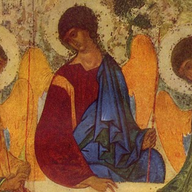
Is All That's In God God?
Divine simplicity is often summarized in the axiom, "All that's in God is God." If this is taken at face value, though, it conflicts with Trinitarian orthodoxy. 1) By this axiom, the Persons are identical with the essence of God. 2) But the Persons have (or are) identifying particularities or…
In Medias Res
Your weekly digest for all things Theopolis.