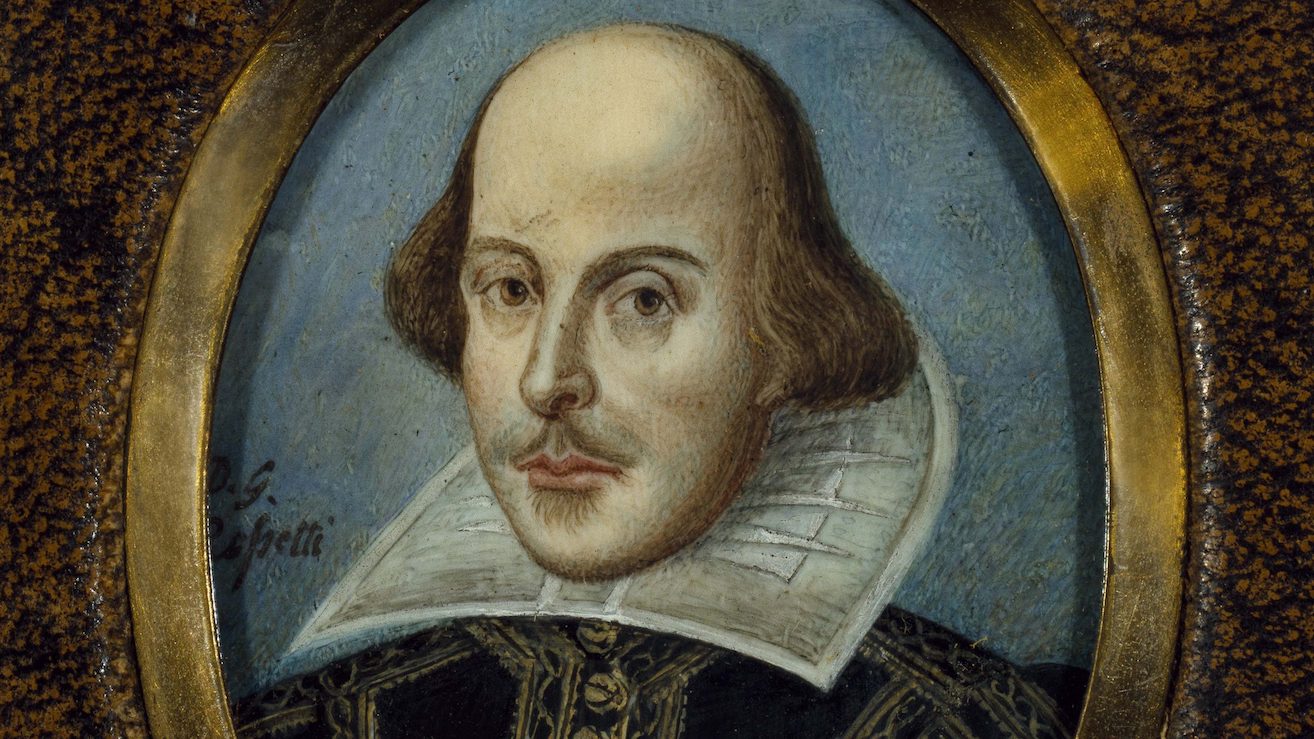
Edward Oakes offers a fascinating review of several new books on Shakespeare in the June/July issue of First Things . He gives this summary of the recent argument of Stephen Greenblatt concerning Shakespeare’s views on Purgatory: “Shakespeare’s choice of Wittenberg as the palce where Hamlet spent time as a student before his father’s death cannot be mere whim; for in Wittenberg the young prince would have imbibed Martin Luther’s theology of justification, including his critique of the dogma of purgatory. Back in Denmark (a Lutheranized country by the time the play was written in 1600), Hamlet encounters his father’s ghost . . . . The budding Lutheran prince is thus jolted out of his Wittenberg theology - but not enough to trust the ghost right away, for the Protestant critique of purtagory still holds swa in his impressionable mind.” Only after testing the ghost’s veracity with the “Mousetrap” play does he tell Ophelia to “get thee to a nunnery.”
Intriguing, but Oakes brings several objections, drawing on Craig Bernthal’s recent book on Shakespeare’s conception of justice. The most interesting point is that the Mousetrap play doesn’t actually accomplish its purpose: “curiously enough, what he presents is a play that seems designed to prevent him from finding out [if Claudius killed Hamlet Sr]. ‘In Hamlet’s play, it is a NEPHEW, Lucianus, who murders his uncle, Gonzago. Claudius, even if he were innocent, would have every right, given Hamlet’s erratic behavior, to take this as a barely veiled threat. Since Claudius’ reaction to “The Mousetrap” could verify either of two hypotheses, it ultimately fails to reveal the truth.’”
Oakes ends by saying that Shakespeare’s own religious beliefs are probably impossible to determine. What is clear, Oakes says, is that Shakespeare was well aware of the theological contests of his day, and of both Catholic and Protestant theologies.
Peter Leithart
Peter J. Leithart is President of Theopolis Institute. He is the author of numerous books on theology, literature, and culture, including Theopolitan, Defending Constantine, and Baptized Body.
More from Literature
Continue reading related articles
God's Plenty
A few thoughts on the “General Prologue” to Chaucer’s Canterbury Tales . 1) The Prologue sets the stage for a multi-layered set of tales. The real-life Chaucer is, of course, the author, but in the Prologue, he introduces a fictional version of himself as narrator: It happened in that season…
Violence as Poetry
Paul and Jane Sinclair, protagonists of J.G. Ballard’s 2000 novel Super-Cannes , move from England to the French Riviera to live at a new high-tech business park, Eden-Olympia (!), after Jane’s friend and former lover, Dr. David Greenwood, goes on a killing spree that ends with suicide. Jane, a pediatrician,…

Memento Mori
Virtually all the characters in Muriel Spark’s 1959 novel, Memento Mori , are over 70. They suffer the physical humiliations of aging and the pains of regret. Unexpectedly, hilariously, they’re as competitive and petty as schoolchildren. Well into his 80s, Godfrey Colston scorns the crippled critic Guy Leets for the…
In Medias Res
Your weekly digest for all things Theopolis.