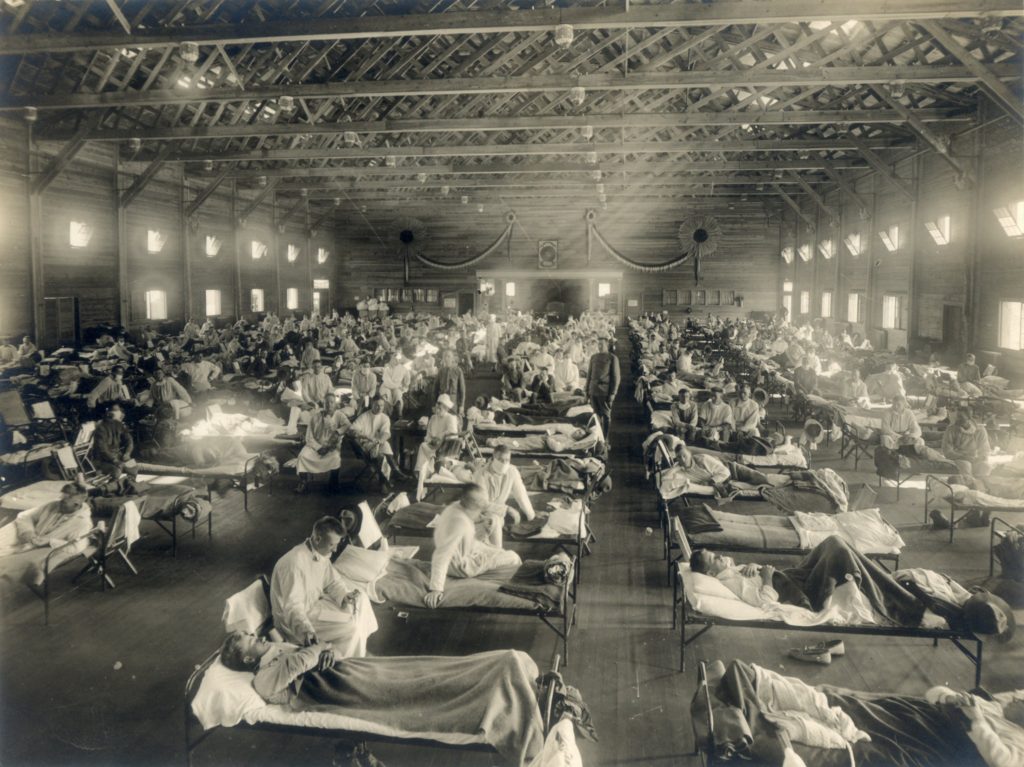
Since the coronavirus pandemic started, people have debated whether or not COVID-19 is "just" a nasty form of the flu or if it's far worse. We’ve heard horror stories about the horrific effects of COVID-19, as if to contrast this deadly virus with influenza. Both sides seem to assume that flu v. COVID is the same as mild v. dangerous.
COVID can be awful, but strains of influenza can be plenty awful too. Jeremy Brown begins his history of Influenza with a riveting account of Autumn Reddinger’s 2013 battle with H1N1 ("swine flu").
Autumn was a young, active, and athletic mother of two. During the Christmas holidays in 2013, she caught a cold but kept plugging away. One evening, she texted a friend. Her texts were so incoherent that her friend drove to her home to get her help. When Autumn got to the hospital in Punxsutawney, Pennsylvania, she told the nurses her lungs were on fire. To the doctors, her lungs sounded clear, and her blood pressure was fine. She had no fever, and a chest X-Ray showed nothing. Still, she was clearly ill and was admitted. Over the next few hours, her condition deteriorated, and she was taken by helicopter to Pittsburgh.
By now she was coughing up blood, and it became almost impossible to get enough oxygen into her to keep her alive. A chest X-ray showed that her lungs – which had sounded clear and looked entirely normal a few hours earlier – were now filled with pus and fluid. She was given more antibiotics and hooked up to IV medications to keep her blood pressure from dropping.
Dr. Holt Murray was called in to hook Autumn up to a heart-lung machine (ECMO).
Murray inserted a big needle into a vein in Autumn’s groin. This would remove her blood and send it to the machine to be scrubbed and filled with oxygen. Another needle went into her neck, where the blood would return. It didn’t take long for the ECMO machine to improve her oxygen levels. But then her heart stopped. Murray and his team of nurses and specialists began continuous chest massage and gave an injection of epinephrine to restart the heart. Brief success. Then another episode. More epinephrine. The heart kicked back into action, but it was barely working. Murray did an ultrasound of Autumn’s heart that showed it was functioning at less than 10 percent of capacity. It was no longer able to pump blood through her body.
Autumn had tested negative for influenza, but Dr. Murray tested her again and discovered the H1N1 virus. “In a matter of hours, the virus had destroyed her lungs and was now attacking her heart muscle.” She was taken to another hospital, University of Pittsburgh’s Presbyterian, where a surgeon opened her chest and connected her heart directly to the heart-lung machine.
Fortunately, Autumn survived. Her heart strengthened. Antibiotics cleared out a pneumonia. On January 10, 2014, she was taken off the machine. She stayed in the hospital for another month, then went to a rehab center for another two weeks. In the autumn of 2014, nine months after she caught the flu, she was strong enough to return to work.
" Just the flu?" Hardly.
COVID-19 is a killer virus for some. Flu is a killer too, responsible for the worst epidemic in recorded history (the 1918 Spanish flu). Swine flu still circulates along with other influenza viruses.
COVID works fast in some patients; H1N1 worked fast on Autumn Reddinger. COVID attacks not only respiration but other systems; so, in some cases, does H1N1. COVID kills; so do forms of the flu. We'll have a more honest debate about COVID when we get past the simplistic idea that flu is innocuous.
Brown is gloomy about the prospects of a cure for influenza:
we have learned an enormous amount about influenza. We know its genetic code, how it mutates, and how it makes us sick, and yet we still don’t have effective ways to fight it. The antiviral medications we have are pretty useless, and the flu vaccine is a poor defense. In good years it is effective only half the time, and in 2018 the record was even worse; the vaccine was only effective in about one-third of those who received it .
This should make us skeptical about the possibility that a vaccine can end COVID-19. We’ve learned to live with the potential horrors of influenza. In all likelihood, we’ll have to do the same with COVID-19.
Peter Leithart
Peter J. Leithart is President of Theopolis Institute. He is the author of numerous books on theology, literature, and culture, including Theopolitan, Defending Constantine, and Baptized Body.
More from Coronavirus
Continue reading related articles

New Normals
Much remains uncertain about the new coronavirus, including its infection rate and its fatality rate. As if the natural uncertainty of such things weren't confusing enough, we're battered with conflicting narratives about the numbers, accusations of "fake news" tossed in every direction. Thus far, it seems healthy people without any…
Let My People Go!
Alabama's Governor Kay Ivey loosened the shutdown last week, allowing more businesses to operate and opening the Gulf coast beaches. I appreciate the complexity of the issues governors face. They must make life-or-death decisions, without the kind of information they need to be certain their decisions are right. Governors throughout…
Whose Model? Which Science?
"Follow the science" has been the basso continuo of the coronavirus epidemic. Following the science, many nations went into more or less severe shutdowns. These same nations intend to follow the science in deciding when to re-open, to allow businesses, schools, and churches to start operating again. Skeptics who question…
In Medias Res
Your weekly digest for all things Theopolis.