
Music is often considered the most mystical, ephemeral, ethereal of all arts. For some, music is for this reason the most perfect, the most purely artistic, of all arts.
Maybe.
But think: When Bach wants to “comment” (Calvin Stapert’s term) on the chorale “Wachet auf” in Cantata 140, he gives the commentary to lower voices singing beneath the soprano chorale. The commentary is visible in the score and audible on the page. Music can evoke what’s absent, of course; Bach uses the dotted rhythms of French overture at the beginning of Cantata 140 because of its evocation of courtly pomp, appropriate to the Cantata’s rendition of the arrival of the heavenly Bridegroom (again, I’m relying on Stapert). But music can render “text” and “commentary” together, simultaneously, at different registers in different voices. In music, two, three, or more lines can be going simultaneously, all physically audible.
Poets, it seems, have less opportunity to put both text and commentary explicitly, openly in their poetry (unless, like Eliot, the poet appends learned footnotes). Poetry and other literary art is in one sense much “thinner” than music; there’s only one line of text. If a poet wants to bring a “commentary” into play in his poem - through allusion or metalepsis - he has to comment on the text in the same line as the text itself. Commentary is almost entirely absent from the text, almost entirely evoked rather than seen or heard. It’s “heard” only in the mind of the reader who catches the allusion.
One would think that music, lacking the semantic load of language (an A-flat doesn’t mean in the way the word “dog” means), would be more elusive and allusive. But in some ways it appears that language is more mystical.
Peter Leithart
Peter J. Leithart is President of Theopolis Institute. He is the author of numerous books on theology, literature, and culture, including Theopolitan, Defending Constantine, and Baptized Body.
More from Music
Continue reading related articles
Exultant Singer
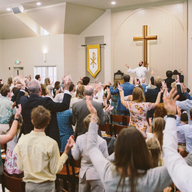
The Lord your God is in your midst, a mighty One who will save; he will rejoice over you with gladness; he will quiet you by his love; he will exult over you with loud singing. — Zephaniah 3:17 The God who commands song is Himself an exultant Singer. Zephaniah…
The God Who Sings
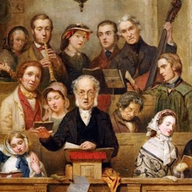
Yesterday, I preached the first in a series of sermons on liturgical music. Here's a snippet of the sermon. We’ve all been swept away by music. Maybe it was a live performance by a favorite band or of a favorite symphony. Perhaps it happens while you’re fixing dinner and Alexa…
How the Church Lost Its Soundscape
The following was first published in 2011 at Firstthings.com . “By the twelfth century,” Christopher Page writes in his magisterial The Christian West and Its Singers (2010), “the Latin West could be imagined as a soundscape of Latin chant.” From the eighth-century alliance of Pope Stephen with the Frankish King…
In Medias Res
Your weekly digest for all things Theopolis.