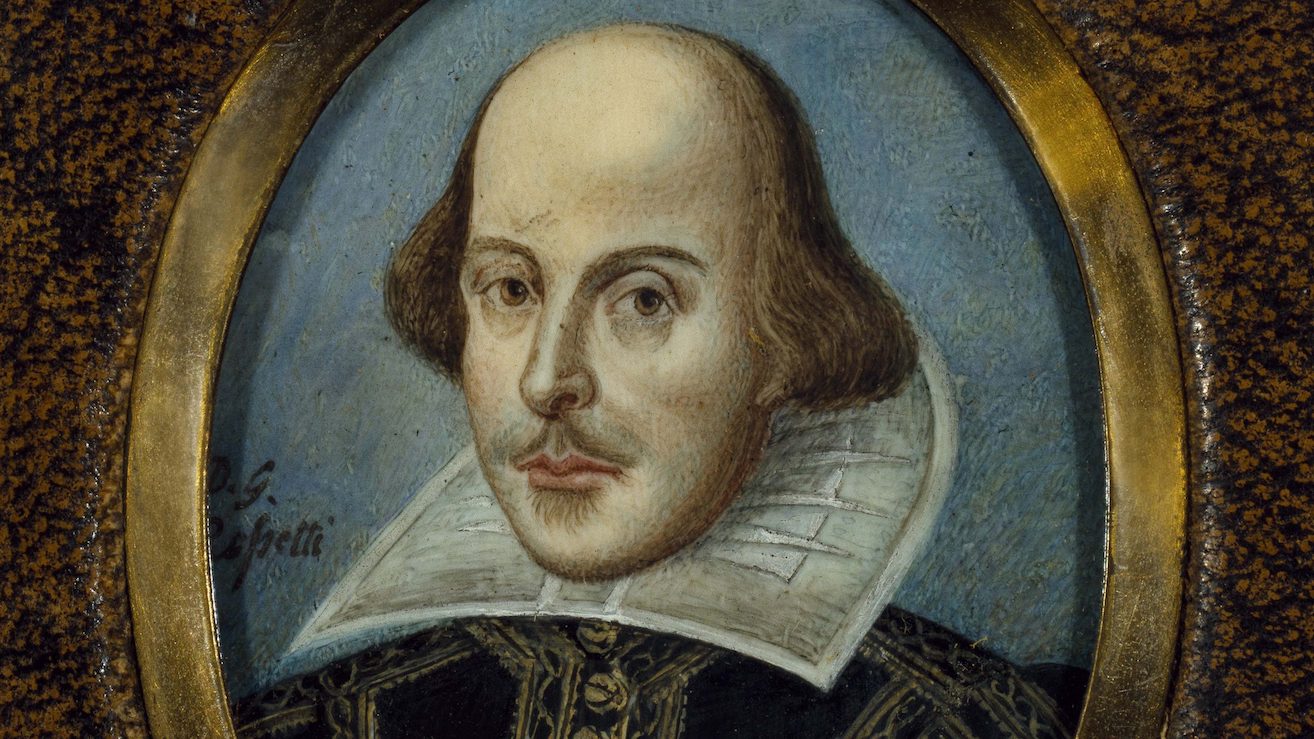
I am grateful to Ralph Smith for references to Frances Yates’ work on Shakespeare’s plays.
In an analysis of The Tempest, Frances Yates writes: “It is inevitable and unavoidable in thinking of Prospero to bring in the name of John Dee, the great mathematical magus of whom Shakespeare must have known, the teacher of Philip Sidney, and deeply in the confidence of Queen Elizabeth I. In his famous preface to Euclid of 1570, which became the Bible of the rising generations of Elizabethan scientists and mathematicians, Dee sets out, following Agrippa, the theory of the three worlds, emphasizing, as does Agrippa, that through all the three worlds there runs, as the connecting link, number . . . .
“Dee was in his own right a brilliant mathematician, and he related his study of number to the three worlds of the Cabalists. In the lower elemental world, he studied number as technology and applied science. In the celestial world his study of number was related to astrology and alchemy. And in the supercelestial world, Dee believed that he had found the secret of conjuring spirits by numerical computations in the tradition of Trichtemius and Agrippa. Dee’s type of science can be classified as ‘Rosicrucian,’ using the word . . . to designate a stage in the history of the magico-scientific tradition which is intermediate between the Renaissance and the seventeenth century.” Yates goes on to suggest that “Prospero represents precisely that Rosicrucian stage. We see him as a conjuror in the play, but the knowledge of such a Dee-like figure would have included mathematics developing into science, and particularly the science of navigation in which Dee was proficient and in which he instructed the great mariners of the Elizabethan age.”
If, as Yates is suggesting, Shakespeare “chose to glorify a Dee-like magus” around 1611, he was engaged in an act of rehabilitation. Dee fell out of favor in Elizabeth’s court in the 1590s, was ignored by James I, and died in poverty in 1608. Shakespeare makes his magus a “virtuous opponent of evil sorcery, the noble and benevolent ruler who uses his magico-scientific knowledge for good ends.” Thus, “Prospero might be a vindication of Dee, a reply to the censure of James” and a show of support for Prince Henry, who encouraged the mathematicians and navigators who continued Dee’s work into the Stuart era.
The Tempest is but one example of the general phenomenon that Yates sees in Shakespeare “Last Plays,” namely, the “atmosphere of learned magic, the medical magic of Cerimon in Pericles, the deep Hermetic magic of The Winter’s Tale, the incantatory singing of Henry VIII.”
Peter Leithart
Peter J. Leithart is President of Theopolis Institute. He is the author of numerous books on theology, literature, and culture, including Theopolitan, Defending Constantine, and Baptized Body.
More from Literature
Continue reading related articles
God's Plenty
A few thoughts on the “General Prologue” to Chaucer’s Canterbury Tales . 1) The Prologue sets the stage for a multi-layered set of tales. The real-life Chaucer is, of course, the author, but in the Prologue, he introduces a fictional version of himself as narrator: It happened in that season…
Violence as Poetry
Paul and Jane Sinclair, protagonists of J.G. Ballard’s 2000 novel Super-Cannes , move from England to the French Riviera to live at a new high-tech business park, Eden-Olympia (!), after Jane’s friend and former lover, Dr. David Greenwood, goes on a killing spree that ends with suicide. Jane, a pediatrician,…

Memento Mori
Virtually all the characters in Muriel Spark’s 1959 novel, Memento Mori , are over 70. They suffer the physical humiliations of aging and the pains of regret. Unexpectedly, hilariously, they’re as competitive and petty as schoolchildren. Well into his 80s, Godfrey Colston scorns the crippled critic Guy Leets for the…
In Medias Res
Your weekly digest for all things Theopolis.