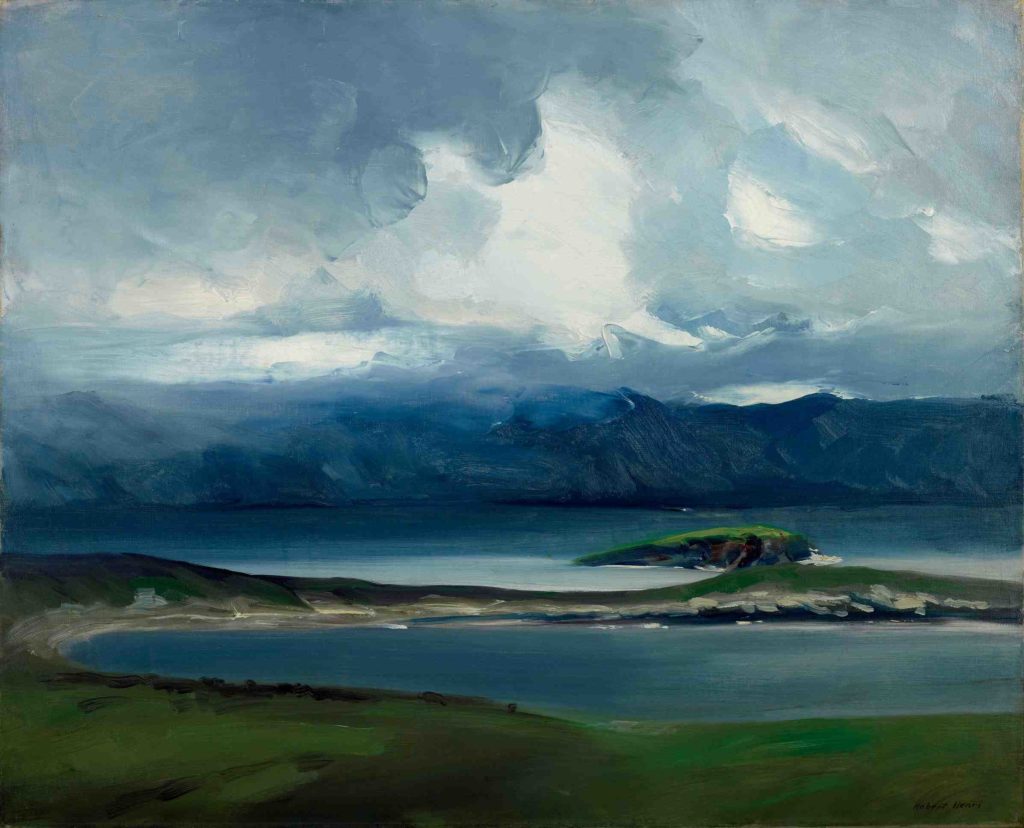
Red Sky in Morning , Paul Lynch's 2013 debut novel, is a stylistic tour de force . Like the poetry of Seamus Heaney (whom Lynch credits for inspiration), he captures the craggy, muck-mudded landscape of Lynch's native Ireland.
Convoluted syntax, unobtrusive Irish colloquialisms, hints of alliterative verse lend the novel a distinctly Celtic archaism.
The opening sentences illustrate: "Night sky was black and then there was blood, morning crack of light on the edge of the earth. The crimson spill sent the bright stars to fade, hills stepping out of shadow and clouds finding flesh. First rain from a soundless sky and music it made of the land."
Adding the articles back into that last sentence ("the first rain") robs it of its power. If Lynch had written what we expect, "It made music of the land," he wouldn't have signalled so strongly that he's writing a tale that might be sung by a bard. "It made music of the land" doesn't scan.
That kind of prose grabs my attention. My one worry is that I'll get stuck in thickly layered poetry and lose track of the story; or, worse, discovered there's no story to lose track of.
Lynch's book doesn't suffer those defects. If the density of the prose comes from Heaney, characters and plot come from a Cormac McCarthy novel. (In an afterword, Lynch mentions his debt to Blood Meridian .)
Red Sky in Morning is a 275-page chase sequence, set in the 1830s, with the young Coll Coyle as the prey and the relentless, sadistic Faller as tracker, the most terrifying villain since McCarthy's Chigurh ( No Country for Old Men ). The plot is tight, but slows slightly whenever Faller goes unmentioned for a few pages.
Faller fancies himself an agent to bring balance to the world. At one point, he turns philosophical (like one of McCarthy's cowboys or lawmen) and explains the human condition in a single sentence: It's all a matter of "weight."
In the womb, we're weightlessly suspended in fluid. Why do infants start "mewling . . . like an animal" as soon as they're born? "It is because it feels itself for the first time, discovers its own weight in the world. . . . With weight comes sensation and pain and hunger and the need for sleep and all these wants and needs and all of that ad infinitum."
We can't recover from the pain of our own weight, because the more we need the more we want: "give a hungry man soup and he asks for meat. And when he's given meat one finds he's sitting at your table. Next thing he's asking for the silverware." People "aren't people" but "animals, brutes, blind and stupid" who pursue "endless needs" without knowing where they come from and without realizing that "all the rest we place on top to make is feel better is a delusion."
Under these circumstances, murder is a form of mercy: "The price of life is the burden of your own weight and some people are better off without it."
Later, facing his own tracker, Faller reflects on the way our calculations "are destroyed by accidents or agencies beyond our control." It's "nonsense" to think we control our fate: "Every man, every nation, thinks they have control over a world that throws them about like a high wind. I'll tell you, there's always an agency more powerful than your own." That, Faller says is "the terrible beauty of it."
That's Lynch's novel in a phrase: With its rugged prose and relentless plot, it's a thing of "terrible beauty."
Peter Leithart
Peter J. Leithart is President of Theopolis Institute. He is the author of numerous books on theology, literature, and culture, including Theopolitan, Defending Constantine, and Baptized Body.
More from Literature
Continue reading related articles
God's Plenty
A few thoughts on the “General Prologue” to Chaucer’s Canterbury Tales . 1) The Prologue sets the stage for a multi-layered set of tales. The real-life Chaucer is, of course, the author, but in the Prologue, he introduces a fictional version of himself as narrator: It happened in that season…
Violence as Poetry
Paul and Jane Sinclair, protagonists of J.G. Ballard’s 2000 novel Super-Cannes , move from England to the French Riviera to live at a new high-tech business park, Eden-Olympia (!), after Jane’s friend and former lover, Dr. David Greenwood, goes on a killing spree that ends with suicide. Jane, a pediatrician,…

Memento Mori
Virtually all the characters in Muriel Spark’s 1959 novel, Memento Mori , are over 70. They suffer the physical humiliations of aging and the pains of regret. Unexpectedly, hilariously, they’re as competitive and petty as schoolchildren. Well into his 80s, Godfrey Colston scorns the crippled critic Guy Leets for the…
In Medias Res
Your weekly digest for all things Theopolis.