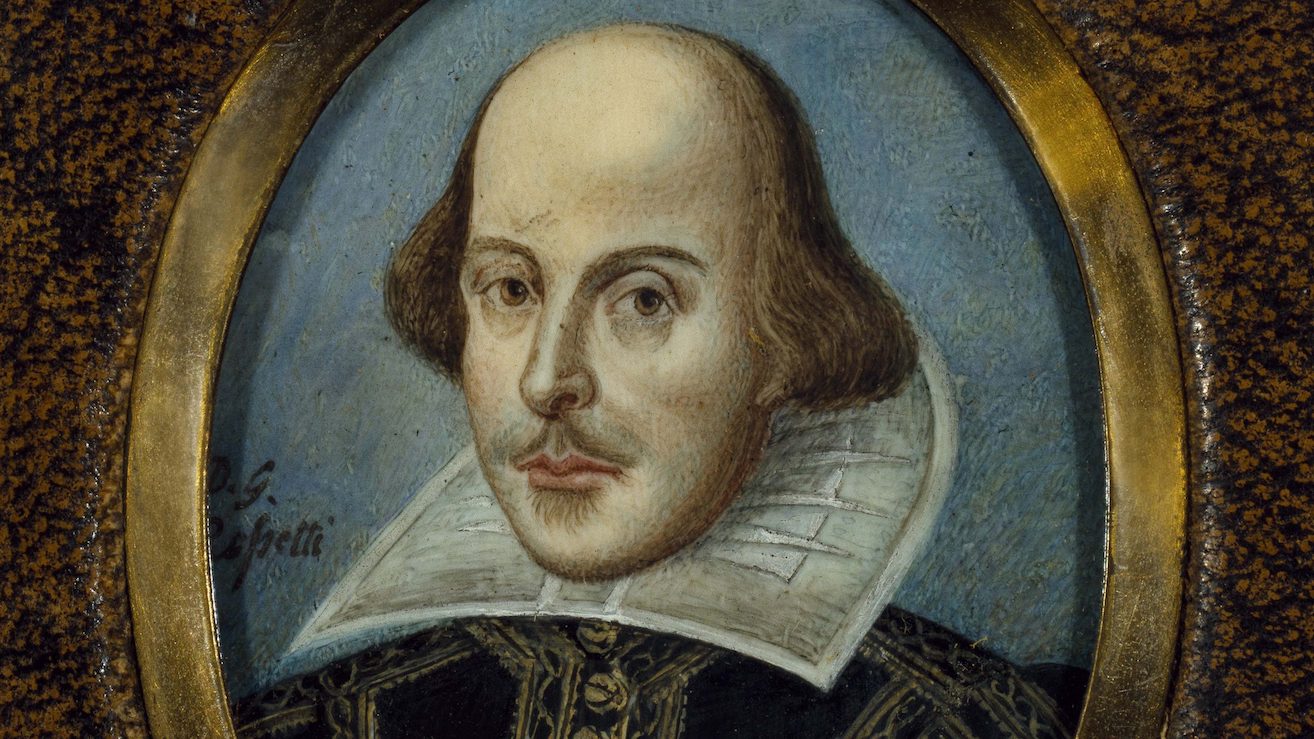
Shakespeare’s two tetrologies on English history trace the shift from a sacrally based political order (Richard II) to a “Machiavellian” one (Richard III). That is the sequence of actual history. But the sequence of Shakespeare’s composition is different. Shakespeare wrote the historically later tetrology (2 Parts of Henry VI and Richard III) first, and then followed with the second (Richard II, 2 Parts of Henry IV, Henry V). Henry V is, in terms of order of composition, the climax of Shakespeare’s English history plays.
What do we make of this? Is Henry V the perfect modern secular ruler? Or is he somehow a combination of the best of both the sacral politics of the Middle Ages and the secular politics of the modern period? It seems that the soliloquies tell all. We know how calculating Richard III is because we overhear his thoughts in his soliloquies (especially that in 3 Henry VI, Act 3, scene 2, where he describes himself as a political chameleon, Proteus, and a Machiavel.) What do Henry’s soliloquies reveal? A king who is conscious of the sins of his father, who pleads with God for mercy, who meditates profoundly on kingship. Henry definitely has his Machiavellian side; he play-acts with Falstaff in order to impress England with his sudden reformation. But if the soliloquies reveal the man as he is, then those Machiavellian tricks are subordinated to a vision of Christian kingship.
Peter Leithart
Peter J. Leithart is President of Theopolis Institute. He is the author of numerous books on theology, literature, and culture, including Theopolitan, Defending Constantine, and Baptized Body.
More from Literature
Continue reading related articles
God's Plenty
A few thoughts on the “General Prologue” to Chaucer’s Canterbury Tales . 1) The Prologue sets the stage for a multi-layered set of tales. The real-life Chaucer is, of course, the author, but in the Prologue, he introduces a fictional version of himself as narrator: It happened in that season…
Violence as Poetry
Paul and Jane Sinclair, protagonists of J.G. Ballard’s 2000 novel Super-Cannes , move from England to the French Riviera to live at a new high-tech business park, Eden-Olympia (!), after Jane’s friend and former lover, Dr. David Greenwood, goes on a killing spree that ends with suicide. Jane, a pediatrician,…

Memento Mori
Virtually all the characters in Muriel Spark’s 1959 novel, Memento Mori , are over 70. They suffer the physical humiliations of aging and the pains of regret. Unexpectedly, hilariously, they’re as competitive and petty as schoolchildren. Well into his 80s, Godfrey Colston scorns the crippled critic Guy Leets for the…
In Medias Res
Your weekly digest for all things Theopolis.