
Evaluating Levinas and his criticisms of Husserl, Derrida probes the coherence of Levinas’ notion of “infinitely other.” Contrary to Levinas, who argues that we are incorrectly seduced by everyday life to think of the other as an “alter ego,” Derrida says: “The other as alter ego signifies the other as other, irreducible to my ego, precisely becauase it is an ego, because it has the form of the ego, The egoity of the other permits him to say ‘ego’ as I do; and this is why he is Other, and not a stone, or a being without speech in my real economy. This is why, if you will, he is face, can speak to me, understand me, and eventually command me. Dissymmetry itself would be impossible without this symmetry.”
Again, “The movement of transcendence toward the other, as invoked by Levinas, would have no meaning if it did not bear within it, as one of its essential meanings, that in my ipseity I know myself o be other for the other.”
Again: “(1) The infinitely other . . . can be what it is only if it is other, that is, other than . Other than must be other than myself. Henceforth, it is no longer absolved of a relation to an ego. Therefore, it is no longer infinitely, absolutely other. It is no longer what it is. If it was absolved, it would not be the other either, but the Same. (2) The infinitely other cannot be what it is - infinitely other - except by being absolutely not the same. That is, in particular, by being other than itself (non ego). Beither other than itself, it is not what it is. Therefore, it is not infinitely other, etc.”
In conclusion, “the expression ‘infinitely other’ or ‘absolutely other’ cannot be stated and thought simultaneously; that the other cannot be absolutely exterior to the same without ceasing to be other . . . .” And “the other is absolutely other only if he is an ego, that is, in a certain way, if he is the same as I. Inversely, the other as res is simultaneously less other (not absolutely other) and less ‘the same’ than I. Simultaneously more and less other, which means, once more, that the absolute of alterity is the same.”
Peter Leithart
Peter J. Leithart is President of Theopolis Institute. He is the author of numerous books on theology, literature, and culture, including Theopolitan, Defending Constantine, and Baptized Body.
More from Philosophy
Continue reading related articles

Substance or Tune?
Jonathan Edwards didn’t think the world is a machine. At the heart of the mechanistic interpretation of Newtonian physics, he discerned, was the notion that “bodies” are (in Robert Jenson’s words) “the sort of thing that either can or cannot act ‘properly by themselves.’” The mechanistic world picture involved an…
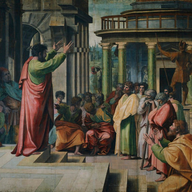
Paul's Idol Polemics
Joshua Jipp argues that Paul's Areopagus address contains both critique and propaganda, critique of Athenian superstition, lust for novelty, and idolatry, and propaganda in favor of Christian faith as a more consistent fulfillment of the aspirations of Hellenistic philosophical theology. Much of the critique, Jipp shows, is drawn from Isaiah's…

Of Causes and Effects
This essay was first published in The Theopolitan, a weekly newsletter for Theopolis Partners. To become a Partner, you must donate at least $500 per year or $50 per month. Give here . Craig Carter’s Thesis #2 about Trinitarian classical theism ( Contemplating God with the Great Tradition ) is,…
In Medias Res
Your weekly digest for all things Theopolis.