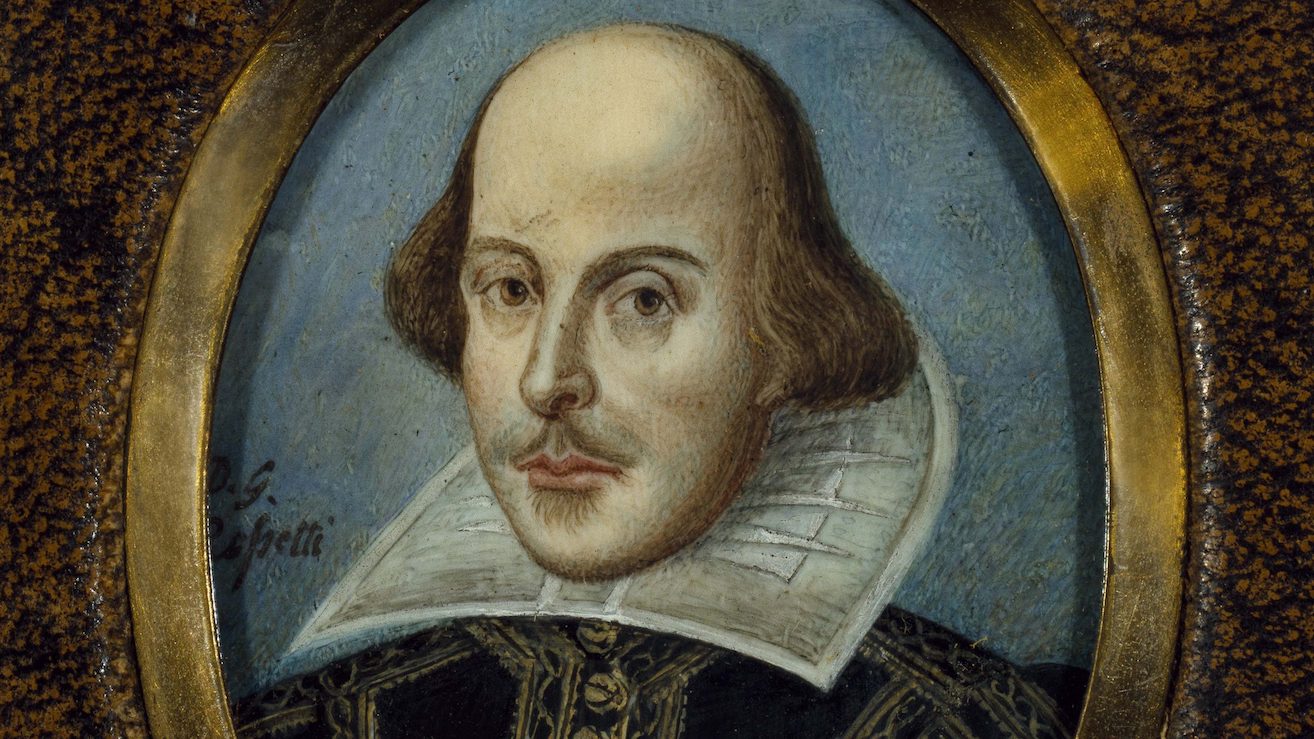
Peter Dickson reviews Michael Wood’s BBC film In Search of Shakespeare in the Feb 16 edition of The Weekly Standard . He points out why many scholars are not convinced by Wood’s claim that Shakespeare was a Catholic He admits that “the evidence for the staunch Catholicism of Shakespeare’s parents and his own dossier as a crypto-Catholic remains impressive. His favorite daughter, Susanna, failed to attend and initially defied inquisitive officials about her nonattendance at Anglican services in 1606 . . . . In early 1613, while his dramas were being featured for the first and very Protestant royal wedding in seventy years (the king’s daughter marrying the leader of the German Protestants), Shakespeare had the amazing audacity to go out and purchase the Blackfriar’s Gatehouse. This property was notorious for being a haven or safehouse where Catholics and priests gathered in secret for the Mass and other religious observances.” Still, in the end, it remains very unlikely that Shakespeare’s works were written by “a person with a sectarian worldview or the ‘siege mentality’ natural for English Catholics in the face of brutal persecution.” Further, scholars recognize that “some Shakespearean dramas convey a hostility to the papacy and Catholic views, to the point that he sometimes seems a propagandist for the Tudor regime.” He finds strained Wood’s claim that the sonnets follow the pattern of the Rosary, or that the ghost in Hamlet is Catholic.
I share Dickson’s skepticism about a Catholic Shakespeare. The value of the debate, however, is that it raises questions about the religious content of the plays that has often been overlooked. Dickson’s article is called “The Roman Plays?” which, though intended as a joke, points to the analogies that the Roman plays draw between Catholic custom and pagan Rome. To take one example: The conspirators who dip cloths in the blood of Caesar resemble nothing so much as devout Catholics collecting and preserving relics.
Peter Leithart
Peter J. Leithart is President of Theopolis Institute. He is the author of numerous books on theology, literature, and culture, including Theopolitan, Defending Constantine, and Baptized Body.
More from Literature
Continue reading related articles
God's Plenty
A few thoughts on the “General Prologue” to Chaucer’s Canterbury Tales . 1) The Prologue sets the stage for a multi-layered set of tales. The real-life Chaucer is, of course, the author, but in the Prologue, he introduces a fictional version of himself as narrator: It happened in that season…
Violence as Poetry
Paul and Jane Sinclair, protagonists of J.G. Ballard’s 2000 novel Super-Cannes , move from England to the French Riviera to live at a new high-tech business park, Eden-Olympia (!), after Jane’s friend and former lover, Dr. David Greenwood, goes on a killing spree that ends with suicide. Jane, a pediatrician,…

Memento Mori
Virtually all the characters in Muriel Spark’s 1959 novel, Memento Mori , are over 70. They suffer the physical humiliations of aging and the pains of regret. Unexpectedly, hilariously, they’re as competitive and petty as schoolchildren. Well into his 80s, Godfrey Colston scorns the crippled critic Guy Leets for the…
In Medias Res
Your weekly digest for all things Theopolis.