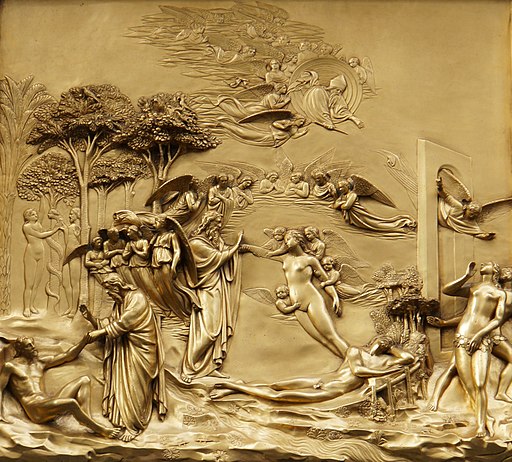
John Paul II ( Man and Woman He Created Them: A Theology Of The Body , 181-5) argues from Genesis that “‘alone,’ the man does not completely realize [his] essence.” Without the woman, Adam does not possess the “basic conditions that make it possible to exist in a relation of reciprocal gift.”
Genesis makes it clear “how fundamental and constitutive the relationship and communion of persons is for man. Communion of persons means living in a reciprocal ‘for,’ in a relationship of reciprocal gift. And this relationship is precisely the fulfillment of ‘man’s’ original solitude.” Man realizes his essence not simply by being “with” but by being “for” someone else.
This reciprocity is manifest in the sexual differentiation of the human body: “The body, which expresses femininity ‘for’ masculinity, and vice versa, masculinity ‘for’ femininity, manifests the reciprocity and the communion of persons.” Thus the human body becomes “a witness to the creation as a fundamental gift, and therefore a witness to Love as the source from which this same giving springs.”
Sex is “the original sign of a creative donation and at the same time the sign of a gift that man, male-female, becomes aware of as a gift lived so to speak in an original way.” Human beings are created with “spousal” bodies, bodies that manifest their destination to be for one another, their destination for communion, and thus their essence as the image of God.
As male and female realize this communion in becoming one flesh, they become fruitful in procreation, and thus “they place their humanity in some way under the blessing of fruitfulness.” The procreative result of the reciprocal giving of male and female is the expression of full human freedom: “Aware of the procreative power of his own body and of his own sex, man is at the same time free from the ‘constraints’ of his own body and his own sex.”
This brief meditation is one of the most succinct statements of biblical anthropology and sexuality I have found anywhere.
And we can add a theological gloss, courtesy of Hans Urs von Balthasar. At the tail end of a discussion of the theological (Augustine, Richard of St. Victor) and philosophical (Hegel, Rosenzweig, Buber, Ferdinand Ebner) sources of dialogic personalism, von Balthasar records his amazement “that in discussions of trinitarian logic in the world the parent-child relationship is always lightly brushed aside” ( Theo-Logic, II , 59).
This absence isn't entirely surprising. Many pagan and Christians thinkers had little experience with small children. For Greeks, paideia began when boys outgrew the care of their mothers; medieval monks thought virginity a higher form of life than marriage; moderns treat sex as a purely physical phenomenon. Still, it’s unfortunate that “no serious thought is given to the possibility of fruitfulness as a moment of a genuine imago Trinitatis ” (60).
For von Balthasar, everyday parental experience provides a precise analogy with the Trinity. A child appears suddenly and “quickly proves to be a third, independent spirit-person,” filling parents with “unexpected delight” (62). This is “the most eloquent i mago Trinitatis that we find woven into the fabric of the creature.” He explains:
It not only transcends Augustine’s self-contained I, but also allows the “condilectus [co-beloved]” that Richard’s model imports from the outside to spring from the intimacy of love itself – precisely as its fruitfulness – while avoiding the dangerous tendency of the dialogicians to allow interpersonal encounter to slide into a mere two-way monologue. . . . It is permanent proof of the triadic structure of creaturely logic. It shows that, when creatures attempt to introduce abstract logical principles . . . into real life (in the form of contraception), the contradict the law that live, causing a “steresis” in the Blondelian sense: sin (62).
“Fecundity,” von Balthasar concludes, “is the law, not only of organisms, but . . . also of the life of the spirit” (62), because all created fecundity images the fecund love of the Father for the Son and the Son for the Father, which bears the fruit of the Spirit.
Seen through the lenses of John Paul II and von Balthasar, our culture’s war against heteronormativity, sexual difference, fertility, and children isn’t just a war against creation and the image of God. It’s an effort to erase the clearest trace of Triune love. It’s a war against God.
Peter Leithart
Peter J. Leithart is President of Theopolis Institute. He is the author of numerous books on theology, literature, and culture, including Theopolitan, Defending Constantine, and Baptized Body.
More from Sexuality
Continue reading related articles
Love the Little Children
First we slaughtered unborn babies in their mothers' wombs. Then we started killing babies born from "botched" abortions. Or born babies that didn't look quite perfect. Now we're butchering the bodies of children in an insane attempt to turn them into their opposites. And the UN is undermining age of…

Adam's Helper
Yahweh declares Adam alone is “not good” (Genesis 2:18). His solution is a fresh act of making. He deliberated over the creation of man with a “Let us” (1:26). He resorts again to the first person as He declares His intention to create woman: “I will make” (2:18). “Let us”…
Primal Screams
Mary Eberstadt’s Primal Screams is a well-researched, cleanly-written book, full of evidence, theories, statistics, anecdotes, analysis. Its thesis is arresting and compelling. Eberstadt claims we can trace the rise of identity politics to the “Great Scattering” that followed the sexual revolution of the 1960s. When we as a culture decided…
In Medias Res
Your weekly digest for all things Theopolis.