The ordination rite for Aaron & sons is a ritual of taking and giving.
At one level, that’s simply a basic linguistic fact. The verb “take” (Heb. laqach ) is used only five times in Leviticus 1-7, mostly with reference to taking blood to smear on the horns of the altar (4:5, 25, 30, 34) and once with reference to Yahweh taking the thigh and breast of the peace offering for the priests (7:34).
Suddenly, in chapters 8—9, the account of the ordination of the priests, the verb is all over the place, used fourteen times (sixteen, if we include Leviticus 10).
Moses is the one who “takes,” and he takes all sorts of things: Aaron and his sons (8:2), anointing oil (8:10, 30), blood (8:15, 23), fat (8:16, 25), breads (8:26, 28), the breast of the ram of ordination (8:29). Most of these actions are part of the rituals prescribed in chapters 1—7, but Yahweh doesn’t use laqach .
The verb “give” (Heb. natan , root of the name “Nathan”) is more common in Leviticus 1—7, used fifteen times, usually translated as “put.” That amounts to roughly two occurrences per chapter.
Again, chapters 8—10 stand out, in that natan is used eleven times. Again, Moses is the primary giver, and he gives many things: the tunic and ephod (8:17, 2x), the Urim and Thummim (8:8), blood on the horns of the altar (8:15; 9:9), blood on Aaron and sons (8:23, 24), flesh and bread to Aaron and his sons (8:27; cf. 10:14, 17).
What should we make of this? In the immediate context, these verbs highlight dimensions of the ordination rite. In Leviticus 4, laqach and natan are used in combination. In the purification offering, the priest “takes” blood and “gives” it to the altar (4:25, 30, 34). That phrasing reappears in chapter 8, as Moses takes blood and gives it to the horns of the altar (8:15). But Moses also takes blood and gives it to the ear, thumb, and toe of the priests (8:23-24).
That reinforces the parallel between altar and priest. Moses smears the four horns of the altar, and smears three of the four horns of priestly power (ear, hand, foot), the first horn (penis) having been “given” blood at circumcision. Both altar and priest are given blood taken from an animal, so that both can be “ladders” to heaven, agents of atonement and communion with Yahweh.
Earlier, Yahweh “takes” food and “gives” it to the priests (7:34). Moses repeats that giving-and-taking in the ordination rite, as he gives food into the hands of the priests (8:27) and then takes them away (8:28-29). Aaron & sons aren’t yet priests, so they don’t yet receive this food permanently. At the end of the rite, though, Moses emphasizes that Yahweh gives them parts of the sin offering and peace offering as their permanent due (10:14, 17).
The give-and-take of the rite qualifies Aaron & sons to receive a permanent gift. The ritual is called “the filling of the hand” (Exodus 29:29), and by the end Aaron & sons have their hands full.
More generally, this cluster of uses of “give” and “take” highlights the fact that the rite of filling is a “gift-exchange” ceremony. Priesthood is a gift, as are the privileges that go with priesthood. Yahweh takes Aaron & sons from among the Israelites to give them priesthood. Moses takes blood and flesh to consecrate and feed the priests.
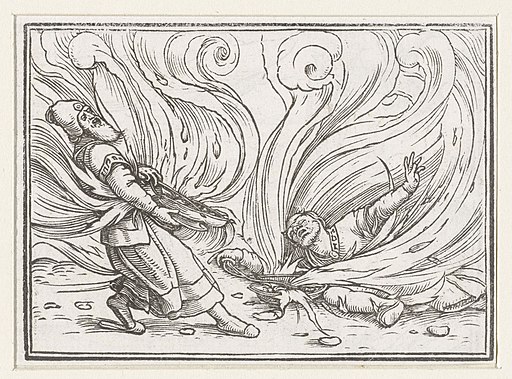
But they hold the priesthood only in the manner of gift, and if they prove unfaithful it will be taken away. It’s no accident that at the climax of the ordination narrative, Aaron’s sons Nadab and Abihu “take” firepans and “give” incense into them (10:1), an unlawful taking with deadly consequences.
Peter Leithart
Peter J. Leithart is President of Theopolis Institute. He is the author of numerous books on theology, literature, and culture, including Theopolitan, Defending Constantine, and Baptized Body.
More from Leviticus
Continue reading related articles

Table of Demons
Let’s stipulate some translations. The Hebrew sheretz = “swarmer”; remesh = “creeper”; chayyah = “beast.” In the original creation, swarmers are found only in the water (Gen 1:20-21), while creepers are on land (1:24-26). Only after the flood do swarmers swarm on earth (Gen 7:21 is the turning point). There…
Purification and the Liturgy
For decades, our little Biblical Horizons clan has argued that the order of Levitical offerings provides an outline for Christian worship. The order of offerings is: Purification, ascension, and peace. The corresponding order of Christian liturgy is: confession, ascent, and communion. That claim is based on passages where those three…
Corporate Sin
A couple of observations about the sin or purification offering, with implications for corporate dimensions of sin. 1. Leviticus 4 prescribes the rituals for the purification offering for priests (4:1-12), the congregation (4:13-21), leaders (4:22-26), and common Israelites (4:27-35) The introduction to the last category includes a grammatical ambiguity. The…
In Medias Res
Your weekly digest for all things Theopolis.