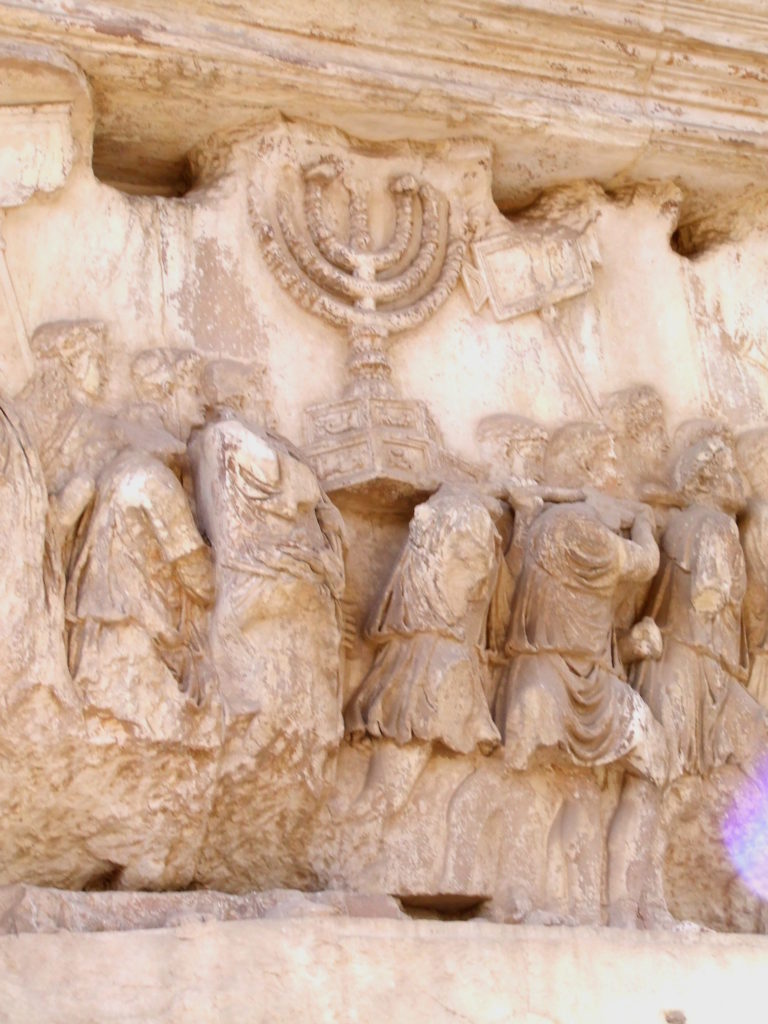
The tabernacle menorah is made of pure gold, hammered, apparently one piece with base, shaft, and the adornments of the shaft (Exodus 25:31). It’s one of two pure gold items in the tent, the other being the cover of the ark of the covenant, with its cherubim (Exodus 25:17-18). All the other gold furniture – table, incense altar, coffer of the covenant – is made of wood with a gold overlay. Though located on the south side of the Holy Place, judged by the material of its construction, the menorah is as much of the Most Holy Place as of the Holy Place. It provides a glimpse of the ark-throne to those who never see the ark-throne.
Like the ark, the menorah has a triple structure – base, shaft with branches, and lamps – which correspond to the three zones of Sinai and the three rooms of the tabernacle. Like the ark, it’s a golden tabernacle-in-miniature. Six branches come out from the central shaft, three on each side of the shaft (Exodus 25:32); each branch holds a detachable lamp full of oil, thus making a total of seven lamps (Exodus 25:37). Each branch is adorned with three “cups” (Heb. gaviya’ ), and the shaft with four cups (Exodus 25:33-34). 3 cups x 6 branches = 18; add the four cups of the shaft, and the total is 22, the number of letters in the Hebrew alphabet and a common numerical symbol.
The decorations of the menorah are all botanical. It has bulbs, flowers, branches. Even the “cups” are “shaped like almond blossoms” (Exodus 25:33). The menorah is a tree, reminiscent of the trees of Eden. With its seven lamps, it’s a burning tree, a permanent burning bush inside the portable Sinai of the tabernacle. Specifically, it’s an almond tree, and therein lies a pun. The Hebrew term for “almond” is shaqad/shaqed . The Hebrew word for “watch” is shaqad . Yahweh makes the pun explicit in a vision of Jeremiah (Jeremiah 1:11-12), who sees an almond and is told, “Right-o, I’m watching over My Word to perform it.” An almond tree is a “watcher” tree.
Over whom or what does the menorah keep watch? In the tabernacle floor plan, there can be only one answer: The table and showbread on the north side of the Holy Place. The “eyes” of the burning tree watch over the twelve loaves. And who is watching? The seven lamps are the seven eyes of God, seven lights fueled by the oil of the Spirit of the sleepless God who keeps watch over Israel. And, too, the watcher lamp is a priestly figure, assigned to keep watch over Israel on behalf of Yahweh. It’s not accident that Aaron’s rod sprouted almond blossoms (Numbers 17).
Thus the lamp is a human figure, representing the anointed man who burns with the light of God. For centuries, Yahweh lit His lamp and hid it under the bushel basket of the tabernacle and then the temple. In the last days, He pours His illuminating Spirit on all flesh, and brings the lamps out from hiding, so that our light can shine before men, who see our good works and glorify our heavenly Father. You are the light of the world, Jesus tells His disciples. That is, you are the menorah, you are the anointed ones, you are the eyes of God.
And: You are like stars in the night sky, the fulfillment of the promise to Abraham, rulers in the heavens. Because the menorah is also a solar system. The tabernacle is an architectural new creation, the Holy Place is the firmament, and (as Philo and Josephus said) the lights of the menorah are the ancient solar system – sun, moon, and the five known planets (Mercury, Venus, Mars, Jupiter, and Saturn).
The description of the menorah ends with a second reference to the “pattern” ( tabnit ) shown to Moses on the mountain (Exodus 25:40; cf. v. 9). The first use of the term refers to the tabernacle in general. In verse 40, the referent is the lamps, along with the snuffers and trays used to care for the lamps. What Yahweh showed on the mountain was not merely the general pattern of the tabernacle and its furnishings, but specific liturgical tools. Israel’s worship mimics the worship of heaven, down to the spoons and snuffers.
Peter Leithart
Peter J. Leithart is President of Theopolis Institute. He is the author of numerous books on theology, literature, and culture, including Theopolitan, Defending Constantine, and Baptized Body.
More from Exodus
Continue reading related articles
Torah as Promise
This essay was first published in The Theopolitan, a weekly newsletter for Theopolis Partners. To become a Partner, you must donate at least $500 per year or $50 per month. Give here . It’s a truism that each negative commandment in Scripture implies a positive command. “Do not kill” entails…
Israel's Wise Women
Moses informs the congregation of Israel about what’s needed for the tabernacle (Exodus 35:4-19), and the congregation goes off to finds things to contribute (Exodus 35:20). Yahweh speaks to Moses, and Moses acts, bringing the word of Yahweh to fulfillment. Now Moses speaks the word of Yahweh to the people,…
Israel's Wise Men
When Moses demands that Pharaoh let Yahweh’s people go into the wilderness to celebrate a feast, Pharaoh calls for his magicians, sorcery, and wise men (7:11; wise men is chakamiym ). Moses defeats those wise men, and the motif of wisdom goes subterranean for twenty-odd chapters. When it re-emerges, the…
In Medias Res
Your weekly digest for all things Theopolis.