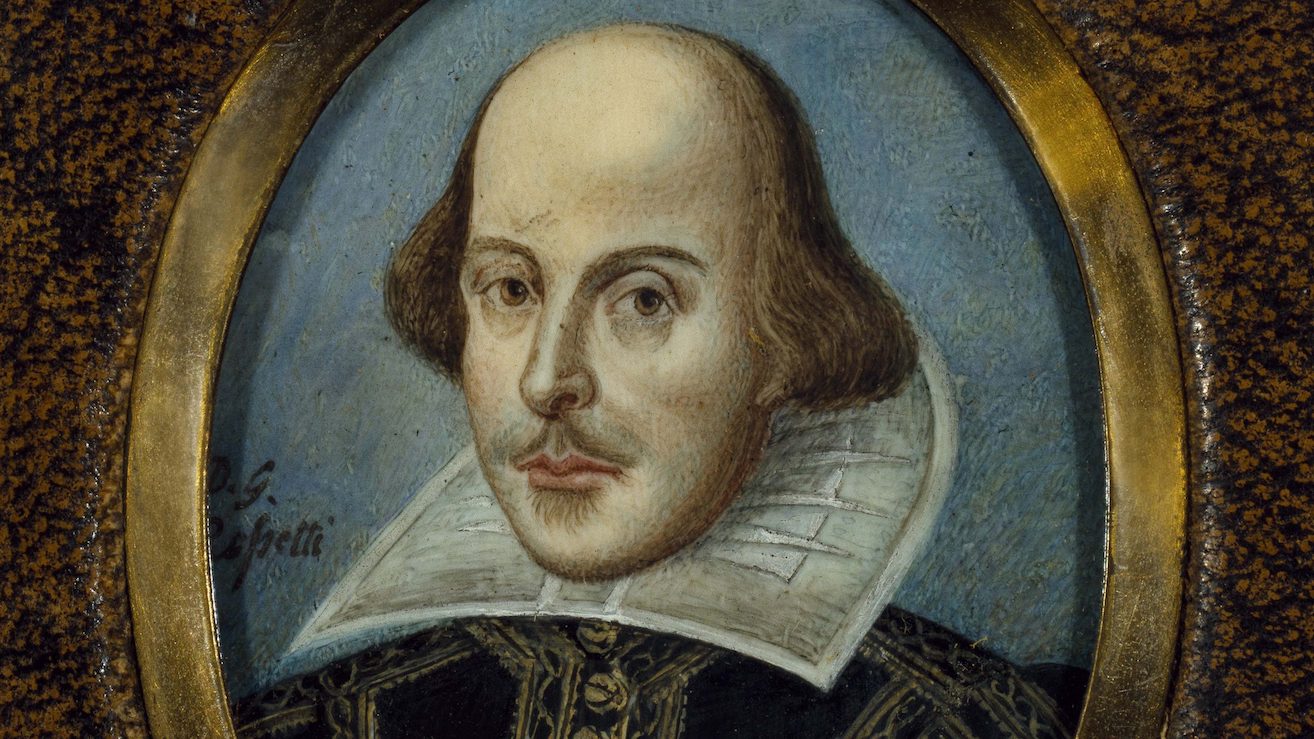
Shakespeare’s Merchant of Venice is organized around caskets, bonds, and rings. Of these, the ring plot is the most baffling. After Portia (disguised as a lawyer) saves Antonio’s bacon, she demands that Bassanio hand over a ring as a way of showing his gratitude for her/his intervention. Bassanio got the ring from Portia, with promises he would never let it go. When Portia later asks for it (in her own person), Bassanio hems and haws until he has to admit he gave it away. Portia then produces the ring. Whazzup with that?
Catherine Dunn suggests that the choice before Bassanio is a choice between honor and love: “The conflict in Bassanio’s mind is more than a clash between romantic love and friendship (a theme so prevelant in Renaissance literature); it is a conflict between love and honor.” Antonio urges Bassanio to give the ring, mindful of how the lawyer’s “deservings, and my love withal” compare with “your wive’s commandment.” Later, when Portia asks for the ring, he protests, “I was enforc’d to send it after him. I was beset with shame and courtesy. My honour would not let ingratitude so much besmear it.” So, honor triumphs over love. But Portia is not impressed: She threatens to go futher, offering the “learned doctor” who received her jewel her body and bed. Ultimately, she relents and forgives Bassanio when Antonio guarantees that he will never again let Bassanio break his word. But her threat suggests that in Portia’s mind, love should triumph over honor, as mercy has over justice.
Peter Leithart
Peter J. Leithart is President of Theopolis Institute. He is the author of numerous books on theology, literature, and culture, including Theopolitan, Defending Constantine, and Baptized Body.
More from Literature
Continue reading related articles
God's Plenty
A few thoughts on the “General Prologue” to Chaucer’s Canterbury Tales . 1) The Prologue sets the stage for a multi-layered set of tales. The real-life Chaucer is, of course, the author, but in the Prologue, he introduces a fictional version of himself as narrator: It happened in that season…
Violence as Poetry
Paul and Jane Sinclair, protagonists of J.G. Ballard’s 2000 novel Super-Cannes , move from England to the French Riviera to live at a new high-tech business park, Eden-Olympia (!), after Jane’s friend and former lover, Dr. David Greenwood, goes on a killing spree that ends with suicide. Jane, a pediatrician,…

Memento Mori
Virtually all the characters in Muriel Spark’s 1959 novel, Memento Mori , are over 70. They suffer the physical humiliations of aging and the pains of regret. Unexpectedly, hilariously, they’re as competitive and petty as schoolchildren. Well into his 80s, Godfrey Colston scorns the crippled critic Guy Leets for the…
In Medias Res
Your weekly digest for all things Theopolis.