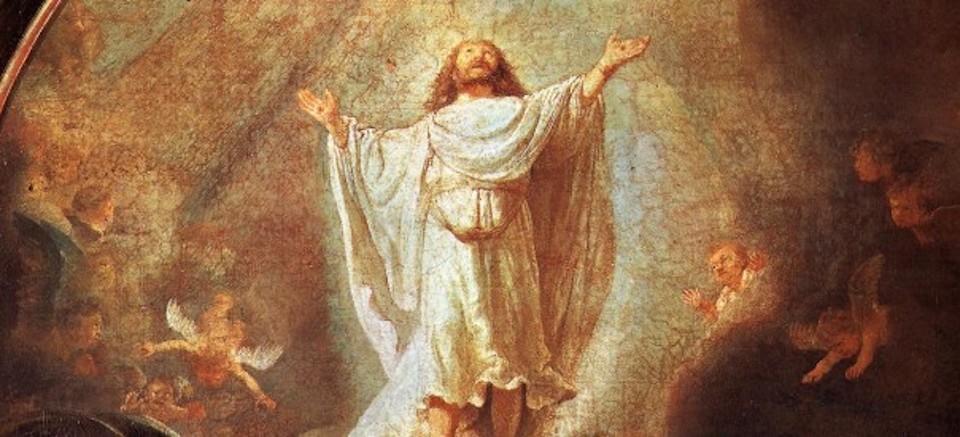
Ascension and Eucharist
It’s a simple point, obviously biblical and creedal: Jesus of Nazareth ascended into heaven as the God-man, and He remains the God-man in all his specific particularity from now to the end. He is Jesus the Christ, the same yesterday, today, and forever. Duh! But Douglas Farrow shows in his recent Ascension Theology (T&T Clark, 2011) that this straightforward view of Jesus’ ascension has profound implications for theology, and that its denial has wreaked untold havoc on modern Christianity.
Not that distortions are only modern. In his opening chapter he points to Origen as the origin of “a long gradation in ascension theology” that leads all the way to Bultmann. According to Origen, it was more “befitting his divinity” for us to conceive of Jesus ascension as “an ascension of the mind rather than of the body.” Augustine, even while rejecting the Origenist conception, undermines the very thing he wants to affirm, because he explains Jesus’ bodily ascension as an effort “to remove from the disciples the stumbling block of his humanity, in order that they might come to a robust faith in his divinity.”
It is in the modern period that ascension theology gets twisted beyond recognition. Schleiermacher is the first to explain the ascension “in terms of the effect Jesus has on us ,” this tendency evident also in Kant and especially Hegel. For the Hegelian Strauss, Jesus ascension is His diffusion into humanity, His ascent to become a principle of historical development. Ascension theology thus underwrites an explicit religion of humanity: “ Mankind is the union of the two natures . . . Mankind is the worker of miracles . . . Mankind is the sinless existence . . . It is Mankind that dies, rises, and ascends to heaven,” Strauss sang.
Farrow illustrates the gnostic extremes of this tendency with a summary of Teilhard de Chardin, for whom “the risen Christ is no longer a particular man” but “the theanthropic power that is slowing transforming our transient nature into a unified spiritual one.” Jesus is left behind, and this allows Teilhard to synthesize Christ, the church, and the cosmos, and to identify human progress with the coming of the kingdom. Farrow rightly insists that Scripture and church tradition have always insisted that we must talk about Christ and the church “much in the way that the psalmists, say, spoke of Israel and her king – as distinct if inseparable,” a distinction that is, he again rightly argues, is wholly compatible with the totus christus theology of Augustine and with what he calls the “new ontology” of communion.
For several chapters, Farrow’s book moves along - bracing, challenging, and lovely all at the same time. Then he spends a chapter on “presence in absence,” focused on the Eucharist, and things go awry. A recent convert to Rome, Farrow wants to show, against the Reformers, that transubstantiation is not only compatible with Ascension and Pentecost – that is, with Jesus’ real absence and His presence by the Spirit – but that transubstantiation is necessary for retaining the dialectic of presence-in-absence. He accomplishes his aim, but only by shining up transubstantiation in intriguing ways.
Citing Herbert McCabe, Farrow insists, quite correctly, that transubstantiation doesn’t involve a chemical change within this world. Rather, transubstantiation is an eschatological fact. Instead of speaking of Christ dropping down from heaven on altar after altar, Catholics should consider that “in converting bread and wine into body and blood the Spirit brings forward the regeneration of all things and in some fashion redeems spatio-temporal reality as such.” With this insertion into creation of what Benedict XVI calls “a radical change, a sort of ‘nuclear fission,’” transubstantiation aims at the conversion of the communicants and through them of the cosmos. Benedict says that the transformation of the bread and wine ignites “a process which transforms reality, a process leading ultimately to the transfiguration of the entire world, to the point where God will be all in all.” Armed with this eschatological transubstantiation, Catholics can keep their substance and accidents, their bell-ringing marking before-and-after, their mastication of Christ, but under the proviso that Eucharistic conversion is subject not to a philosophical theory but “to the truth of the resurrection and ascension.”
There is a good deal to admire in this formulation. But it is not the way transubstantiation has typically been explained, and Farrow knows it. On page 73, he says that “transubstantiation, rightly understood, is an eschatological concept,” but he’s already conceded on page 69 that the debates about transubstantiation in western theology have paid insufficient attention to eschatology, and that this failure “left room in practice for the tendency . . . to fetishize pure presence.” The Reformers were right to be worried about the fetishization, he admits. Joyce’s “caricature” of the Mass in Portrait of the Artist rests on “the most severe mistakes and willful misrepresentations,” but whose mistakes were they? Joyce’s? Not only: Farrow recognizes that “the tradition supplies considerable evidence . . . that mistakes abounded.” Who, before the twentieth century, “rightly understood” transubstantiation?
For all the welcome honesty of Farrow’s discussion, there is something very odd at work: Transubstantiation must be defended partly for the sake of the tradition; but, since the tradition often missed the point, we must revive an eschatological framework, which the tradition has suppressed. Farrow would do well to ask whether transubstantiation would have taken such strong hold if the eschatological character of the Eucharist had been suitably highlighted in the first place.
Several other problems arise. Farrow’s whole discussion assumes what I’ve elsewhere called the “zoom lens” method of Eucharistic theology. Grant the eschatology, but why does the bread and wine only and uniquely participate in the new creation? Why focus on the elements, rather than on the meal as a whole, and particularly the people? Schmemann can say all that Farrow says about the eschatological Eucharist while denying transubstantiation because he doesn’t have a microscope trained on the food and drink.
Farrow doesn’t leave the church out of the picture, but when he draws back the camera and looks at the event more broadly, his eschatological theory breaks down, and that because he affirms transubstantiation. It is refreshing to see him emphasize that transubstantiation is not the end point of Eucharistic transformation, but aims at the “still more wonderful conversio ” of the here and now of the communicants into the “glorious there and then of Jesus Christ” through the Spirit. This conversion he describes as a “consubstantiation.”
Nicely done, coopting the Lutheran term into a Catholic Eucharistic theology. Yet the rhetorical triumph wilts in substantive defeat. Farrow takes note of Lumen Gentium ’s traditional claim that by receiving the body and blood we are “transformed into that which we consume,” but explains this as the “Spirit’s work of generating and perfecting a communion of being with Christ.” The church is not, in short, transubstantiated into Christ, but why not? The bread and wine turn into the body and blood, and this because the stuff of the old creation is taken up into the life of the new. Why then don’t communicants become the substance of Christ’s body and blood? If the final transfiguration of the cosmos isn’t a substantive transformation of trees and bees and granite and slugs into the body of Christ, why should the proleptic transformation involve substantive transformation? If the bread and wine are the firstfruits of the transfigured cosmos, why isn’t everything destined to be transubstantiated? On Farrow’s argument, it should be, and his refusal to push his argument in this direction demonstrates that transubstantiation is not necessary to the accomplishment of the Eucharist’s ecclesial aim. Why can’t we have (as Schmemann argues, and Calvin implies) a proleptic translation of the church into the kingdom without transubstantiation of the bread and wine?
Farrow claims that the Protestant refusal of transubstantiation ends with Erastian confusion of church and world. I disagree, but I cannot find anything to complain about in this argument: “Without adequate recognition of the real absence of Christ . . . [the church is] prone to self-glorying and to illusions of worldly power. . . . [But] where absence goes unchallenged by an eschatologically decisive presence – head and members in true communion of body and soul – ‘presence’ will eventually be found wherever we choose to find it, even in secular principalities that demand conformity from the church and the silencing of its gospel.” Which is to say, confession of Jesus’ presence-and-absence in ascension is decisive not only for the Eucharist, but for the church’s health and mission as a whole.
Peter Leithart is a contributor to Theopolis.
More from Ascension
Continue reading related articles

The Son of Man in the Clouds | Part 1
References to the Son of Man coming on the clouds occur five times in the Synoptic Gospels. Three times such expressions appear in the parallel accounts of the Olivet Discourse (Matthew 24:30; Mark 13:36; Luke 21:27). Then, in parallel accounts of Jesus’ trial before the leaders of Israel, such expressions…
On the Ascension of the Lord
Leo the Great's second sermon on the Ascension, Sermon 74 . I. The mystery of our salvation, dearly-beloved, which the Creator of the universe valued at the price of His blood, has now been carried out under conditions of humiliation from the day of His bodily birth to the end…
Brexit and the Binding of Satan, Part 4
Since the judgment of Babel was followed by the initiation of the circumcision, the impending end of the circumcision in AD70 explains the significance of the first century miracle of foreign tongues. Except for a few Aramaic “teasers” in the book of Daniel, the Word of God was monolingual and…
In Medias Res
Your weekly digest for all things Theopolis.