It seems at least sane to believe that past societies experienced upheaval and disarray quite like what we are experiencing today. Perhaps we are witnessing something altogether new or greater in degree than what peoples witnessed in the past, but it doesn’t seem likely. History is filled with fissures and faults. Societies rise and fall whether they were great or not.
This may cause some to believe that society is just that: a flux that men and women try futilely to stabilize. But this is not the whole story. The Lord removes kings and sets up kings, the Lord visits societies with panic, yet the Lord beckons all kings and nations to himself. The heavens themselves “wear out like a garment. Like clothing you will change them and they will be discarded” (Psalm 102:26). There may be flux, but it is directional flux.
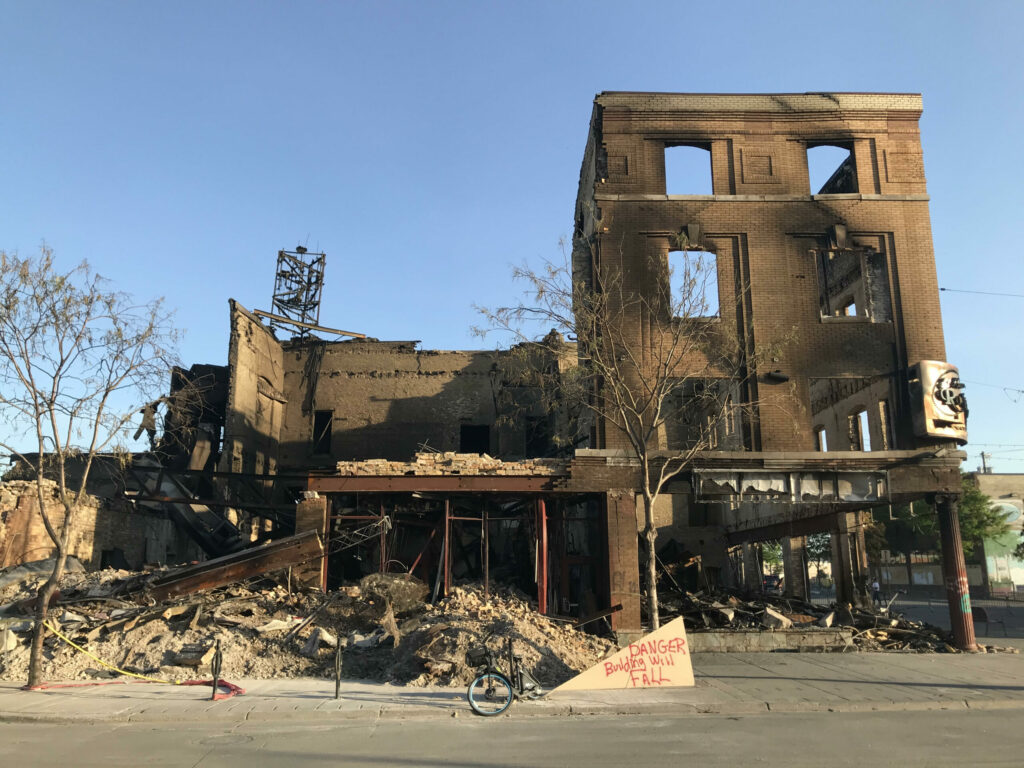
But in the midst of such upheaval, it is as if heaven and earth themselves ebb and flow. Living in close proximity to the murder of George Floyd, the razing of the Minneapolis Police Department’s third precinct building, and the complete destruction of some other structures has set my mind whirring about the nature of buildings and their catastrophic demise.
Buildings are not all that dissimilar to people. Eve was “built” from Adam, like an adorned structure or a city. The tabernacle and temple had parts like great big bodies, and the priests wore garments that symbolized their role as walking, breathing temples of Yahweh. “I am a little world made cunningly,” said Donne, and perhaps we may say that the world also is cunningly made to be a big body.
This is how some architects talk about their constructions. They are built environments . They surround or encompass men and women, presenting possibilities. And the more they build, the more plausible their message. When we are within their structures, they are our firmament, subtly shaping our desire and direction by their Potemkin stars. When we stand beside them, they are mountains, promising an ascent to the divine. When they collapse…isn’t it something akin to the end of the world?
A couple months ago, my wife and I strolled past what was once one of our favorite Minneapolis diners. It was a pile of rubble surrounded by a shell of brick. Bare sky could be seen through some of its windows, where rooms ought to be. It was this barrenness that struck me. It was a loss of boundaries. This place used to be defined by limits—walls—and now it is lost in its limitlessness. We used to get mimosas there on Sundays and talk about life. From there we once watched Native American performers showcase their traditional dances in the street. We have fond memories there. But without walls the site is formless and void. It has been unmade.
Just recently 9/11 came and went. A world was destroyed in that catastrophe, and simultaneously a world was created that directed a great many young lives. But this year, in spite of a small flurry of comments and pictures on social media, the day of commemoration simply felt different. In 2020, that 9/11 world seems distant. Could it be that the buildings razed this year constituted a new world destruction and rebirth? Along with a renewed porous vulnerability of body and society in the age of Covid-19, there are new gaps in the city. Stars have fallen, mountains have been moved into the heart of the sea, and Man has stepped out into something of a new existence—at least for now.
Of course, some worlds beg for destruction. Evil unsurprisingly embeds itself into the walls. And while we may busy ourselves debating whether it is an act of justice or iconoclasm or terrorism, we are all left with a changed view of the city. Our world has changed. Buildings, at least for a little while, don’t seem so permanent, and neither do the stories they represent.
All this got me thinking about the story of Samson. After all, doesn’t he tear down walls of oppression? Doesn’t he bring the heavens down upon the heads of those who constructed it? Samson pushed over the load-bearing pillars, and, like a great tree being felled, the Philistine building collapsed upon himself and three thousand people (Judges 16:23–31). Justice! But we should take care with our conclusions and applications. Sampson’s world-felling act is really the counterpart and climax to a Philistine threat to one of his wives two chapters earlier.
After being unable to answer Samson’s riddle—and therefore subject to some monetary consequences—the group of Philistine men threaten to burn down Samson’s wife’s house. We can hear their justification to the woman: “Have you invited us here to impoverish us?” (Judges 14:15, ESV). In other words, you , woman, are oppressing us by way of this Israelite, and we demand justice. Under the threat of this movement of “justice” the woman moralizes to Samson in a way familiar to modern ears, “You only hate me; you do not love me.” Why don’t you love like Jesus, Samson? You’re supposed to serve the poor, not make them poor.
Needless to say there is no pure character in this story. In the following chapters, Samson and the Philistines trade barbs. He lights their fields on fire, and they set light to his wife and father-in-law. Somewhere near the middle of the story, a fitting statement shows itself: “We have come up to bind Samson, to do to him as he did to us” (Judges 15:10). In all the iconoclasms and oppressive-system razing, we are liable to the same lame justification for taking part in works of evil.
Yet we have another architectural model. “Tear down this temple, and in three days I will rebuild it.” Though he was talking about his body, the Temple did go through an unmaking, “not one stone left upon another” (Matt 24). A world was destroyed then, one generation after the crucifixion of Christ. This world was in flux. It was the crossroads of great eras of humanity. Peoples and nations were passing away. Stars were falling and the earth was shaken. Systems oppressed peoples, but Christ, the better Samson, brought them all down upon his body alone, and raised up a new world in himself. Consequently, by the gift of his Spirit, the church lives in him. He is their built environment.
World upheaval is the life of the body of Christ. We take part in his wounds, and we send forth his Spirit. We hold the stance of resurrecting and rebuilding, since the Lord of life indwells us. Some worlds beg for destruction, and some Christians play a part in pulling down diseased walls, but we are never circumscribed by flux as meaninglessness. Goodness is our creation and glory is our end, and life must rise from death.
Joseph McCulley is a tutor at Saint Benedict Hall in Kailua, Hawaii.
Joe McCulley is a contributor to Theopolis.
More from Architecture
Continue reading related articles
House of Living Stones
The following was delivered as the Solemn Charge and Exhortation to Theopolis students beginning the Easter term course on Architecture and Liturgical Space . As we will be reminded repeatedly throughout the week, the Bible has a lot to say about building and buildings. Long stretches of Exodus, Kings, Chronicles,…

On Biblical Theology
Biblical Theology is often defined as the historical unfolding of God’s revelation, or of God’s revelation and of the history of his covenantal redemption and transformation of humanity and the world. In practice, Biblical Theology is usually broader than this, and also includes the study of literary structure and of…
The Crystalline Vision: Bauhaus and the Bible
“What is in the nature of these materials?” The Bauhaus, founded in Germany in 1919 by architect Walter Gropius, had a profound influence in every area of design, from graphics and typography to clothing, furniture and architecture. The institution was not so much a style as a method, its philosophy…
In Medias Res
Your weekly digest for all things Theopolis.