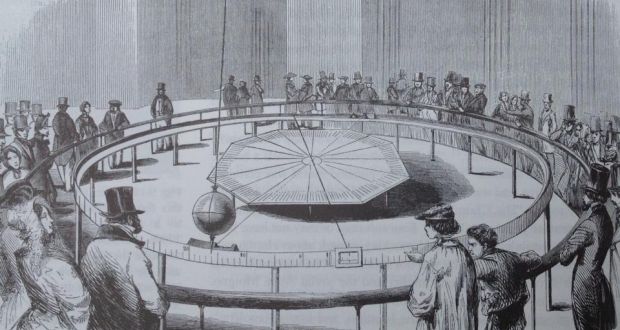
Umberto Eco’s "The Name of the Rose" was certainly one of the best literary works of the past decade, though the film version hardly measured up to it. Now Eco has given us a new novel, "Foucault’s Pendulum." Like Rose, Foucault’s Pendulum reflects on the limitations of human knowledge, and on man’s desire to play God. In Foucault, however, Eco makes his own Christian commitments clear.
If you’ve kept up with the reviews, you know that "Foucault’s Pendulum" deals with occultism and conspiracy theory. Eco shows the destructive nature of these things, and presents Christianity as the alternative. Eco also shows us that though occultism and conspiracy theories look fascinating to start with, they soon become interminably boring. To make this point, Eco goes out of his way in the middle of the novel to bore the reader. The critics have seen this as a flaw, but I see it as a brilliant literary device. The climax of this "boring" section comes when the "wise woman of Proverbs" applies common sense and brings the central character back to earth.
The three primary male characters are a would-be Jew, a lapsed Catholic, and a lapsed Calvinist (who is the central character). The three primary female characters are the wise woman from Proverbs, the foolish woman of Proverbs, and a modern supposedly liberated woman. As we watch these characters respond to the modern world and to occultism, we find much food for thought. I highly recommend Foucault’s Pendulum.
James Jordan is scholar-in-residence at Theopolis. This piece originally appeared at Biblical Horizons .
James B. Jordan is a contributor to Theopolis.
More from Biblical Horizons
Continue reading related articles

Priestly Animals
The first commandment given in the Levitical sacrificial legislation has to do with the animals appropriate to sacrifice: "When any man of you brings an offering to the Lord, you shall bring your offering of cattle ( behemah ), from the herd or the flock" (Lev. 1:2). Cattle alone were…

The Bible and Western Literature
The most cursory glance at the history of Western literature reveals that it has been deeply influenced by the Bible. Some of the greatest classics of Western literature draw their plots, characters, and ideas largely from Scripture; Dante’s Divine Comedy and Milton’s Paradise Lost are two of the most notable…
Broadening Our View of the Trinity
This article was originally posted in May of 1994. We speak of God as Father, Son, and Holy Spirit. The early Church tended to speak of Him as Father, Word, and Spirit. In this short essay, I want to suggest some other ways to think of the Trinity, ways that…
In Medias Res
Your weekly digest for all things Theopolis.