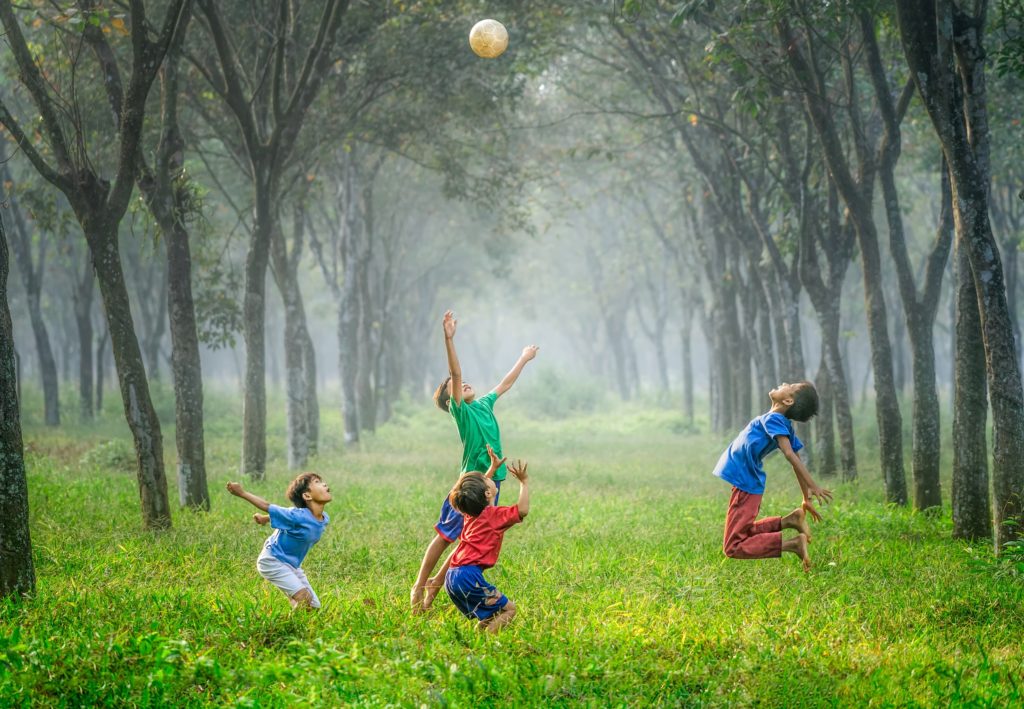
“And the streets of the city shall be full of boys and girls playing in its streets,” Zachariah 8:5.
1. Ultimatum game
Ultimatum Game is an economic experiment. Its rules are simple: I will give you $100 as long as you give part of that money to the person next to you and that person accepts your offer. If not, neither of you will get anything. How much of that $100 are you willing to give to someone else to keep the rest for yourself? We could think that the other person should settle even for $1 . After all, it's better to get $1 than nothing. However, this actually very rarely happens. Usually people are willing to accept $40, but almost never $1. Likewise, only a few offer the other person more than $50. But why shouldn't you offer $60? If you do this, what will you gain and what will you lose? Reputation? Friends? Game mates? If you prove to be a generous person, then many will want to play this game or any other game with you. So the question is: Do you want to win a single game or a series of games?
2. Rats
Young rats love to wrestle and play. However, if one rat is larger than the other by even 10%, then he has enough advantage at the start to win every time. However, if a larger rat defeats a smaller one three times, the smaller one will not want to play with the larger one. The bigger rat has to let the smaller one win one in three games for the smaller one to keep playing with him. What can we learn from rats? Perhaps, again, a winner does not always win? Or maybe there is another kind of a win apart from the immediate one?
3. The prefrontal cortex
Among young rats deprived of the possibility of playing and wrestling, the prefrontal cortex is underdeveloped. But the prefrontal cortex plays an important role in planning cognitive behavior, expressing feelings, making decisions, interpersonal relations, and in communication. It is believed that the main task of the prefrontal cortex is to harmonize thoughts and actions with motivation and goals. The prefrontal cortex develops poorly not only in play-less rats, but also in other mammals, including humans deprived of any possibility to play with others. Playing seems to be essential for healthy development and acquiring social skills.
4. Romanian orphanages
John Bowlby, a British pediatrician, psychologist and psychiatrist working among others with children evacuated from London during WWII, as well as in children's hospitals, noticed that depriving the youngest children of contact with their mother leads to serious disorders in the child's psyche and development, and especially in shaping healthy social relations. This is exactly what was observed in Romanian orphanages from Ceausescu's times. With a roof, a bed, food and diapers provided, little children not only retreated in any physical and mental development, but some even died. Apparently, every child needs close and intimate contact with the mother (and father at a later date) for normal emotional and psycho-social development. It was observed that among the pre-born babies, those with much physical contact with the mother, actually develop noticeably quicker and better. Just rubbing the infants, talking to them, playing with them, stimulates both physical and mental maturation. Playing with infants and babies is as much important as providing them with food and shelter.
5. Peek-a-boo
Babies are born with three basic reflexes: sucking, grasping, and gazing. When they are born, they come to a world that is almost completely alien to them. They need a sense of security based on trust in their parents to calmly explore this new world and learn to live in it. One of the problems young children have to deal with is a lack of long-term memory. Therefore, in their case, the most true statement is “out of sight, out of heart” or possibly “out of mind.” If you hide something, the little child will think it has literally disappeared, vanished, ceased to exist. Show it again and the child will not only be surprised but also be pleased. This is the peek-a-boo game. A child usually takes two years to acquire any concept of object durability. Peek-a-boo is not only great fun, but also a very important educational tool and maturation boost.
6. Rough-and-tumble
Rough-and-tumble is not only a favorite game of young rats, but also an important game in the development of human babies – especially in the age group 3-4. Rough-and-tumble understood as all kinds of physical games consisting in wrestling, tossing a child, jumping on the bed, etc. Such play (with the participation of, for example, a father) stimulates the child's physical, emotional and cognitive development. He learns the possibilities and the limits of his body, risk-taking, the limits of play, the potential to harm others, hierarchy negotiation, acceptable behavior, aggression control, etc. “[Fathers] also push them to take risks and reach for their physical, cognitive, and emotional limits. However, using their increased size, strength, and cognitive abilities, fathers can provide a secure environment for these interactions by asserting their authority and setting limits on their children’s behavior. These parental behaviors constitute an expression of dominance and are especially important for preschool aged children, whose self-regulation abilities are just starting to emerge.” 1
7. Marbles
Jean Piaget observed children playing marbles. Children aged 2-5 only imitate older children, not really realizing the rules of the game. At 7-8, they begin to grasp the rules of the game, albeit imperfectly. When they play without older children, they often set rules on the fly, but it can be chaotic and there is a lot of argument. At the age of 11-12, children not only know the rules of the game, but also perceive their observance as an ethical matter based on mutual agreement – the rules must be respected for the game to make any sense, although the common consensus may lead to some modification of the rules of the game, but only in such a way that the game becomes more interesting, satisfying and internally consistent, not to make it easier and therefore boring. There is a shift from heteronomy to autonomy here. In the beginning, the rules were something “dictated” by the older generation, but eventually they become internalized and accepted as their own and good. Cheating becomes a crime. Most of all, however, children realize that there is no play without following the rules. No fun without restrictions.
8. Rules
Imagine two sisters playing “two sisters.” Or two sisters playing “mom and baby.” How does it work? By acting out behaviors perceived as appropriate for the role played. It is similar with playing cowboys and Indians or policemen and thieves. No fun without rules. Every make-believe situation has hidden rules. Playing a game is thus different from eating ice cream. You just eat ice cream and enjoy it on the spot. But in play there is no gratification without sticking to the rules. “In play, the child is free, but it is an illusory freedom,” wrote Lev Vygotski. So, it is not surprising that two sisters playing “two sisters” actually behave much better as sisters than in everyday life. For a time being they adopt and keep they rules of the game, which makes them better sisters. But it also proves that they can become better sisters if they only approach life with the same seriousness as they approach the game.
This is the play paradox mentioned by Vygotski: “In play [a child] adopts the line of least resistance, i.e., he does what he feels like most because play is connected with pleasure. At the same time, he learns to follow the line of greatest resistance; for by subordinating themselves to rules, children renounce what they want, since subjection to rule and renunciation of spontaneous impulsive action constitute the path to maximum pleasure in play. (...) In other words, as Spinoza said: ‘An affect can be overcome only by a stronger affect.’ (...) Thus, the essential attribute of play is a rule that has become an affect." 2 By playing, children acquire understanding or at least the feeling, that following rules can lead to a sense of joy and satisfaction, but also to some kind of a positive accomplishment. They learn what delayed gratification is and they start appreciating it.
9. Order and beauty
Johan Huizinga in his assessment of play goes beyond benefits of playing for metal and cognitive development of an individual and points to its social and cultural values. “Inside the play-ground an absolute and peculiar order reigns. Here we come across another, very positive feature of play: it creates order, is order. Into an imperfect world and into the confusion of life it brings a temporary, a limited perfection. Play demands order absolute and supreme. The least deviation from it ‘spoils the game’, robs it of its character and makes it worthless. The profound affinity between play and order is perhaps the reason why play, as we noted in passing, seems to lie to such a large extent in the field of aesthetics. Play has a tendency to be beautiful. It may be that this aesthetic factor is identical with the impulse to create orderly form, which animates play in all its aspects. The words we use to denote the elements of play belong for the most part to aesthetics, terms with which we try to describe the effects of beauty: tension, poise, balance, contrast, variation, solution, resolution, etc. Play casts a spell over us ; it is ‘enchanting’, ‘captivating.’ It is invested with the noblest qualities we are capable of perceiving in things: rhythm and harmony.” 3 In play we express our longing for a harmonious, good, and beautiful life and world. And we are reminded what we could do to start moving towards this goal.
10. Play and religion
Huizinga also connects play with religion. “Primitive society performs its sacred rites, its sacrifices, consecrations and mysteries, all of which serve to guarantee the well-being of the world, in a spirit of pure play truly understood. Now in myth and ritual the great instinctive forces of civilized life have their origin: law and order, commerce and profit, craft and art, poetry, wisdom and science. All are rooted in the primaeval soil of play.” 4 Worship is then, as Huizinga notes, about harmonizing our individual and social life with the cosmic order, or as we would rather say, with the creation order. As we worship God, as we “play” the liturgy game, we learn how to live in His world.
Conclusions
Even from the very brief examination of play, we should draw at least two important conclusions. First, playing with children is perhaps as important for their maturation as taking them to church on Sunday. Parents who do not play with their children deprive them of an essential ingredient of maturity. Man cannot live on bread alone. A child does not grow on bread alone. Two, if we could only be as serious about everyday life as we are serious about play and games, the world would become a much better place, much closer to the heavenly blueprint. Perhaps this is one of the reasons why God gives us children, so that we can play with them and re-learn the importance of rules, patience, endurance, order, and delayed gratification. And so that we can enjoy the benefits of life tuned to the creation order at least for the brief moment of a game.
Bogumil Jarmulak received his PhD from Christian Theological Academy in Warsaw, Poland.
Bogumil Jarmulak is a contributor to Theopolis.
More from Culture
Continue reading related articles

Rachel’s Reward: A Review of The Night of the Hunter
Thus says the Lord: “A voice is heard in Ramah, lamentation and bitter weeping. Rachel is weeping for her children; she refuses to be comforted for her children, because they are no more” (Jer 31:15). The Night of the Hunter belongs on every Christian’s Christmas list. My family has even…

Devilish Irony: The Blind Service of The Satanic Temple
I was settled nicely into my chair and listening to the conversation in an undergrad religion seminar, my last required course to graduate. Though a few Christians sat scattered around the room, the course itself was dedicated to poking holes in traditional understandings of the Bible: our readings deconstructed notions…

The Rule of the Incarnate
This article originally appeared at American Reformer on October 29, 2025. Reproduced with permission. Why the West Was Never Meant to Be Governed by Law Alone Back in the early nineties, I was in the candidate process for Undergraduate Pilot Training with the Texas Air National Guard, hoping to fly…
In Medias Res
Your weekly digest for all things Theopolis.