An octave is a repetition, a repetition with a difference. It’s not the first note played again , but the first note played at a higher pitch. Octaves have always marked new beginnings. Hebrew boys were circumcised on the eighth day. Firstborn sheep were dedicated to Yahweh on the eighth day. Aaron entered the priesthood on the eighth day. Lepers, men with discharges, women with flows of blood were cleansed on the eighth day. The temple dedication climaxed with a solemn assembly on the eighth day.
Easter is itself an octave, an eighth. Jesus rose on the day after the Sabbath, after Israel’s week ended. Easter is a repetition of all the eights of the Old creation, but transcends all those partial new beginnings by taking them an octave higher. After Easter we celebrate the octave of Easter, the evening of the eighth day after the eighth day. We move up another octave. If we’ve already celebrated the beginning of a new week, why do we need a second eighth day?
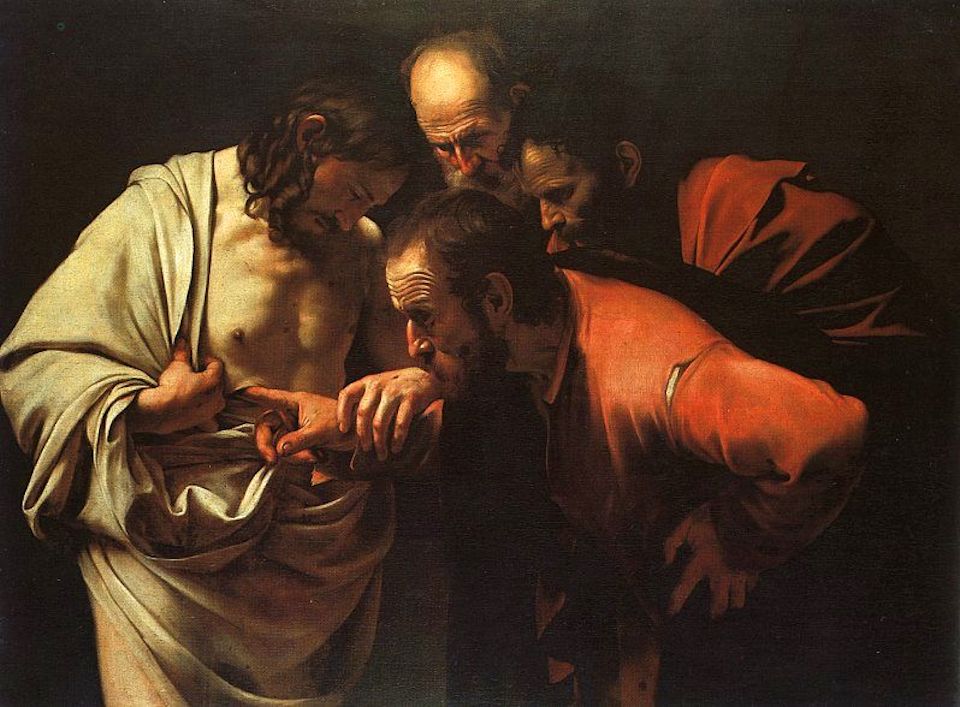
In some Christian traditions, the octave of Easter is the feast of St. Thomas, and that’s because Jesus appears to Thomas on the eighth day after Easter. Thomas, famously, comes to faith slowly, but so does everyone else. Peter and the Beloved Disciple enter the tomb on Easter, but neither of them understands that Jesus had to rise from the dead and neither speaks to Jesus until He meets them later for a seaside breakfast. Mary stays at the tomb weeping after the disciples leave, but she at first mistakes Jesus for the gardener. Even after the disciples hear Mary’s Easter announcement “I have seen the Lord,” they stay locked in a room hiding from the Jews. All the disciples, not just Thomas, struggle to believe the news too glad to be true.
What makes Thomas unique is the fact that he doesn’t see Jesus on Easter, the first eighth day. He sees Jesus eight days later. Yet Thomas is the first to acknowledge Jesus for who He is. Criticize Thomas if you must, but he confesses Jesus before Peter or John do. Thomas sees Jesus’ wounds and falls in worship, for the wounds prove that Jesus is “My Lord and my God.”
John 20 moves from Mary and the apostles who see Jesus on Easter to Thomas who sees Jesus after eight days, but at the end of the chapter John tells us he’s writing to us who have never seen Jesus at all. Thomas’ encounter with Jesus on the octave of Easter assures us that the new life of the eighth day is not limited to those few who see Jesus on Easter. Our distance from the event does not exclude us from resurrection life. On the contrary: Thomas is the first of the Twelve to enter fully into Easter faith, the first fully to grasp the new beginning of Easter, even though he doesn’t see Jesus until the second octave.
After the octave that is Easter, after the octave of Easter, after two millennia or five or ten, we can still know that “Jesus is the Christ the Son of God” and by believing we can still learn to sing Easter’s octave and enter the abundant life of the eighth day.
Peter J. Leithart is President of Theopolis .
Peter Leithart is a contributor to Theopolis.
More from John
Continue reading related articles
Jesus’ Post-Resurrection Appearances
If we only read the Gospels of Mark and Luke, we might get the impression that Jesus’ ascension was on resurrection Sunday. Matthew speaks of going to Galilee but he does not put things into a clear time frame. John shows us that Jesus appeared to the disciples eight days…

The Mathematics of the Gospel
Quantifying the Love of God “For God so loved the world that he gave his only begotten son, that whosoever believes in him should not perish, but have everlasting life” ~ John 3:16 This most beloved verse in all the Bible was spoken by the Savior himself to Nicodemus. As…

Eternal Life Chiasm in John's Gospel
In his masterful work, De Doctrina Christiana , Augustine of Hippo writes: I would have learned men to know that the authors of our Scriptures use all those forms of expression which grammarians call by the Greek name tropes, and use them more freely and in greater variety than people…
In Medias Res
Your weekly digest for all things Theopolis.