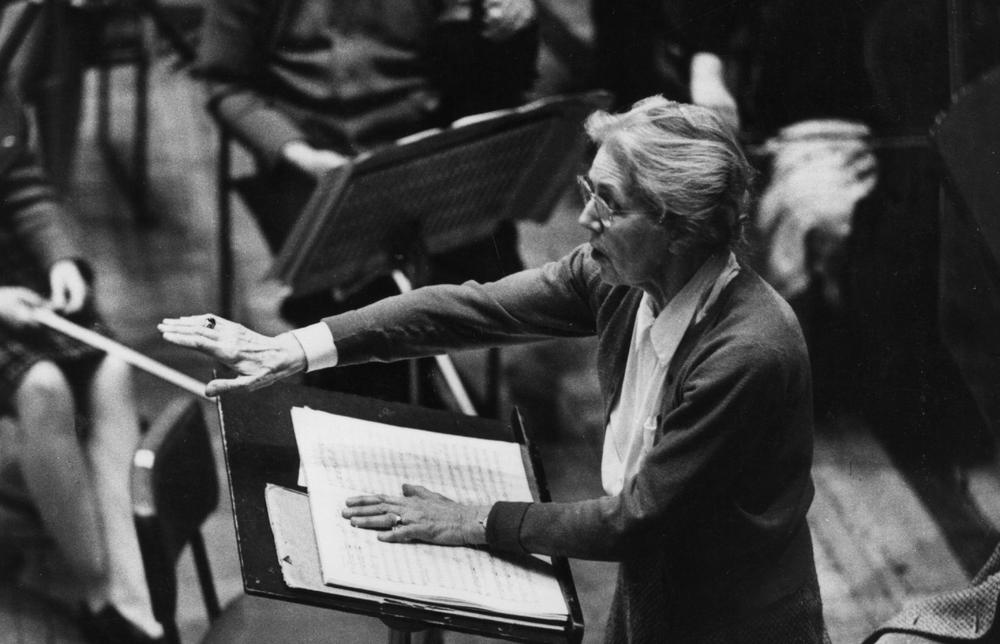
Nadia Boulanger (1887-1979) was one of the most remarkable women of the 20th century. A devout Christian, she was the master teacher of composition at the American Conservatory in Fontainebleau, France. She taught music and composition to two generations of students, and is regarded as one of the most influential musicians of our age. Virtually every American composer of serious music studied with her.
Some of her aphorisms and reflections on creativity and work are found in Don G. Campbell, Master Teacher Nadia Boulanger (Washington: Pastoral Press, 1984). Here are a few of them.
"Novelty is what perishes quickest."
"It is one thing to be gifted and quite another thing to be worthy of one’s own gift."
"There are dangers in atonal music. There is nothing to surprise one."
"What is important is not to define, but to act. One must try to do one’s work with enough love and enough care to make it represent one’s very best. The whole joy of being a human being is to realize the difficulty in reaching one’s aim. The higher the aim, the greater the difficulty, and the greater our humility and joy. As for beauty — is it not mainly through beauty for service, of which there is no material reward or punishment, that we reach the spiritual art of our life, which is the whole purpose of existence and its only goal?"
"There is nothing boring in life except ourselves. The most humble work does not have to be boring. I remember the old woman who cleaned the floor in my place in Gargenville. She died a few years ago. Every day I think of her with the most profound respect and with greatest reverence. She was eighty years old. One day she knocked at my door and said, `Mademoiselle, I know you don’t like to be disturbed, but the floor, it shines in such a way. Come and see.’ Now I think of her always. In my mind, Stravinsky and Madame Duval will always appear before the Lord for the same reason. Each has done what he does with all his consciousness. When I said to Mme. Duval the same thing, she did not know exactly what I meant. But when I said it to Stravinsky, who knew her, he said, `How you flatter me, for when I do something, I have something to gain. I have something. But she, she has only the work to be well done.’"
This post originally appeared at Biblical Horizons. BIBLICAL Horizons, No. 7
James B. Jordan is a contributor to Theopolis.
More from Biblical Horizons
Continue reading related articles

Priestly Animals
The first commandment given in the Levitical sacrificial legislation has to do with the animals appropriate to sacrifice: "When any man of you brings an offering to the Lord, you shall bring your offering of cattle ( behemah ), from the herd or the flock" (Lev. 1:2). Cattle alone were…

The Bible and Western Literature
The most cursory glance at the history of Western literature reveals that it has been deeply influenced by the Bible. Some of the greatest classics of Western literature draw their plots, characters, and ideas largely from Scripture; Dante’s Divine Comedy and Milton’s Paradise Lost are two of the most notable…

Broadening Our View of the Trinity
This article was originally posted in May of 1994. We speak of God as Father, Son, and Holy Spirit. The early Church tended to speak of Him as Father, Word, and Spirit. In this short essay, I want to suggest some other ways to think of the Trinity, ways that…
In Medias Res
Your weekly digest for all things Theopolis.