Theopolis Logo

Writing

Explore our collection of theological essays, biblical studies, and reflections on faith and culture.

See all
tonik-haz3tnzqp6w-unsplash
Anxiety

Viral Anxiety Requires Infectious Wisdom

At the time I write this, many in the United States are under some kind of “lock-down” order. But, thanks to the internet, people are still able to communicate with each other. And people have differing opinions on which medical or scientific projection about our current pandemic is most likely…

by Mark HorneApril 21, 2020
screen-shot-2020-04-14-at-8-53-04-am
Gospels

Shall We Receive Good From God, But Not Calamity?

So Jesus came again to Cana in Galilee, where he had made the water wine. And at Capernaum there was an official whose son was ill. When this man heard that Jesus had come from Judea to Galilee, he went to him and asked him to come down and heal…

by Jeff MeyersApril 14, 2020
morgan-vander-hart-s-m2pamjcvg-unsplash
Family

A Family Liturgy

Throughout the world, pastors and leaders are making sometimes excruciating decisions about whether or not to hold public worship services during the coronavirus pandemic and, if so, how. We at Theopolis encourage you to find creative, safe, reasonable, and submissive ways to meet in person with other believers. For many,…

by Peter LeithartApril 8, 2020
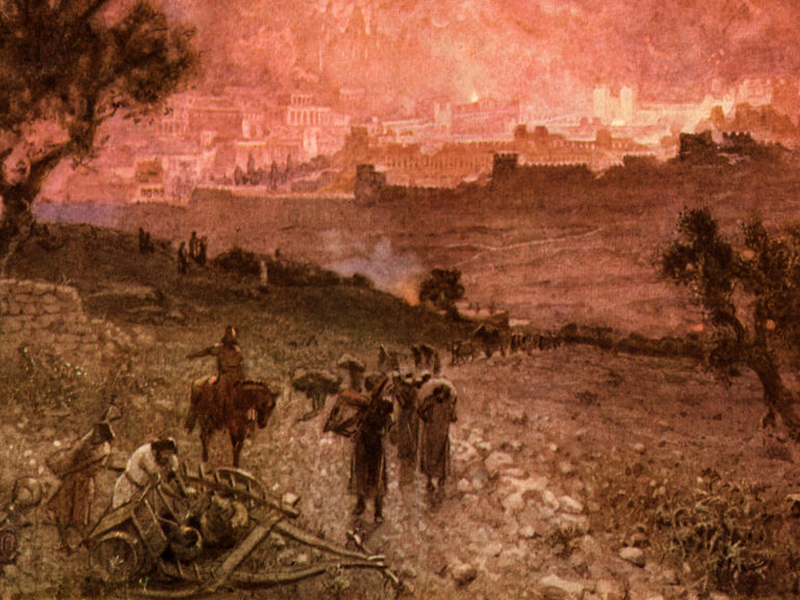
the-destruction-of-jerusalem-by-nebuzar
Covenant

Zion as an Ascension

An excerpt from The End of Israel: Jesus, Paul & AD70 by Michael Bull The Hebrew word olah, translated “whole burnt offering” literally means “go up.” The explanatory “translation” is helpful in its description of the offering but unfortunately for English readers it veils the symbolic meaning. As far as…

by Mike BullApril 7, 2020
e99a2549
Coronavirus

Worship in Exile

The # Coronavirus is trending more frequently than your favorite five celebrities put together. Our culture has exchanged TMZ stories for the primacy of the geeks who once made their living in the privacy of their laboratory. These are now our modern-day celebrities. It’s safe to say the experts surrounding…

by Uri BritoMarch 31, 2020
screen-shot-2020-03-26-at-11-54-58-am
Baptism

A Baptism Letter

In the name of Jesus Christ, our Savior, Lord, and Friend. Dear sister in Christ, Your baptism is firm and certain not because of anything you have done or the pastor who administered your baptism in Christ’s stead and command. Your baptism is firm and certain because of God and…

by Todd HainsMarch 26, 2020

Showing page 68 of 309

See all

Showing page 10 of 43

See all
Philosophy

Heidegger in his woods

Latour is tired of being accused of having forgotten Being, and offers this clever brush-off of Heidegger: “If, scorning empiricism, you opt out of the exact sciences, then the human sciences,, then traditional philosophy, then the sciences of language, and you hunker down in your forest - then you will…

November 15, 2006
History

Semi-modernism

Postmoderns, Latour suggests, think they are still modern, but in fact they have greatly oversimplified the modern Constitution. Postmoderns might emphasize the separation of subject and world, and stretch that opposition to a breaking point (Latour vividly describes them as doing the splits to keep subject and world apart); but…

November 15, 2006
History

Modern temporality

In his very good section on modern temporality, Latour argues that modernity assumes that everything in the present, modern moment, is purely modern, novel. Anything that appears that is not up-to-date is a “archaism,” and moderns worry constantly that this or that event or trend might “turn back the clock.”…

November 15, 2006
History

Representation

One of the key moves made since the 17th century, Latour argues, is a distinction between modes of “representation.” In the laboratory Boyle is representing things before selected witnesses through scientific experiments, giving mute nature a voice through the scientist, while in politics Hobbes suggests that the Sovereign speaks for…

November 15, 2006
History

We Have Never Been Modern

Bruno Latour’s We Have Never Been Modern (Harvard 1993) is a rich study. He describes modernity in terms of a dual process of “purification” and “hybridization.” Purification involves the clean construction of a nature (and science) separated off from society and the self, while hybridization involves mixtures of nature and…

November 15, 2006

Tears of things

And/Or: Virgil is aware that the furor of civil war can be curbed only by an opposing, and more intense, furor. That, as Milbank says, is the way of paganism - peace established only by superior violence against violence. But in those tears Virgil expresses the the painful recognition -…

November 13, 2006

Showing page 1763 of 2212

Browse by Category

In Medias Res

Your weekly digest for all things Theopolis.

Donate

Theopolis is nearly 100% donor-supported. Consider joining us on our mission.