Theopolis Logo

Writing

Explore our collection of theological essays, biblical studies, and reflections on faith and culture.

See all
kyler-nixon-urkdeazlvtq-unsplash
Music

The Case for Shorter Hymnals

I believe hymnals should be shorter than they are. Much shorter. 100 hymns at most, let’s say. I imagine that this will be a hard one to swallow for most of my readers, so I will attempt to bolster my argument as best I can. I can’t think of any…

by John AhernNovember 16, 2021

books-of-the-bible-joshua-by-ralph-drollinger-capitol-ministries
Hermeneutics

King Joshua and the Christian

Joshua is never called a king in the Bible. Yet while lacking the title, Joshua possesses the trappings of biblical kingship to a degree that it seems warranted to consider him a royal figure. There are lots of reasons for thinking this. In a 1981 Journal of Biblical Literature article,…

by Daniel HoffmanNovember 9, 2021
raphael-schaller-gkincd2eniy-unsplash-5
Language

The Liturgy of Language

God speaks. He is not silent. He has designed humanity for reception of such communication and also to speak on His behalf. This speaking is not simply happenstance. It is not just a curious quirk about humanity. It is intrinsic to who we are that we speak and shape the…

by Chase DavisNovember 2, 2021
ross-sneddon-zstkmnvmwsq-unsplash

Practicing Repentance

One evening, years ago, home from college for Christmas break, I dreamt that I was playing the piano, passionately and well, in the church sanctuary beneath the parsonage in the renovated mansion in rural New Hampshire where my father was the minister. It was something of a lucid dream because…

by Garrett SoucyOctober 26, 2021
artem-kovalev-fk3xucftavk-unsplash
Anxiety

Let Not Your Heart Be Troubled

I’m a big worrier. Always have been. Some of my earliest memories are of being anxious to the point of getting sick, sometimes for trivial reasons. My mind moves a million miles a minute, wondering what will happen in 5 minutes, or tomorrow, or next week, or in ten years.…

by MargaretAnn HesterOctober 21, 2021
main-image
Biblical Studies

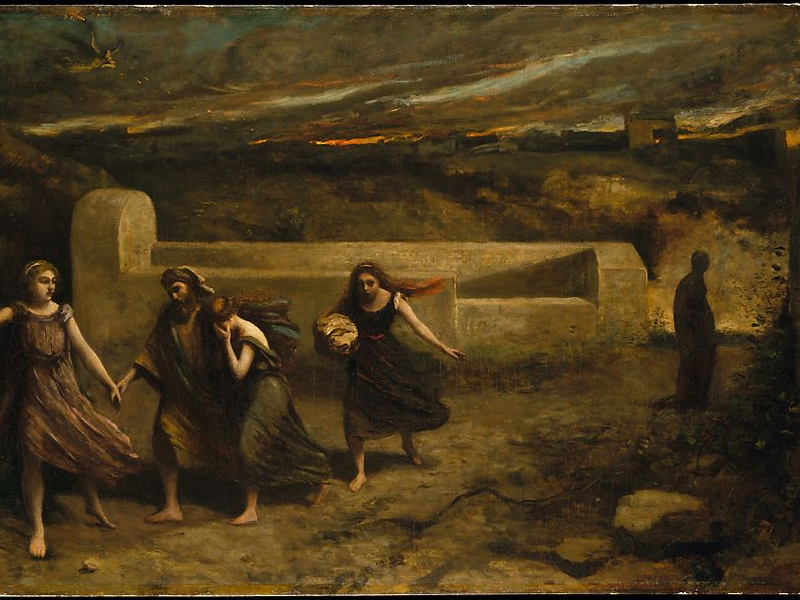
“But Lot’s Wife Behind Him”: Translating a Conjunction in the Sodom Story

“The sun had gone up on the earth when Lot came to Zoar. And the LORD rained on Sodom and on Gomorrah sulfur and fire from the LORD from heaven, and he devastated those cities and the whole valley and all those dwelling in the cities and the growth of…

by Josh JensenOctober 19, 2021

Showing page 50 of 309

See all

Showing page 10 of 43

See all
Philosophy

Hermeneutics v. Semiology

According to Michel Foucault, what Marx, Nietzsche, and Freud introduce is an age of interpretation. He develops one of the implications of this by suggesting there is a “fierce war” between semiology and hermeneutics, between treating words as signs and treating them as interpretations. Nietzsche in particular, Foucault claims, develops…

August 26, 2006
Literature

Shakespeare and Bible

Steven Marx’s Shakespeare and the Bible (Oxford, 2000), purports to be the “first book to explore the pattern and significance” of Shakespeare’s biblical allusions. Perhaps. The results are mixed. Each chapter of Marx’s book attempts to show structural, plot, and thematic parallels between a section of Scripture and a play…

August 26, 2006
Literature

Ubiquitous Shakespeare

Exploring Lake Superior in 1840, one Charles W Penny wrote, “We read the Bible I dare say much more than we would have done had we been in Detroit. Shakespeare was duly honoured, as he is every day when we travel. When on the water, some one of the party…

August 26, 2006

Divine Love

The Persons of the Trinity live out an eternal round of self-sacrificing love. If a proof text is needed, John 15 supplies it. 1) Jesus says, “as the Father loved Me, I have also loved you” (v. 9). Jesus’ love for the disciples is modeled on the Father’s for Him.…

August 26, 2006

Queen of the Sciences

John Stuart Mill declared at the beginning of his book on logic that “Logic is the common judge and arbiter of all particulars investigations. It does not undertake to find evidence, but to determine whether it has been found. Logic neither observes, nor invents, nor discovers; it judges.”

August 24, 2006
History

New

Hans Jonas writes in an essay on technological and scientific advance that one of the key cultural shifts in the sixteenth and seventeenth centuries was a, well, new understanding of “new,” and a corresponding revision of traditional ways of thinking about history: “A sign of this spreading mood is the…

August 24, 2006

Showing page 1804 of 2212

Browse by Category

In Medias Res

Your weekly digest for all things Theopolis.

Donate

Theopolis is nearly 100% donor-supported. Consider joining us on our mission.