Theopolis Logo

Writing

Explore our collection of theological essays, biblical studies, and reflections on faith and culture.

See all
screen-shot-2023-01-26-at-3-44-00-pm
Colossians

Tychicus and Onesimus

In Colossians 4:7-9, Paul tells the Colossian church that he is sending Tychicus and Onesimus to them. It is clear that they are to deliver the letter Paul has written to the church and that they are also to report to the church the details of Paul’s ministry in chains…

by Ralph Allan SmithJanuary 26, 2023

operacion3
Mission

Sustainable Development

On the 11 th of April, 1985, the communist dictator Enver Hoxha breathed his last. It was the beginning of the end of communist Albania. After 40 years of being isolated from almost the entire world, the Albanian people started to see what life really looked like outside their borders.…

by James LeithartJanuary 24, 2023
ian-schneider-iqbc4vu4ypq-unsplash
Biblical Studies

Sex Drives Building

Karl Ove Knausgaard once reminisced about an author he referred to as “the man with his sweater tucked into his trousers” who, upon entering the room, would declare as if it was his creed, “I write because I am dying.” Knausgaard acknowledges this to be one reason among many why…

by Garrett SoucyJanuary 19, 2023
dominik-schroder-fikd9t5_5zq-unsplash
Biblical Studies

The World is Charged with the Threeness of God

The Missing “It Was Good” The patterns and repetitions of Genesis 1 are well known: God speaks, it happens, and God sees that it’s good; names are given, and there’s evening and there’s morning: a day. But the patterns of creation, like the patterns throughout Scripture, are marked by variation…

by Josh JensenJanuary 17, 2023
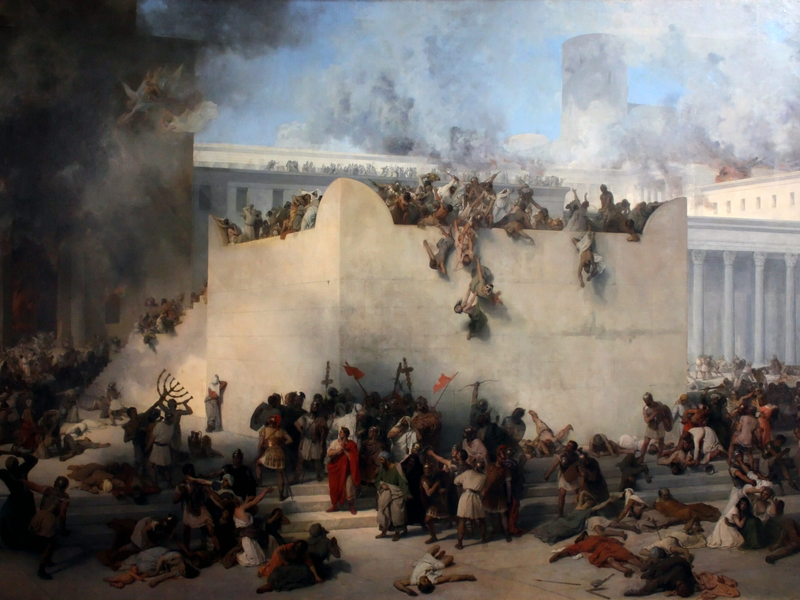
francesco_hayez_017
Biblical Studies

The Day of Christ: Philippians 1:10

And it is my prayer that your love may abound more and more, with knowledge and all discernment, so that you may approve what is excellent, and so be pure and blameless for the day of Christ, filled with the fruit of righteousness that comes through Jesus Christ, to the…

by Ralph Allan SmithJanuary 12, 2023
ian-keefe-mdteilh1czy-unsplash
Biblical Studies

Arboreal theology: Trees in Colossians

The Bible is a book about trees. We start in Eden with two trees, we end in the New Jerusalem with a single double-trunked tree, and the story hinges around the tree they nailed our Lord to. Seeing the Forest We find trees singled out on day three of creation.…

by Tim SuffieldJanuary 10, 2023

Showing page 35 of 309

See all

Showing page 11 of 43

See all
Philosophy

Hermeneutics v. Semiology

According to Michel Foucault, what Marx, Nietzsche, and Freud introduce is an age of interpretation. He develops one of the implications of this by suggesting there is a “fierce war” between semiology and hermeneutics, between treating words as signs and treating them as interpretations. Nietzsche in particular, Foucault claims, develops…

August 26, 2006
Literature

Shakespeare and Bible

Steven Marx’s Shakespeare and the Bible (Oxford, 2000), purports to be the “first book to explore the pattern and significance” of Shakespeare’s biblical allusions. Perhaps. The results are mixed. Each chapter of Marx’s book attempts to show structural, plot, and thematic parallels between a section of Scripture and a play…

August 26, 2006
Literature

Ubiquitous Shakespeare

Exploring Lake Superior in 1840, one Charles W Penny wrote, “We read the Bible I dare say much more than we would have done had we been in Detroit. Shakespeare was duly honoured, as he is every day when we travel. When on the water, some one of the party…

August 26, 2006

Divine Love

The Persons of the Trinity live out an eternal round of self-sacrificing love. If a proof text is needed, John 15 supplies it. 1) Jesus says, “as the Father loved Me, I have also loved you” (v. 9). Jesus’ love for the disciples is modeled on the Father’s for Him.…

August 26, 2006

Queen of the Sciences

John Stuart Mill declared at the beginning of his book on logic that “Logic is the common judge and arbiter of all particulars investigations. It does not undertake to find evidence, but to determine whether it has been found. Logic neither observes, nor invents, nor discovers; it judges.”

August 24, 2006
History

New

Hans Jonas writes in an essay on technological and scientific advance that one of the key cultural shifts in the sixteenth and seventeenth centuries was a, well, new understanding of “new,” and a corresponding revision of traditional ways of thinking about history: “A sign of this spreading mood is the…

August 24, 2006

Showing page 1804 of 2212

Browse by Category

In Medias Res

Your weekly digest for all things Theopolis.

Donate

Theopolis is nearly 100% donor-supported. Consider joining us on our mission.