Theopolis Logo

Writing

Explore our collection of theological essays, biblical studies, and reflections on faith and culture.

See all
johann-siemens-epy0gbjzzzu-unsplash
Apologetics

A Sabbath Conversation: How Old is the Earth?

As Adam and Eve walked to the center of the Garden of Eden to meet with the LORD on their first Sabbath they conversed about the origin and age of the earth. Adam: You know, honey, we spent a lot of time yesterday making preparations for our house, and we…

by Jeff MeyersOctober 3, 1997

img_1043
Biblical Horizons

Psalms for Exile: The Narrative Progression in the Fifth Book of the Psalter

Some of our forefathers believed in reading/singing the psalms in order. Today, when the psalms are even used at all, they tend to be used randomly, though sometimes tied to a church calendar or to the pastor’s sermon. The Bible does not bind us to any particular practice, but there…

by James B. JordanSeptember 4, 1997
jordan-wozniak-xp_agmeea6s-unsplash-2
Biblical Chronology

The Anthropomorphic Days of C. John Collins, Part 2

Dr. Collins begins his essay with a brief statement of the Day Age view and then a brief statement of the Six Day view, focussing on the challenge to that view posed by modern "science." He ends this discussion by writing: "Two crucial points are at stake here: first, the…

by James B. JordanSeptember 4, 1997
john-salzarulo-wtjrpjzabcq-unsplash
Biblical Horizons

Paperweights and the Puzzles of Secularism

In his The Construction of Social Reality , Berkeley philosopher John Searle puzzles over the ontology of the products of human construction. Certain things – granite, platypi, weeping willows – occur naturally; while other realities – stone walls, zoos and parks, Chase Manhattan Bank – exist only as products of…

by Peter LeithartAugust 27, 1997
ales-krivec-4mibe6zg5r0-unsplash
Biblical Chronology

The Anthropomorphic Days of C. John Collins, Part 1

In the journal Presbyterion 20 (1994):109-130, published by Covenant Theological Seminary, Dr. C. John Collins sets forth a revision of the Day Age approach in his essay, "How Old Is the Earth? Anthropomorphic Days in Genesis 1:1–2:3." Dr. Collins’s essay has been widely accepted in evangelical Presbyterian circles as an…

by James B. JordanAugust 4, 1997
screenshot-2023-09-04-at-10-37-01-am
Biblical Horizons

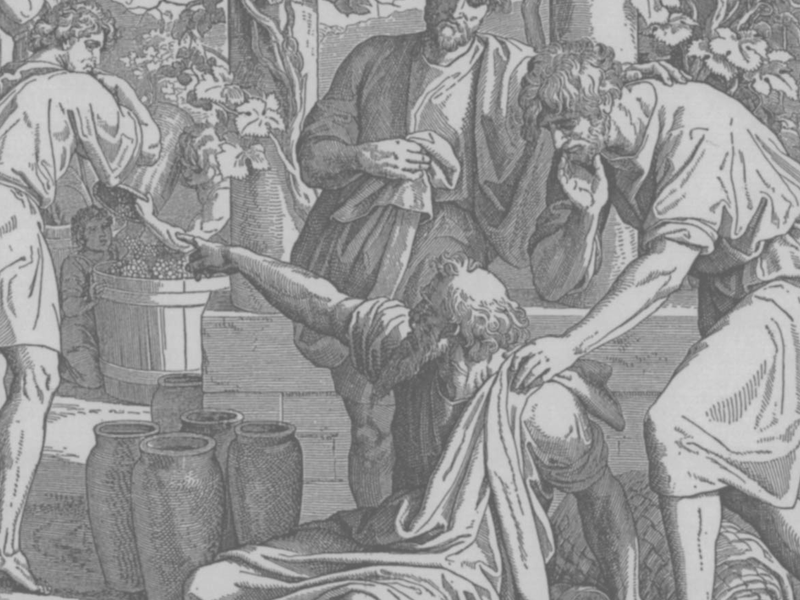
The Sin of Ham and the Curse of Canaan, Part 3 (An Exposition of Genesis 9:20-27)

The Righteousness of Shem and Japheth As noted above, the action of Shem and Japheth was purely symbolic. They did not need to cover Noah with a garment, for he was already covered by the tent. Their action was a symbolic affirmation of Noah’s authority, a symbolic rejection of Ham’s…

by James B. JordanAugust 4, 1997

Showing page 254 of 309

See all

Showing page 11 of 43

See all
Theology

Rehabilitating patriarchy

Russell Moore gave a vigorous presentation at ETS on why egalitarians are winning the evangelical gender debate. He summarized some of the recent sociological work on evangelical family life, which presents a mixed picture. On the one hand, Bradford Wilcox’s Soft Patriarchs, New Men shows that evangelical fathers are not…

November 18, 2005
Literature

Herod’s fears

In For the Time Being , W. H. Auden described Herod’s reaction to the news that “God has been born.” If this is true, and if the news gets out, Herod thinks, all is lost; confusion will reign. The passage is one of the most effective descriptions of the nature…

November 17, 2005
Literature

Herod’s fears

In For the Time Being , W. H. Auden described Herod’s reaction to the news that “God has been born.” If this is true, and if the news gets out, Herod thinks, all is lost; confusion will reign. The passage is one of the most effective descriptions of the nature…

November 17, 2005

Emerson as Sacramental Theologian

Lundin spends considerable time describing Emerson’s rejection of Christian orthodoxy in favor of an American version of Romanticism, and shows that Emerson’s departure from orthodoxy centered on his rejection of the Eucharist. Emerson resigned his post at the Second Church of Boston because he could no longer administer the Supper…

November 17, 2005
Literature

Lewis as critic

Toward the close of Lundin’s book, he offers a number of intriguing criticisms of CS Lewis as a literary critic. He claims that while Lewis recognized the corrosive effects of the Enlightenment and Romantic conception of the self in his theological writings, he adopted a form of romanticism in his…

November 17, 2005
Philosophy

Denken ist Danken

One of the important themes that emerges from Lundin’s book (mentioned in the previous post) is the centrality of gratitude in thought. Heidegger, he says, “was fond of the seventeenth-century Pietist phrase Denken ist Danken , ‘to think is to thank.’” Lundin expounds the point a few pages later: “Through…

November 17, 2005

Showing page 1924 of 2212

Browse by Category

In Medias Res

Your weekly digest for all things Theopolis.

Donate

Theopolis is nearly 100% donor-supported. Consider joining us on our mission.