Theopolis Logo

Writing

Explore our collection of theological essays, biblical studies, and reflections on faith and culture.

See all
tanner-mardis-xuxghzhibn4-unsplash-1-2
Biblical Studies

Tweets-turned-Notes on the Bible’s Chronology

Summary In what follows, I will consider the “year-stamps” employed in Scripture, i.e., statements of the form, “Such-and-such an event took place in the Xth year of Y.” In the process, I will suggest some ways in which the Biblical narrative might relate to events in the extra-Biblical world, though…

by James BejonJuly 16, 2019
durer-prodigal-son-2
Luke

Perspectives on the Prodigal, (Part 2)

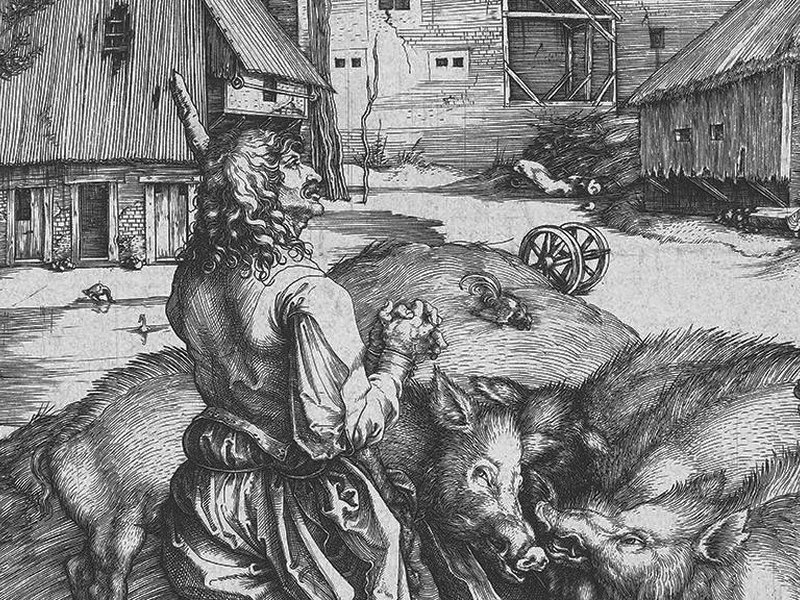
In the first essay on the parable of the Prodigal Son, I suggested that the problems commentators and others encounter in interpreting Jesus three-part parable are not accidental. These are not just problems in our ignorance of cultural background. They are intentional features of the stories —stories designed to poke…

by Ralph Allan SmithJuly 11, 2019
durer-prodigal-son-2
Luke

Perspectives on the Prodigal, (Part 1)

The story of the Prodigal Son is perhaps the most well-known story in the Bible. As others have observed, it may also be one of the most misunderstood. In two short essays, I will point out features of this story that are commonly neglected, aspects of Jesus’ parable that might…

by Ralph Allan SmithJuly 9, 2019
de-rijke-man-en-de-arme-lazarus-by-jacopo-da-ponte-16th-century
Luke

Lazarus and the Rich Man

The parable of Lazarus and the nameless rich man is not an independent story. It is part of a long context that begins in Luke 15:1, where Jesus is eating with tax collectors and sinners and the scribes and Pharisees grumble. In response to their hardheartedness, Jesus tells a three-part…

by Ralph Allan SmithJuly 4, 2019
aaron-burden-uynrnfdkjwg-unsplash
Luke

Everybody has Dropsy - Luke 14:1-24

The Bible is written so that even when a reader cannot pick up on what might be deeper or more detailed aspects of a text, there is virtually always a message to be heard. In the ancient world, where the “reader” of Scripture would likely be a church official facing…

by Ralph Allan SmithJuly 2, 2019
communion
Biblical Theology

Fruit Trees and Grain Plants

The distinction between garden (or vineyard) and field begins in Genesis 2. This relates to the ordering of the formless world. Plants of the field are contrasted with the garden planted by God in Genesis 2:5&8. Later on, under the Old Covenant the Israelites will be required to keep their…

by James B. JordanJune 27, 2019

Showing page 77 of 309

See all

Showing page 12 of 43

See all

Tent of Meeting

Leviticus 1 tells us that Yahweh called Moses from the tent of meeting to deliver instructions about sacrifice. What is that "tent of meeting" ( 'ohel mo'ed )? Judging by the usage of Leviticus, it would seem to be the tabernacle or a portion of the tabernacle. Most of the…

January 8, 2019

Don't Do, Don't Desire

The Ten Words include twelve negative commands. Most of the verbs that are negated are unique: 1) Thou shalt not have ( lo' yihyeh-leka ; literally, "there shalt not be to thee") other gods. 2) Thou shalt not prostrate ( lo'-tishtachweh ) to them (i.e., images). 3) Thou shalt not…

January 7, 2019
Philosophy

Theology's Maidservant

Thomas Aquinas summed up a long tradition when he said that philosophy is theology's ancilla , its maidservant. That's an apt description, and applies as well to natural science, social science, poetry, literary criticism, history, etc. etc. Philosophy has a special role only because her work often resembles theology's, and…

December 20, 2018

The Limits of Natural Law

John Milbank currently has a series of essays on natural law running a Church Life Journal . It's a "revisionist" account of natural law. And one of the revisions is Milbank's post-Kantian conception of the relation of nature and culture, something he lays out in his essay, " Only Theology…

December 19, 2018

Simplicity: Further Exploration

Steven Duby ( Divine Simplicity ) addresses the sort of argument I offered in yesterday's post . I quote a long paragraph (p. 148), with comments interspersed. "One might contend," Duby writes, "for a divine complexity that is necessary and irrevocable with no risk of divisibility. Such a hypothesis elicits…

December 18, 2018

Divine Simplicity: An Experimental Response

This is a response to the notion of divine simplicity. It's not a refutation. It's an experiment designed to tease out the logic of the claim. Simplicity means that God is without parts. He has no physical parts, and He's not a composite of any metaphysical "parts" either. He's not…

December 17, 2018

Showing page 50 of 2212

Browse by Category

In Medias Res

Your weekly digest for all things Theopolis.

Donate

Theopolis is nearly 100% donor-supported. Consider joining us on our mission.