Theopolis Logo

Writing

Explore our collection of theological essays, biblical studies, and reflections on faith and culture.

See all
hebrew-manuscript-2
Hermeneutics

The Complexity of Biblical Allusion

There is no question about the fact that the book of Deuteronomy is full of literary allusion. But there is a serious problem, even a paradox, of understanding how that allusion works. To begin with, if we assume that Deuteronomy was written by Moses — with some editorial emendations added…

by Ralph Allan SmithJanuary 23, 2018

bladerunner
Culture

The Artificial Resurrection

Genesis and Genetics in Blade Runner 2049 The power of science fiction, and what’s positive about it, is that you’re able to experience the worst-case scenario without actually having to live it. (Actor Ryan Gosling, who plays Officer “K”) (Warning: The following analysis contains spoilers for both Blade Runner films.)…

by Mike BullJanuary 18, 2018
sixteen-miles-out-d40gdcd_-he-unsplash
Biblical Studies

The Battle of Gog and Magog

The battle of Gog and Magog is found in Ezekiel 38-39. My purpose in this brief essay is to propound an explanation for this passage that I have not encountered in any of my commentaries, but that makes more sense to me than any other. I offer it here in…

by James B. JordanJanuary 16, 2018
resurrection

Deep Hope

I. Varlam Shalamov in Kolyma Tales describes his experience of the Gulag, where he spent more than a dozen of years. In a story titled The Life of Engineer Kipreev Shalamov reflects on the theme of hope in the life of a prisoner: “Hope always shackles the convict. Hope is…

by Bogumil JarmulakJanuary 11, 2018
abraham-defeats-kings-g-jollain-2
Biblical Theology

Abram’s 318 Men

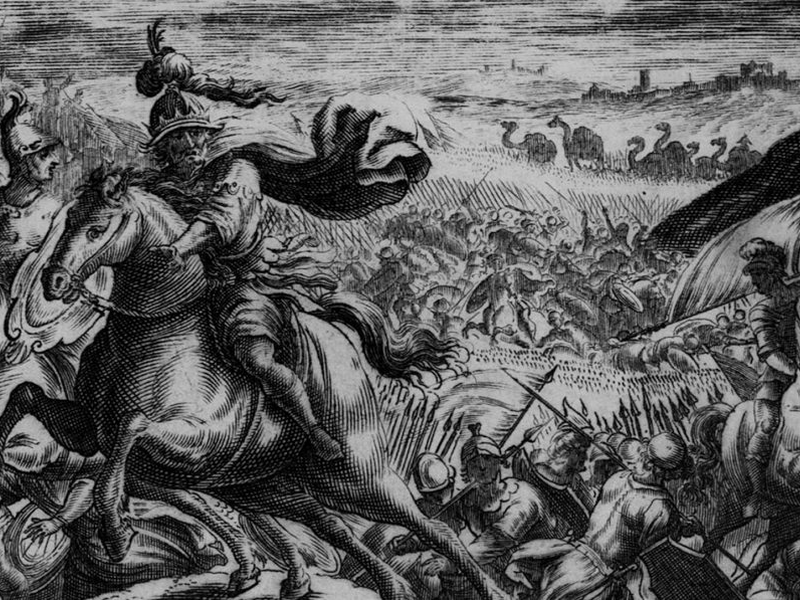
Genesis 14:14 says that Abram mustered his trained men, “born in his house,” to rescue Lot, and gives their number as 318. It is clear that the precise number is provided for some reason, but what is it? S. Gevirtz notes that 318 is the sum of all the prime…

by James B. JordanJanuary 9, 2018
tanner-mardis-xuxghzhibn4-unsplash-1
Biblical Studies

The Flying Scroll

And he said to me, "What do you see?" And I answered, "I see a flying scroll; its length is twenty cubits and its width ten cubits" (Zechariah 5:2). Immediately following his vision of the outpouring of the Spirit upon the restoration community (4:1-14), Zechariah saw a flying scroll. The…

by Peter LeithartJanuary 4, 2018

Showing page 100 of 309

See all

Showing page 13 of 43

See all

One Will

It is sometimes argued that the Christological formula of essence and person determines the way to understand person and essence in Trinitarian theology. The incarnate Son is a single person, the Person of the divine Son. But this Person exists in two natures. The church rejected monophysite Christologies; Jesus has…

March 16, 2016

Democracy and Class

In his forthcoming Democracy: A Life, Paul Cartledge summarizes Aristotle's discussion of democracy in the Politics and the disputed Constitution of Athens . According to Cartledge, Aristotle “deconstructs or decomposes demokratia as such, that genus of ‘constitution’ as it were, into four sub-species, ranging along a spectrum from the most…

March 16, 2016

David's Sons

1 Chronicles 2 gives a family tree for Judah. The following chapter focuses in on the royal family of David. The overall structure is chiastic: A. Sons born in Hebron. B. List of six sons born in Hebron, with mothers. C. He reigned in Hebron for seven years and six…

March 15, 2016

God's Bounded Freedom

According to Rowan Williams ( Arius ), the central concern is with the freedom of God's will. Arius insists that God is self-subsistent, and because he is immaterial he is “without any kind of plurality or composition.” If the Son is eternally with God, then there is something beside God…

March 15, 2016

Congregational Singing in Medieval Liturgy

In his book on Worship Wars in Early Lutheranism , Joseph Herl argues that, though Luther advocated congregational singing, the Lutheran liturgy remained a largely choral liturgy for the first generations after the Reformation. Along the way to making his case, he dispels some myths about the medieval mass. Contrary…

March 15, 2016

Summoning

Alan Jacobs takes issue with Corey Robin's essay on “ How Intellectuals Create a Public ,” where he argues that public intellectuals shouldn't write for readers who already exist but “summon” a new public into being. Jacobs says that Robin writes a lot about summoning, which, Jacobs says, has two…

March 14, 2016

Showing page 310 of 2212

Browse by Category

In Medias Res

Your weekly digest for all things Theopolis.

Donate

Theopolis is nearly 100% donor-supported. Consider joining us on our mission.