Theopolis Logo

Writing

Explore our collection of theological essays, biblical studies, and reflections on faith and culture.

See all
denise-jans-dpemksg59la-unsplash
Art

Glorifications Versus Debasement

Because of sin, the arts sometimes do not serve to glorify but to debase. Sinful men make their environments ugly, and create ugly art to “enhance” their ugly words. But since all men are still God’s images, no men are able to live with such ugliness all the time. Thus,…

by James B. JordanMay 25, 1994

jeremy-yap-j39x2xx_8cq-unsplash
Art

Words and Glory

Arts and literature reviews in most evangelical Christian publications generally approach their subjects in terms of ideology. We are told whether or not the film or book is acceptable in terms of morals, sexual graphicness, and theological accuracy. While there is definitely a place for such reviews, I fear that…

by James B. JordanMay 25, 1994

screen-shot-2018-04-12-at-9-48-08-am
Biblical Horizons

Broadening Our View of the Trinity

We speak of God as Father, Son, and Holy Spirit. The early Church tended to speak of Him as Father, Word, and Spirit. In this short essay, I want to suggest some other ways to think of the Trinity, ways that I have found pastorally helpful in my own life…

by James B. JordanMay 5, 1994
Biblical Studies

Thousands of Generations

I, Yahweh your God, am a jealous God, visiting the iniquity of the fathers on the children, on the third and fourth of those who hate Me, but showing lovingkindness to thousands, to those who love Me and guard My commandments (Ex. 20:5-6). The Second Word forbids acts of ceremonial…

by James B. JordanMay 5, 1994
ben-white-w8qqn1pmqh0-unsplash
Biblical Chronology

The Chronology of the Pentateuch (Part 3)

8. The Table of Nations If we assume births every two years, and about 30 years between generations (cp. Gen. 11:12-24), we can come up with an approximate series of dates for the generations recorded in Genesis 10. We shall assume that all three of Noah’s sons had their firstborn…

by James B. JordanMay 5, 1994
49980-nicolas_poussin_-_the_judgment_of_solomon_-_wga18330-800w-tn
Biblical Studies

The Eighth Month

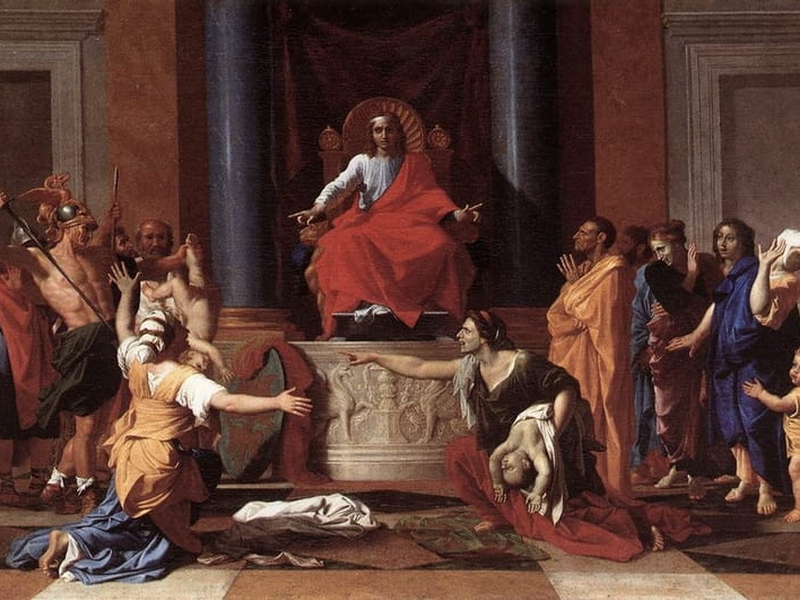
Zechariah’s first prophecy (Zech. 1:1-6) was delivered in the eighth month of the second year of Darius. The notation of this date serves a number of purposes. Most obviously, it relates Zechariah’s prophecies to those of Haggai. By the time Zechariah delivered his first prophecy, Haggai had already chided the…

by Peter LeithartApril 23, 1994

Showing page 279 of 309

See all

Showing page 13 of 43

See all

Jesus the Carpenter

W hen Jesus begins the Sermon on the Mount, He is sitting on a mountain teaching about the law. He is a new Moses; He is Yahweh. To get the full force of the analogy, we should recalled that God reveals more on Sinai than the Ten Word or moral…

January 6, 2015

Salt of the Earth

Mark Kulansky observes in his Salt: A World History that “Almost no place on earth is without salt. But this was not clear until revealed by modern geology, and so for all of history until the twentieth century, salt was desperately searched for, traded for, and fought over.” Salt’s importance…

January 6, 2015

Who Are The Disciples?

When we read of Jesus’ “disciples,” we naturally think of the Twelve. But that’s not nearly as clear as we try to make it. Many Bibles include the heading “the first disciples” for the episode in Matthew 4:18-22, but the text never uses the word. Peter, Andrew, James, and John…

January 5, 2015

Salty

In a classic essay on the “Symbolic Significance of Salt,” Ernst Jones neatly summarizes how the natural properties of salt lend themselves to social and religious uses: “Salt is a pure, white, immaculate and incorruptible substance, apparently irreducible into any further constituent elements, and indispensable to living beings. It has…

January 5, 2015
Atonement

Social Atonement

H ow, Walter Rauschenbush asked in his Theology for a Social Gospel , does Jesus bear our sins? Unsatisfied with “imputation” as an explanation, he turned to a “social” explanation. Jesus was in solidarity with humanity, and human history is a history of sin. Humanity is bound in a enslaving…

January 5, 2015

Joy of Justification

In her contribution to J ustification in a Post-Christian Society (52), Christine Helmer summarizes the work of Birgit Stolt, who has examined Luther’s vocabulary of justification: “Through careful linguistic analysis, Stolt shows Luther’s doctrine of justification is not couched in the sterile dogmatic vocabulary of a cognitive appreciation for the…

January 2, 2015

Showing page 480 of 2212

Browse by Category

In Medias Res

Your weekly digest for all things Theopolis.

Donate

Theopolis is nearly 100% donor-supported. Consider joining us on our mission.