Theopolis Logo

Writing

Explore our collection of theological essays, biblical studies, and reflections on faith and culture.

See all
aaron-burden-h8s0pf2rcqs-unsplash
Galatians

The Restoration of the Galatians

While controversies over the writings of Paul continue in various corners of the intellectual globe, the word of God given through Paul and his scribe and all of the church’s interpreters and translators over the last two millennia is still readily available to the lofty and the lowly. Paul, as…

by Grace LangnessMarch 25, 2013

kiwihug-l4gw27xzn1i-unsplash
Deuteronomy

Law and History: How to Read the Law of Moses (Part 2)

The second in a series of studies in Deuteronomy. Deuteronomy 22:30: A man shall not take his father’s wife, and shall not uncover his father’s wing (Hebrew: kanaf ). There are a number of unusual features in this law that mark it out from the previous context, indicating that it…

by Ralph Allan SmithMarch 20, 2013
200403-moss-pilate-tease_pncfq5
History

Victimhood and the Gospel

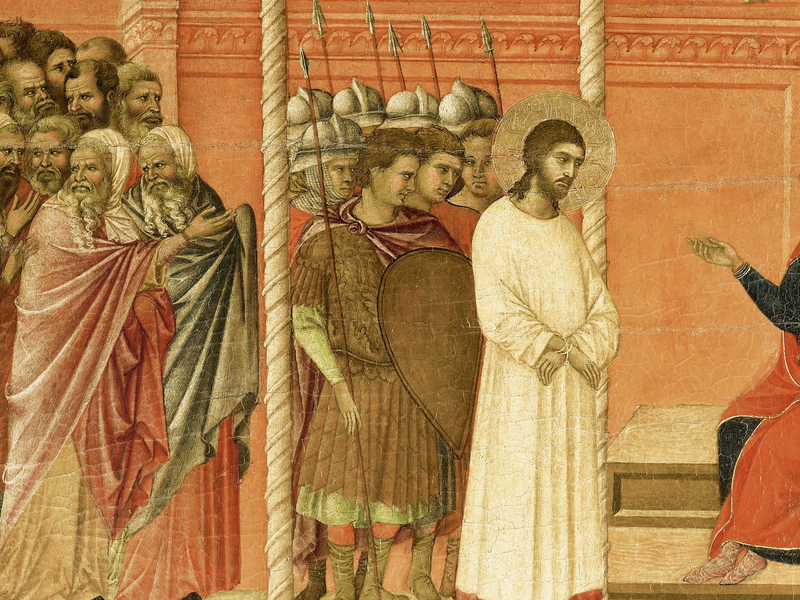
The texts of Christianity have been slowly at work, under the power of the Holy Spirit for 2000 years now. If we could be magically transported back into the world of two millennia ago, modern Americans would be shocked at the cruelty of that world. There was no concern for…

by Richard BledsoeMarch 18, 2013
aaron-burden-1ebsmyrau-s-unsplash
Luke

The Dysfunctional Family of the Gadarene Madman

The Story of the Gadarene Madman is told in all three synoptic Gospels (Matthew 8:28-34, Mark 5:1-20, Luke 8:26-37). Jesus ventures into a Gentile area when He passes over the Sea of Galilee. Upon disembarking from his boat, he is immediately met by a demon-possessed madman. Upon meeting Jesus, he…

by Richard BledsoeMarch 13, 2013
aaron-burden-1ebsmyrau-s-unsplash
Deuteronomy

Law and History: How to Read the Law of Moses

Part 1 of a multi-part series of studies on Deuteronomy 22:30-23:8. Eric Auerbach, in his classic work on Western literature, devotes his first chapter to contrasting Homer with the Bible. Of Homer, he writes of the “need of Homeric style to leave nothing which it mentions half in darkness and…

by Ralph Allan SmithMarch 12, 2013
markus-winkler-aid-xyrtlec-unsplash
Theopolis News

James Jordan in Korea, Japan

Trinity House Fellow James B. Jordan will be a speaker at an International Conference on Biblical Symbolism that will be held in Seoul on Monday, May 27 in 2013. He will address "The Importance of Biblical Symbolism and Symbolic Interpretation of the Bible." The conference will have three other speakers…

by Peter LeithartMarch 9, 2013

Showing page 197 of 309

See all

Showing page 14 of 43

See all

Cities Ascending and Descending

The Bible ends with a vision of the descent of a jeweled bridal city Jerusalem descending from heaven. Before the city descends, though. a city ascends: Babylon is destroyed and her smoke rises forever and ever. God's city descends only after the city of man is sent up to God…

August 14, 2015

Anti-Labor, Anti-Catholic

David Sehat argues ( The Myth of American Religious Freedom ) that the American moral establishment was undermined by the labor movement: “By the last quarter of the nineteenth century the corporation had joined the family, the church, and the school as an institution perpetuating Christian moral authority” (189). This…

August 13, 2015

Myth and the Fragmentation of Humanity

Paganism, writes Eugen Rosenstock-Huessy ( Christian Future ), “is best understood . . . as primitive man's response to the fear of death.” That means not only personal death but also the death of those groups to which he is bound—family, race, country. The problem is that “all finite forms…

August 13, 2015

The End For Which God Made Us

“The patristic concept of theosis is the most precise and compendious possible evocation of the end for which God creates us,” writes Robert Jenson in a characteristically dense essay in The Catholicity of the Reformation . It doesn't imply that the Creator-creature distinction is somehow erased; that difference is “indeed…

August 13, 2015

What Cantwell Achieved

David Sehat ( The Myth of American Religious Freedom , 222-3) observes that Cantwell v. Connecticut (1940) was the first Supreme Court decision to incorporate the religion clause of the First Amendment to the States. In the case, Jehovah's Witnesses were denied a license to proselytize. The Court struck down…

August 12, 2015

Creating Genocide

Emmanuel Katongole ( A Future for Africa , 98-101) argues, as others have, that the racial division behind the Rwandan genocide was forged during Western colonization. “Before the colonial occupation of Rwanda,” he writes, “the Hutu and Tutsi were not ‘clearly distinct and rigidly separated ethnic groups.'” The distinction existed,…

August 12, 2015

Showing page 390 of 2212

Browse by Category

In Medias Res

Your weekly digest for all things Theopolis.

Donate

Theopolis is nearly 100% donor-supported. Consider joining us on our mission.