Theopolis Logo

Writing

Explore our collection of theological essays, biblical studies, and reflections on faith and culture.

See all
sculptor
Art

The Artist's Litany

If we say that we have no sin, we deceive ourselves, and the truth is not in us. (1 John 1:8) O God the Father, creator of heaven and earth, Alpha and Omega, beginning and end, who inspired Creation with the breath of your nostrils, who placed Adam in the…

by Christian LeithartFebruary 2, 2016
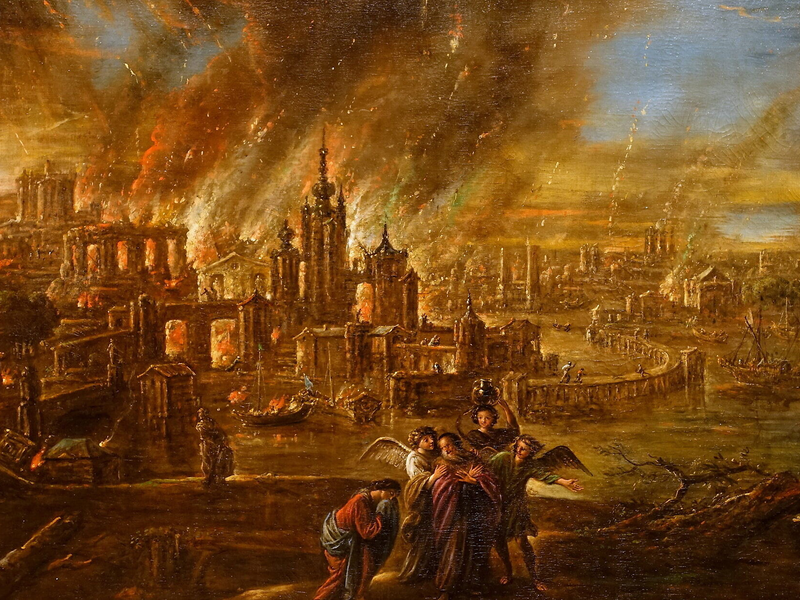
sodom_and_gomorrah_afire_by_jacob_jacobsz-_de_wet_d-_j-_probably_koln_c-_1680_oil_on_canvas_-_hessisches_landesmuseum_darmstadt_-_darmstadt_germany_-_dsc01149-e1632540497247
American Culture

American Sodom

For nearly a half-century, Sodom has been a key symbol in the American culture wars. On the one side, we have an aggressive movement among homosexuals that has first decriminalized homosexual conduct, then to force cultural and legal recognition of homosexuals as a minority and to normalize homosexual behaviors, finally…

by Peter LeithartJanuary 28, 2016
image-20150409-15244-1r08rsu
Biblical Theology

The Meaning of the Mount of Olives

Speaking of the Church, Romans 11:16-17 says, "And if the root be holy, the branches are also. But if some of the branches were broken off, and you, being a wild olive were grafted in among them and became partaker with them of the root of the fatness of the…

by James B. JordanJanuary 26, 2016
img_6134
Isaiah

No Sabbath for God

At the end of Isaiah 61, Yahweh's Servant rejoices because the Lord clothes Him with salvation and righteousness. He decks Him like a bridegroom with a garland on His head. He wears jewels like a bride. He is a new bridegroom in a new garden of Eden, a garden of…

by Peter LeithartJanuary 21, 2016
hebrew-manuscript-2
Biblical Law

Approaching the Torah

Before anything else, a word about “Torah” may be in order. I have been persuaded that “law” is a bad translation of “Torah,” even though it is evident that what is called “Torah” does have commandments, statutes, and ordinances in abundance. Why not “law?” “Law” as a translation for “Torah”…

by Ralph Allan SmithJanuary 19, 2016
jane-austen-2
Biblical Horizons

Jane Austen, Pundit

Few novelists seem as innocent of the temptation to punditry as Jane Austen. Though living through a period that witnessed the birth of an independent United States, the French Revolution and the Terror, the Napoleonic wars and the rise of revolutionary romanticism, and the upheavals of the Industrial Revolution, she…

by Peter LeithartJanuary 14, 2016

Showing page 137 of 309

See all

Showing page 16 of 43

See all
Philosophy

Cinematic perception and Zeno’s arrow

Henri Bergson attempted to solve the paradox of Zeno’s arrow (which can never cover the infinite points between the bow and the target, and yet does) by calling attention to the implicit spatialization of time within the paradox. The space in which movement takes place is divisible, but the duration…

May 5, 2005
Philosophy

Cinematic perception and Zeno’s arrow

Henri Bergson attempted to solve the paradox of Zeno’s arrow (which can never cover the infinite points between the bow and the target, and yet does) by calling attention to the implicit spatialization of time within the paradox. The space in which movement takes place is divisible, but the duration…

May 5, 2005

Romans 8, continued

INTRODUCTION Paul is talking about the liberation of creation from bondage to decay and corruption into freedom. This raises the question of the time frame for the fulfillment of this prophecy. It is normally taken as a reference to the end of the world. The ?redemption of the body?E(v. 23)…

May 5, 2005

Osiander and the Reformed Tradition

Julie Canlis has a helpful article on Calvin’s response to Osiander in the International Journal of Systematic Theology (6:2 [2004]). A few points are worth highlighting: 1) She sees the response to Osiander as part of the reason why Reformed theologians tend to be skittish about talk of “participation.” Calvin,…

May 5, 2005

Justification and Reformation

In two older articles, Alister McGrath examines the sources for the Reformation doctrine of justification, covering ground also covered in his 2-volume Iustitia Dei. The first article, published in the Harvard Theological Review in 1982 (75:2, pp. 219-242) examines the evidence for claiming that the Reformation doctrine of justification was…

May 4, 2005
Theology

More on Hart, The Beauty of the Infinite

Covenant of Light. This section concludes Part I of The Beauty of the Infinite , entitled ?Dionysus Against the Crucified.?E With this section, Hart concludes his critique of classical, modern and postmodern thought, and the outlines of the Christian ontology that interrupted the history of metaphysics and that he develops…

May 4, 2005

Showing page 1984 of 2212

Browse by Category

In Medias Res

Your weekly digest for all things Theopolis.

Donate

Theopolis is nearly 100% donor-supported. Consider joining us on our mission.