Theopolis Logo

Writing

Explore our collection of theological essays, biblical studies, and reflections on faith and culture.

See all
aaron-burden-h8s0pf2rcqs-unsplash
Galatians

The Restoration of the Galatians

While controversies over the writings of Paul continue in various corners of the intellectual globe, the word of God given through Paul and his scribe and all of the church’s interpreters and translators over the last two millennia is still readily available to the lofty and the lowly. Paul, as…

by Grace LangnessMarch 25, 2013

kiwihug-l4gw27xzn1i-unsplash
Deuteronomy

Law and History: How to Read the Law of Moses (Part 2)

The second in a series of studies in Deuteronomy. Deuteronomy 22:30: A man shall not take his father’s wife, and shall not uncover his father’s wing (Hebrew: kanaf ). There are a number of unusual features in this law that mark it out from the previous context, indicating that it…

by Ralph Allan SmithMarch 20, 2013
200403-moss-pilate-tease_pncfq5
History

Victimhood and the Gospel

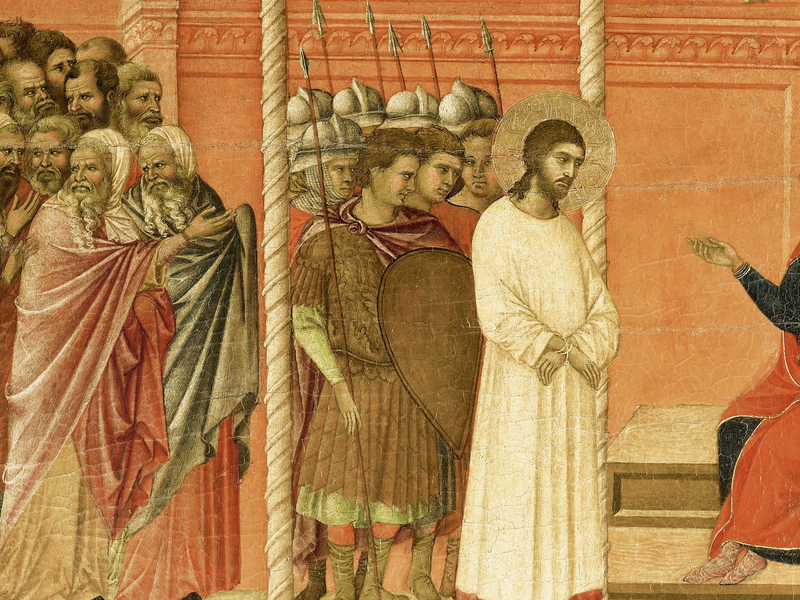
The texts of Christianity have been slowly at work, under the power of the Holy Spirit for 2000 years now. If we could be magically transported back into the world of two millennia ago, modern Americans would be shocked at the cruelty of that world. There was no concern for…

by Richard BledsoeMarch 18, 2013
aaron-burden-1ebsmyrau-s-unsplash
Luke

The Dysfunctional Family of the Gadarene Madman

The Story of the Gadarene Madman is told in all three synoptic Gospels (Matthew 8:28-34, Mark 5:1-20, Luke 8:26-37). Jesus ventures into a Gentile area when He passes over the Sea of Galilee. Upon disembarking from his boat, he is immediately met by a demon-possessed madman. Upon meeting Jesus, he…

by Richard BledsoeMarch 13, 2013
aaron-burden-1ebsmyrau-s-unsplash
Deuteronomy

Law and History: How to Read the Law of Moses

Part 1 of a multi-part series of studies on Deuteronomy 22:30-23:8. Eric Auerbach, in his classic work on Western literature, devotes his first chapter to contrasting Homer with the Bible. Of Homer, he writes of the “need of Homeric style to leave nothing which it mentions half in darkness and…

by Ralph Allan SmithMarch 12, 2013
markus-winkler-aid-xyrtlec-unsplash
Theopolis News

James Jordan in Korea, Japan

Trinity House Fellow James B. Jordan will be a speaker at an International Conference on Biblical Symbolism that will be held in Seoul on Monday, May 27 in 2013. He will address "The Importance of Biblical Symbolism and Symbolic Interpretation of the Bible." The conference will have three other speakers…

by Peter LeithartMarch 9, 2013

Showing page 197 of 309

See all

Showing page 17 of 43

See all
Christendom

For and Against Christendom

Someone asked me recently about my views on church and state. I replied that I advocate a "Christendom model" of church-state relations. Then I proceeded to qualify. When I was done qualifying, I suddenly wondered whether what I call "Christendom" corresponds to what other people understand by the word. It…

January 30, 2018

Nation of Kings

Ezra begins where 2 Chronicles ends, with the decree of Cyrus. Some scholars have argued that the repetition indicates that the books were once united. It's said that the doubling is an ancient literary device to knot together two sections of a text. Whether that is the case or not,…

January 29, 2018

Simplifying Space?

James Simpson briefly reviews the career of the 17th-century iconoclast William Dowsing in his history of iconoclasm, Under the Hammer . What motivated Dowsing, he argues, wasn't an effort to prioritize the word over the image, but a quest for "jurisdictional clarity." With the triumph of Parliament, the complex jurisdictional…

January 26, 2018

Freudianism Without Freud

The key question regarding Freud, says Rosenstock-Huessy ( In the Cross of Reality , 266), is "Whom did Freud obey when he began to develop his theory?" The question arises because "in Freud's relational system there is no place for Sigmund Freud's own experience." He shares this distinction of an…

January 26, 2018

Improving to Death

Alexandra Schwartz's New Yorker essay on self-improvement movements ( "Improving Ourselves to Death" ) starts out breezily enough, but it turns grim pretty fast. The "death" in her title isn't metaphorical. She summarizes the experiment of Carl Cederström and André Spicer, who tried to improve one area of their lives…

January 26, 2018

Dostoevsky's Doodles

In a TLS review of Kontantin Barsht's Drawings and Calligraphy of Fyodor Dostoevsky , Robert Bird reminds us that Dostoevsky was a "trained draughtsman" who "thought in images no less than in words: "He wrote frequently about painting, and many of his key terms suggest visual, rather than verbal communication,…

January 26, 2018

Showing page 100 of 2212

Browse by Category

In Medias Res

Your weekly digest for all things Theopolis.

Donate

Theopolis is nearly 100% donor-supported. Consider joining us on our mission.