Theopolis Logo

Writing

Explore our collection of theological essays, biblical studies, and reflections on faith and culture.

See all
johann-siemens-epy0gbjzzzu-unsplash
Apologetics

A Sabbath Conversation: How Old is the Earth?

As Adam and Eve walked to the center of the Garden of Eden to meet with the LORD on their first Sabbath they conversed about the origin and age of the earth. Adam: You know, honey, we spent a lot of time yesterday making preparations for our house, and we…

by Jeff MeyersOctober 3, 1997
img_1043
Biblical Horizons

Psalms for Exile: The Narrative Progression in the Fifth Book of the Psalter

Some of our forefathers believed in reading/singing the psalms in order. Today, when the psalms are even used at all, they tend to be used randomly, though sometimes tied to a church calendar or to the pastor’s sermon. The Bible does not bind us to any particular practice, but there…

by James B. JordanSeptember 4, 1997
jordan-wozniak-xp_agmeea6s-unsplash-2
Biblical Chronology

The Anthropomorphic Days of C. John Collins, Part 2

Dr. Collins begins his essay with a brief statement of the Day Age view and then a brief statement of the Six Day view, focussing on the challenge to that view posed by modern "science." He ends this discussion by writing: "Two crucial points are at stake here: first, the…

by James B. JordanSeptember 4, 1997
john-salzarulo-wtjrpjzabcq-unsplash
Biblical Horizons

Paperweights and the Puzzles of Secularism

In his The Construction of Social Reality , Berkeley philosopher John Searle puzzles over the ontology of the products of human construction. Certain things – granite, platypi, weeping willows – occur naturally; while other realities – stone walls, zoos and parks, Chase Manhattan Bank – exist only as products of…

by Peter LeithartAugust 27, 1997
ales-krivec-4mibe6zg5r0-unsplash
Biblical Chronology

The Anthropomorphic Days of C. John Collins, Part 1

In the journal Presbyterion 20 (1994):109-130, published by Covenant Theological Seminary, Dr. C. John Collins sets forth a revision of the Day Age approach in his essay, "How Old Is the Earth? Anthropomorphic Days in Genesis 1:1–2:3." Dr. Collins’s essay has been widely accepted in evangelical Presbyterian circles as an…

by James B. JordanAugust 4, 1997
screenshot-2023-09-04-at-10-37-01-am
Biblical Horizons

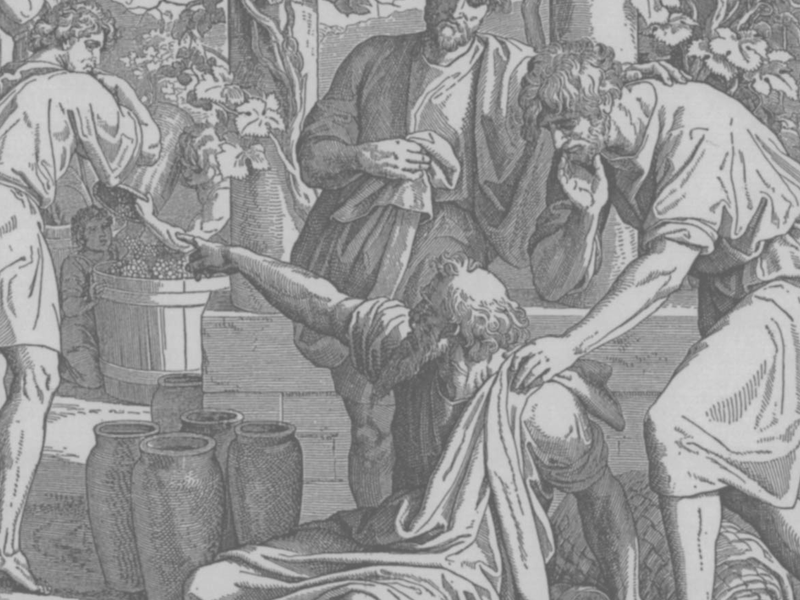
The Sin of Ham and the Curse of Canaan, Part 3 (An Exposition of Genesis 9:20-27)

The Righteousness of Shem and Japheth As noted above, the action of Shem and Japheth was purely symbolic. They did not need to cover Noah with a garment, for he was already covered by the tent. Their action was a symbolic affirmation of Noah’s authority, a symbolic rejection of Ham’s…

by James B. JordanAugust 4, 1997

Showing page 254 of 309

See all

Showing page 17 of 43

See all

Twenty-Something Radical Orthodoxy

A couple of years ago, Kyle Nicholas summed up "The Progress and Future of Radical Orthodoxy ," now entering its early adulthood. Though the movement has waned, he argues for "its continuing relevance." "Amidst scathing critiques from every corner," he points out, "Radical Orthodoxy has continued to bear fruit on…

September 22, 2017
Eucharist

Homily on Grain

In his Material Eucharist (30), David Grumett summarizes the "Homily on the Grain" from the Syrian poet Cyrillonas: "Alluding to the incarnation and to Christ's two natures,. he describes the grain falling into the earth and its kernel encased within a dual outer husk. This echoes the image that Jesus…

September 22, 2017

On the Structure of Leviticus

Leviticus is divided into thirty-seven speeches, each introduced by "Yahweh spoke to Moses" (see Warning, Literary Artistry in Leviticus ). The 19th speech - the central one - is Leviticus 16, instruction for the "day of coverings." From this, one can derive a simple chiastic outline of the book (I've…

September 21, 2017

The Cross of Eugen Rosenstock-Huessy, 4

IV. Cross of Reality Christianity’s history is the story of the cross’s penetra­tion into human experience and society. New epochs are formed when the cross begins to mark a new “sphere of our minds or bodies” ( CF , p.165). In the new era that Rosenstock-Huessy saw coming, the cross…

September 21, 2017

Post-Confederate Memorials

Joseph Bottum offers a Girardian analysis of the current craze for knocking down monuments ( Weekly Standard ). Along the way, he explores the origins of the Confederate memorials, observing that "The list of removed statues and memorials seems mostly to prove what busy beavers the United Daughters of the…

September 21, 2017

The Cross of Eugen Rosenstock-Huessy, 3

III. The Cross and Civilization Jesus gives abundant life. As the Crucified and Risen Man, he also creates new possibilities for history, forms a new epoch of history, the Christian era, and forms the possibil­ity of a new civilization. To understand fully what Rossen­stock-Huessy means by this, we need to…

September 20, 2017

Showing page 142 of 2212

Browse by Category

In Medias Res

Your weekly digest for all things Theopolis.

Donate

Theopolis is nearly 100% donor-supported. Consider joining us on our mission.