Theopolis Logo

Writing

Explore our collection of theological essays, biblical studies, and reflections on faith and culture.

See all
e99a2191
Theopolis News

New Season & New Relationships

We have moved from death to new life, from Lenten darkness to Easter light. And while Easter Sunday may have come and gone, it's effects are continually with us. This season has brought with it several new relationships, events, and signs of growth for Theopolis. We have been networking with…

by Peter LeithartMay 9, 2016

eucharist-2
Eucharist

Social Eucharist in the Middle Ages

In The People's Work , a social history of Christian Worship, Frank Senn summarizes the developments of the medieval period with regard to the Eucharist. He begins by challenging the assumption that medieval society was held together by “the church.” He notes that the church was often divided and conflicted,…

by Peter LeithartMay 5, 2016
turing-machine
Biblical Theology

What Is Systematic Typology? Part 4: Wheels Within Wheels

The structure of the Bible resembles something which was grown rather than built, composed rather than assembled. Its employment of “structure-as-sign” at every level from micro- to macrocosmic leads to the conclusion that a hermeneutic worthy of Scripture requires not only training in history, art and music but also the…

by Mike BullMay 3, 2016
giotto-noli-me-3
Luke

Eighth Day, Eighth Verdict

For some in first-century Israel, Easter was anything but good news. It was a terrifying surprise. For the rulers and powers that put Jesus to death, the idea that He had been raised by some power beyond their control was chilling. Early in Luke’s gospel, we're told that Herod thought…

by Peter LeithartApril 28, 2016
sebastian-pena-lambarri-yv593oymkmo-unsplash
Hermeneutics

153 Large Fish

Simon Peter went up, and drew the net to land, full of large fish, a hundred and fifty-three; and although there were so many, the net was not torn. (John 21:11) This is one of those texts in the Bible that many people puzzle over. It is not a puzzle…

by James B. JordanApril 26, 2016
jesus-on-trial
Philemon

Pilate the Kingmaker

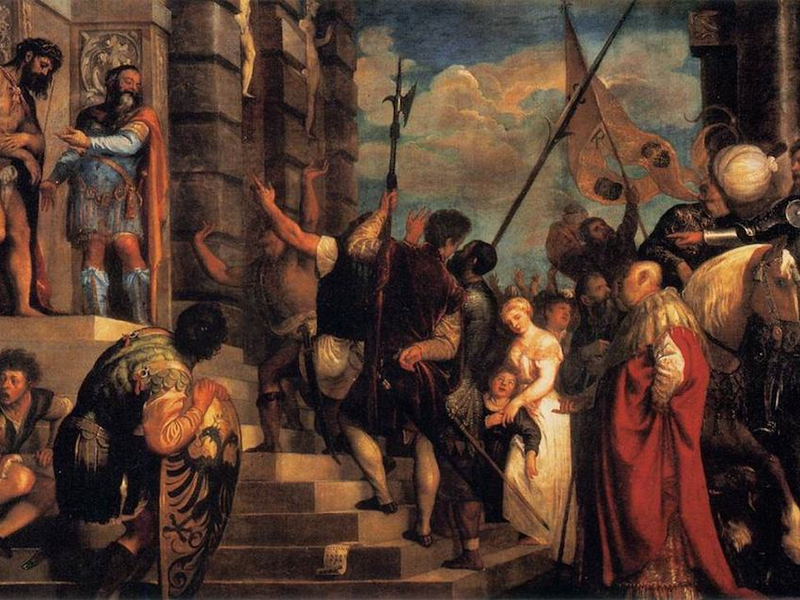
God is not mocked, Paul says. God is mocked, says Matthew. Who’s right? The two are in perfect harmony, but to see that, we need to run through the passage again. We’ll see that at every point, the mockery is being turned against the mockers. At every point, mockery is…

by Peter LeithartApril 21, 2016

Showing page 132 of 309

See all
See all
Art

Aesthetic enjoyment

Adorno writes that enjoyment is not the be-all of art.  Certainly it isn’t for the producers of art: “If you ask a musician if he enjoys playing his instrument, he will probably reply: ‘I hate it’ . . . People who have a genuine relation to art would rather immerse…

September 24, 2009

Soteriology in time

Soteriology is eschatology, and that means soteriology  has to have an already/not yet structure.  Rejecting either justification by faith or judgment according to works breaks the bond of eschatology and soteriology.  Another way to say this is soteriology is about what happens in time . The alternatives are: 1) Antinomian:…

September 23, 2009

God acknowledging God

Commenting on the “seal” in Song of Songs 4:12, Luther writes, “In the same way we Christians are now sealed by the Word, Baptism, and the Sacramental of the Altar, by which we are distinguished from all other races, not just before the world, but rather in God’s own judgment.”…

September 23, 2009

Film, actors and audience

In his classic essay on the “work of art in the age of mechanical reproduction,” Walter Benjamin made some trenchant observations on the way film affects actors and audiences.   Importantly, he believes these effects are not the result of some perversion of the medium of film, but inherent in…

September 23, 2009

Adam and Elohim

Paul Niskanen has an insightful analysis of Genesis 1:27 in the latest JBL .  He starts with the question of whether Barth’s view that the image of God is found in relationality and specifically in sexual difference has any exegetical support.  He reviews the current discussion, and notes that there…

September 23, 2009

Heidegger’s hermeneutics

Ouch!  Schaeffer again, this time on Heidegger’s interpretive methods: “Paraphrase, translation, dismantling of the syntax, making the text autonomous with regard to the concrete subject who utters it, absolute silence regarding the poetic form: to these five characteristics we must add hermeneutic authoritarianism,” the last of which “postulates an opposition…

September 22, 2009

Showing page 1346 of 2212

Browse by Category

In Medias Res

Your weekly digest for all things Theopolis.

Donate

Theopolis is nearly 100% donor-supported. Consider joining us on our mission.