Theopolis Logo

Writing

Explore our collection of theological essays, biblical studies, and reflections on faith and culture.

See all
johann-siemens-epy0gbjzzzu-unsplash
Apologetics

A Sabbath Conversation: How Old is the Earth?

As Adam and Eve walked to the center of the Garden of Eden to meet with the LORD on their first Sabbath they conversed about the origin and age of the earth. Adam: You know, honey, we spent a lot of time yesterday making preparations for our house, and we…

by Jeff MeyersOctober 3, 1997

img_1043
Biblical Horizons

Psalms for Exile: The Narrative Progression in the Fifth Book of the Psalter

Some of our forefathers believed in reading/singing the psalms in order. Today, when the psalms are even used at all, they tend to be used randomly, though sometimes tied to a church calendar or to the pastor’s sermon. The Bible does not bind us to any particular practice, but there…

by James B. JordanSeptember 4, 1997
jordan-wozniak-xp_agmeea6s-unsplash-2
Biblical Chronology

The Anthropomorphic Days of C. John Collins, Part 2

Dr. Collins begins his essay with a brief statement of the Day Age view and then a brief statement of the Six Day view, focussing on the challenge to that view posed by modern "science." He ends this discussion by writing: "Two crucial points are at stake here: first, the…

by James B. JordanSeptember 4, 1997
john-salzarulo-wtjrpjzabcq-unsplash
Biblical Horizons

Paperweights and the Puzzles of Secularism

In his The Construction of Social Reality , Berkeley philosopher John Searle puzzles over the ontology of the products of human construction. Certain things – granite, platypi, weeping willows – occur naturally; while other realities – stone walls, zoos and parks, Chase Manhattan Bank – exist only as products of…

by Peter LeithartAugust 27, 1997
ales-krivec-4mibe6zg5r0-unsplash
Biblical Chronology

The Anthropomorphic Days of C. John Collins, Part 1

In the journal Presbyterion 20 (1994):109-130, published by Covenant Theological Seminary, Dr. C. John Collins sets forth a revision of the Day Age approach in his essay, "How Old Is the Earth? Anthropomorphic Days in Genesis 1:1–2:3." Dr. Collins’s essay has been widely accepted in evangelical Presbyterian circles as an…

by James B. JordanAugust 4, 1997
screenshot-2023-09-04-at-10-37-01-am
Biblical Horizons

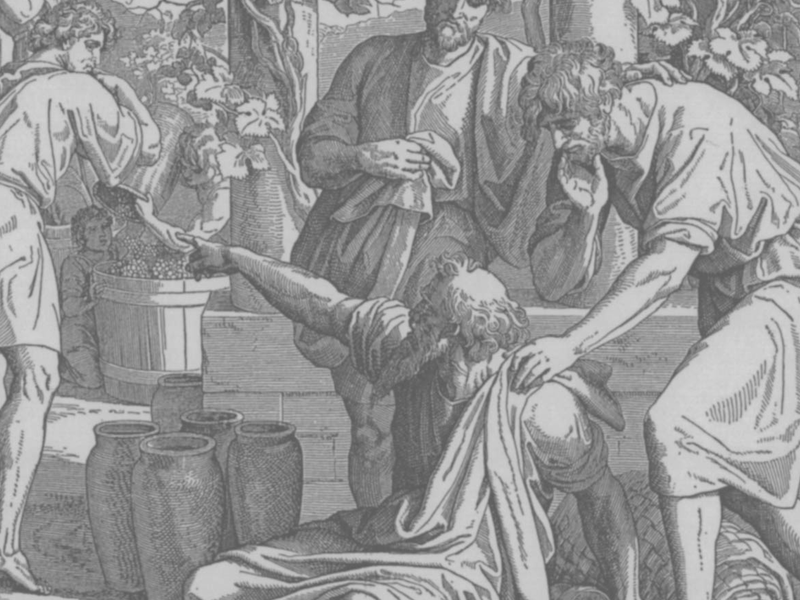
The Sin of Ham and the Curse of Canaan, Part 3 (An Exposition of Genesis 9:20-27)

The Righteousness of Shem and Japheth As noted above, the action of Shem and Japheth was purely symbolic. They did not need to cover Noah with a garment, for he was already covered by the tent. Their action was a symbolic affirmation of Noah’s authority, a symbolic rejection of Ham’s…

by James B. JordanAugust 4, 1997

Showing page 254 of 309

See all
See all
Art

Anxiety of influence

RG Collingwood has a whale of a time excoriating individualistic conceptions of art.  He recognizes a theological motif behind the post-romantic notion of the isolated artistic genius: “Individualism conceives a man as if he were God, a self-contained and self-sufficient creative power whose only task is to be himself and…

September 18, 2009

Triune concreteness

Hegel writes that the Trinity enables Christianity and especially Christian art to attain a concreteness impossible in Judaism and Islam: “When we state . . . of God thathe is simple One, the Supreme Being as such, we have thereby merely given utterance to a lifeless abstraction of the traditional…

September 18, 2009

Proverbs 27:12-18

PROVERBS 27:12 As we have seen repeatedly in our study of Proverbs, wisdom is a kind of foresight, an ability to foretell the future, an ability to see down the road. The prudent or “crafty” ( arum ) man can see the evil ahead and does what he needs to…

September 18, 2009

Medieval economics

Henri Pirenne, in his Economic and Social History of medieval Europe, describes the regulation of economic life in medieval towns during the twelfth and thirteenth centuries. Pirenne is admittedly old news, and perhaps more recent studies have corrected some of his claims. The town government had two main aims: “publicity…

September 17, 2009
Economics

Bad Samaritans

Ha-Joon Chang argues in Bad Samaritans: The Myth of Free Trade and the Secret History of Capitalism that highly developed economies impose unfair and hypocritical demands on developing economies.  In particular, the nations that control the international trade and monetary agencies require that developing economies open their markets to imports,…

September 17, 2009

Byzantine economics

A discussion this morning concerning the economic impact of the gospel got me to thinking about Byzantium.  What kind of economic system did the Eastern Christian empire, with its centralized state and luxurious capital, have? I found some help in Angeliki Laiou and Cecile Morrison’s The Byzantine Economy.  I include some…

September 17, 2009

Showing page 1349 of 2212

Browse by Category

In Medias Res

Your weekly digest for all things Theopolis.

Donate

Theopolis is nearly 100% donor-supported. Consider joining us on our mission.