Theopolis Logo

Writing

Explore our collection of theological essays, biblical studies, and reflections on faith and culture.

See all
timothy-eberly-djj49s6ud2o-unsplash
Leviticus

Yahweh's War Against Death

Stories, frankly all human stories are practically always about one thing aren’t they? Death. The inevitability of death. . . . “There is no such thing as a natural death. Nothing that happens to man is ever natural, since his presence calls the whole world into question. All men must…

by Brian MarrApril 14, 2014

screenshot-2023-09-21-at-4-52-42-pm
Matthew

Inescapable Blood

Matthew is organized around 5 discourses, which trace out the history of Jesus as a recapitulation of the history of God and Israel in the Old Testament. Jesus first speaks as a new Moses, instructing His disciples on a mountain about a righteousness that surpasses the righteousness of the scribes…

by Peter LeithartApril 10, 2014
screen-shot-2022-05-12-at-12-07-23-pm
Angels

Did Angels Marry People? The Sin of Cultural Intermarriage

The fall of the Sethites in Genesis 6 is the third fall of mankind, or the third degree of Adam’s original fall. Adam sinned in a Garden against his Father by stealing something he was supposed to wait to obtain. (“Every tree shall be food for you” Genesis 1:29.) Cain…

by James B. JordanApril 7, 2014
sixteen-miles-out-al48tflf4e8-unsplash
Angels

Did Angels Marry People? The Sons of God in Genesis 6

The recent fantasy film Noah and a slightly related blog comment by my friend Douglas Wilson have stirred up again the question of whether the “sons of God” in Genesis 6 who married the “daughters of men” were fallen angels or the priestly line of Seth. Doug argues for angels,…

by James B. JordanApril 4, 2014
kiwihug-l4gw27xzn1i-unsplash
Angels

The Angels of Jude

The prophecy of Jude concerns apostasy. An illustration of apostasy and its consequences is found in verse 6, which the New American Standard Bible translates this way: "And angels who did not keep their own domain, but abandoned their proper abode, He has kept in eternal bonds under darkness for…

by James B. JordanApril 3, 2014
screenshot-2023-09-21-at-4-22-42-pm
Matthew

Women at the Cross

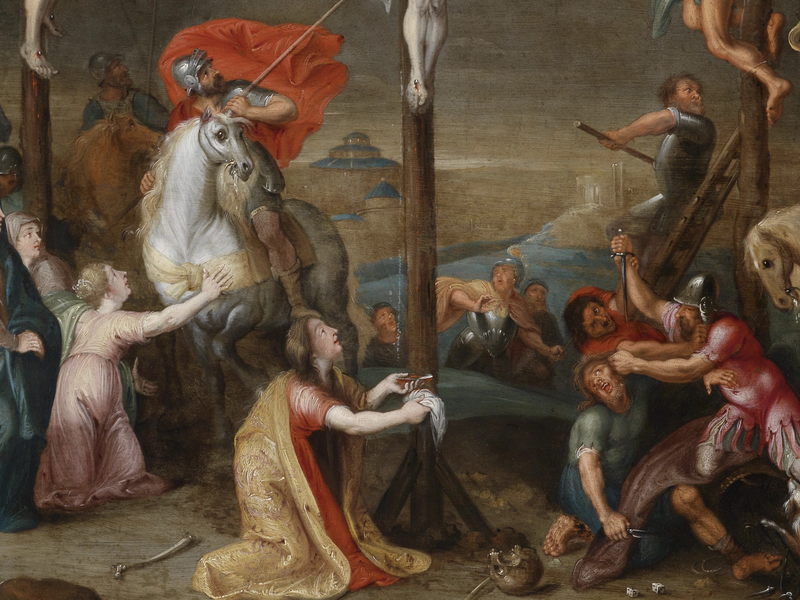
At His death, Jesus is surrounded by a Roman centurion and his cohort of Gentile solders. Matthew doesn't say that any disciples are there. But women are, and so is Joseph of Arimathea, identified as a “disciple” but, as John tells us, a “secret disciple for fear of the Jews,”…

by Peter LeithartMarch 31, 2014

Showing page 176 of 309

See all
See all

Doors, oil, and sleep

A 1974 JBL article by Karl Donfried explores some of the allegorical elements of the parable of the virgins in Matthew 25. He points out that the “door” is an important motif for Matthew: “This is an important theme for Matthew. On the eschatological day, Jesus will stand at the…

August 29, 2009

Twins

“When her days to be delivered were fulfilled, behold, there were twins in her womb.” That’s Genesis 25:24, and it’s talking about Rebekah pregnant with Jacob and Esau. “It came about at the time she was giving birth, that behold, there were twins in her womb.” That’s Genesis 38:27, and…

August 29, 2009

Twisted Fairy Tale

A man had three sons who went out into the wide world to see their fortune. Everyone thought the first two sons were smart and would be successful, but the last son was an oaf, and everyone knew he would return an utter failure . . . . We know…

August 29, 2009

Wise and Foolish

Matthew doesn’t talk about wisdom and foolishness very often, and only twice does he contrast the wise ( phronimos ) to the foolish ( moros ). The first comes at the end of the sermon on the mount, where Jesus contrasts wise and foolish builders; the other comes in the…

August 29, 2009
Philosophy

Humean natural law

Baylor’s Alexander Pruss offers this nifty Aristotelian critique of Humean natural law: “The most basic dichotomy between views of laws of nature is that between Humean views on which the laws of nature are merely descriptions of the actual states of affairs that obtain, and anti-Humean views according to which…

August 28, 2009

Boethian persons

“Persona est rationalis naturae individua substantia,” said Boethius in his treatise on the two natures. This has been viewed as a radically deficient definition of personhood, but Peter Simpson argues that it’s got more going for it than many imagine. In response to the charge that it relegates what really…

August 27, 2009

Showing page 1356 of 2212

Browse by Category

In Medias Res

Your weekly digest for all things Theopolis.

Donate

Theopolis is nearly 100% donor-supported. Consider joining us on our mission.