Theopolis Logo

Writing

Explore our collection of theological essays, biblical studies, and reflections on faith and culture.

See all
rembrandt-main
Art

The Second Word V: On Images and Art, Part 3

The Failure of the Church Yet a third factor played an important role in this historical development, in addition to the imperial adoption of icons and the rise of the icons of the holy man. Brown writes: "The great Christian basilicas of the previous centuries tended to stand empty, except…

by James B. JordanSeptember 4, 1998

screenshot-2023-09-11-at-11-34-45-am
Biblical Horizons

Patriarchal Dominion

The three large patriarchal narratives of Genesis concern the three aspects of the cosmos: matter, space, and time. Over these three is man given dominion. Lucifer was originally appointed to train man in this dominion, but he chose to lead man into rebellion instead. Thus, the Angel of Yahweh replaced…

by James B. JordanAugust 4, 1998
trnava-university-beeyeib-am8-unsplash
Biblical Horizons

The Case Against Western Civilization, Part 6

Part 6: Living in a Dying World (continued) The "Trivium" (continued) The five stages of education are simply the five stages of the covenant as God administers it in human life and history, and in the liturgy of covenant renewal: First, God announces Himself. "I am Yahweh Your God." He…

by James B. JordanAugust 4, 1998
screen-shot-2022-05-12-at-12-07-23-pm
Biblical Studies

Re-creation in the Ascension Offering

The following essay is tentative and exploratory, offered for your consideration. It seems to me that the ritual of the Ascension Offering (incorrectly translated as Burnt Offering) of Leviticus 1 is a symbolic recapitulation of Genesis 1, which thereby portrays the sacrificial ritual as way of moving from a fallen…

by James B. JordanJuly 4, 1998
Biblical Horizons

The Framework Hypothesis: A Gnostic Heresy

Just as the vast majority of evangelical Christians in America today are Arminian and Baptist, so the vast majority do not believe in a creation around 4000 BC. I don’t expect any of these three situations to change anytime soon. Powerful presuppositions are at work in all three instances, along…

by James B. JordanJuly 4, 1998
picture-mosaic-cathedral-jesus-christ-cefalu-italy-copy
Art

The Second Word V: On Images and Art, Part 2

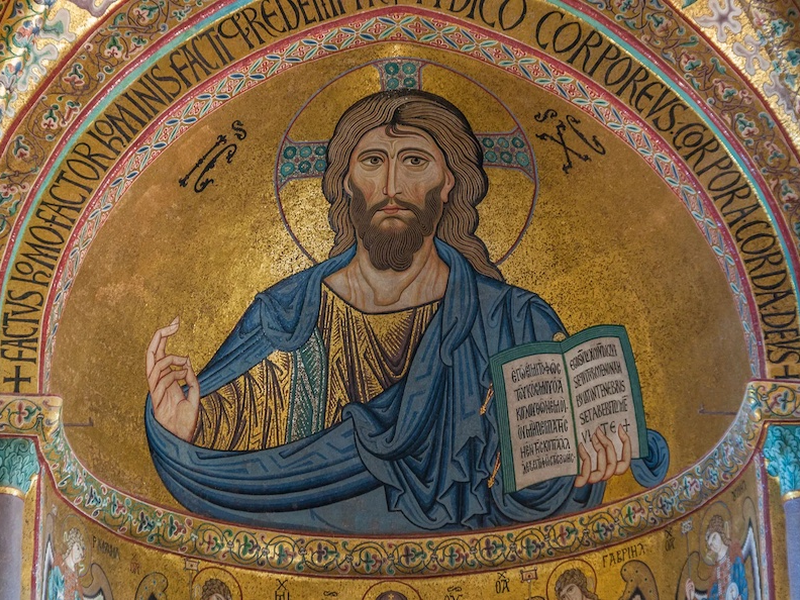
The Iconoclastic Controversy Continuing Pagan Influence How did images creep in? To begin with, there was in the post-Constantinian Church a concerted effort on the part of the semi-pagans to interpret Christianity in essentially pantheistic terms. The heretics put God and man on a continuum of "being," so that God…

by James B. JordanJuly 4, 1998

Showing page 248 of 309

See all
See all
History

Missing Sunday School

Robin Lane Fox ( Pagans and Christians ) summarizes Constantine’s telling of the story of Daniel: In the court of Cambyses, Daniel “worked his miracles and prayed intently three times a day. The Magi became jealous of this new superior, and so he cast him to lions in the royal…

March 26, 2009
History

Religion of the Paperback

That’s how Stroumsa describes early Christianity, because of its preference for the small, portable codex over the traditional, sacred but quite cumbersome scroll. The codex had practical advantages, but Stroumsa thinks that something else was at work: “In going against all religious and cultural norms, the Christians manifestly knew that…

March 25, 2009
History

End of Sacrifice

Guy Stroumsa’s book, The End of Sacrifice (just released from the University of Chicago) is small in size but raises huge questions. Based on lectures delivered at the College de France, Stroumsa’s book examines religious, religio-political and religio-anthropological shifts during the first centuries after Christ. He sees several new emphases…

March 25, 2009
History

Human sacrifice

Eusebius ( Gospel Preparation , 4.17) charges that human sacrifice was regularly practiced by ancient peoples: “And whether it is Phylarchus, or any one else, who records that all the Greeks, before going out to their wars, offer a human sacrifice, do not thou hesitate to take him also as…

March 25, 2009

Magnanimity

Aristotle defined magnanimity or “great-mindedness” as a proper estimate of one’s merits: “The Great-minded man is then, as far as greatness is concerned, at the summit, but in respect of propriety he is in the mean, because he estimates himself at his real value (the other characters respectively are in…

March 25, 2009
Uncategorized

Moses and philosophy

In his Oration to the Saints , Constantine repeats the patristic commonplace that Greek philosophy owed a debt to Moses: “Moses excelled his predecessors in wisdom to such a degree that even those who were praised by the nations as wise men and philosophers came to emulate his wisdom. For…

March 25, 2009

Showing page 1401 of 2212

Browse by Category

In Medias Res

Your weekly digest for all things Theopolis.

Donate

Theopolis is nearly 100% donor-supported. Consider joining us on our mission.