Theopolis Logo

Writing

Explore our collection of theological essays, biblical studies, and reflections on faith and culture.

See all
timothy-eberly-djj49s6ud2o-unsplash
Leviticus

Yahweh's War Against Death

Stories, frankly all human stories are practically always about one thing aren’t they? Death. The inevitability of death. . . . “There is no such thing as a natural death. Nothing that happens to man is ever natural, since his presence calls the whole world into question. All men must…

by Brian MarrApril 14, 2014

screenshot-2023-09-21-at-4-52-42-pm
Matthew

Inescapable Blood

Matthew is organized around 5 discourses, which trace out the history of Jesus as a recapitulation of the history of God and Israel in the Old Testament. Jesus first speaks as a new Moses, instructing His disciples on a mountain about a righteousness that surpasses the righteousness of the scribes…

by Peter LeithartApril 10, 2014
screen-shot-2022-05-12-at-12-07-23-pm
Angels

Did Angels Marry People? The Sin of Cultural Intermarriage

The fall of the Sethites in Genesis 6 is the third fall of mankind, or the third degree of Adam’s original fall. Adam sinned in a Garden against his Father by stealing something he was supposed to wait to obtain. (“Every tree shall be food for you” Genesis 1:29.) Cain…

by James B. JordanApril 7, 2014
sixteen-miles-out-al48tflf4e8-unsplash
Angels

Did Angels Marry People? The Sons of God in Genesis 6

The recent fantasy film Noah and a slightly related blog comment by my friend Douglas Wilson have stirred up again the question of whether the “sons of God” in Genesis 6 who married the “daughters of men” were fallen angels or the priestly line of Seth. Doug argues for angels,…

by James B. JordanApril 4, 2014
kiwihug-l4gw27xzn1i-unsplash
Angels

The Angels of Jude

The prophecy of Jude concerns apostasy. An illustration of apostasy and its consequences is found in verse 6, which the New American Standard Bible translates this way: "And angels who did not keep their own domain, but abandoned their proper abode, He has kept in eternal bonds under darkness for…

by James B. JordanApril 3, 2014
screenshot-2023-09-21-at-4-22-42-pm
Matthew

Women at the Cross

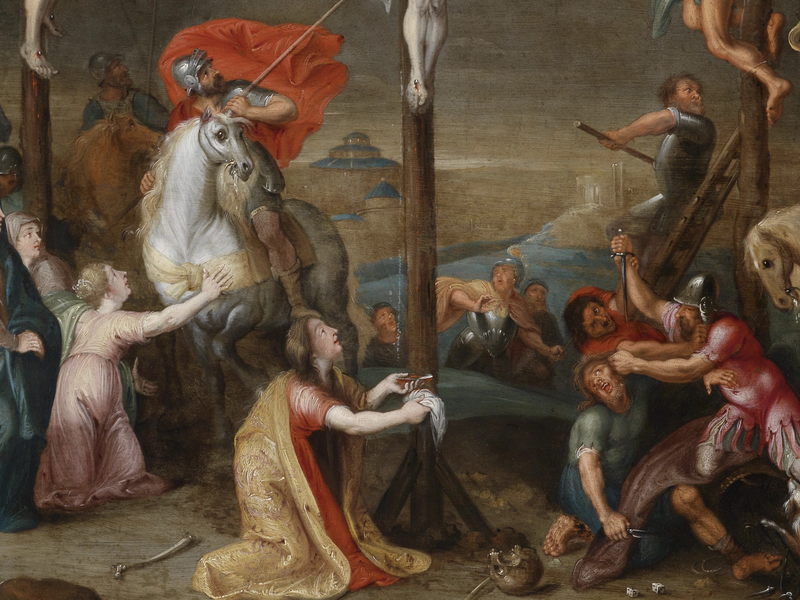
At His death, Jesus is surrounded by a Roman centurion and his cohort of Gentile solders. Matthew doesn't say that any disciples are there. But women are, and so is Joseph of Arimathea, identified as a “disciple” but, as John tells us, a “secret disciple for fear of the Jews,”…

by Peter LeithartMarch 31, 2014

Showing page 176 of 309

See all
See all
History

Purity and objectivity

Proctor again, summarizing a 1938 article on “Science and the Social Order” from Robert Merton: “the ideal of ‘pure science’ serves a dual function in modern society. On the one hand, the exaltation of pure science represents ‘a defense against the invasion of norms that limit directions of potential advance…

October 28, 2008
History

Revival of purity

Proctor yet again, describing the division of political economy into separate disciplines of sociology and economics in the nineteenth century: “Social theory in the eyes of the young sociologists might strive to become scientific, but to do so it must abandon its craft or practical-political origins and restrict itself to…

October 28, 2008
Philosophy

Artifice and nature

Proctor again, speaking of Renaissance science: “In the science of the moderns, there arises a curious reversal of the order of art and nature. Art becomes the standard against which nature is judged. Francis Bacon’s ‘nature in distress’ - nature distraught by experiment - is as genuine as nature left…

October 28, 2008
Philosophy

Pure knowledge

The drive for purity in knowledge is an ancient one. Robert Proctor ( Value-Free Science? ) sees this impulse in Plato and Aristotle. For the former, knowledge is pure “in the degree to which it makes no appeal to practical arts. Thus Plato criticized Eudoxus, Archytas, and Menaechmus for trying…

October 28, 2008

Anarthrous God

CK Barrett argues in his John commentary that the anarthrous theos of John 1:1 (emphasized by Arians everywhere and at all times) shows that “the Word is God, but is not the only being of whom this is true; if ho theos had been written it would have been implied…

October 28, 2008
Uncategorized

Word came, saying

After Genesis 15, the next time the “word of God came . . . saying” is in Samuel. The word of God comes to Samuel, saying that Saul is rejected (1 Samuel 15:10), and again comes to Nathan to deliver the promise to David (2 Samuel 7:4). The connection of…

October 27, 2008

Showing page 1456 of 2212

Browse by Category

In Medias Res

Your weekly digest for all things Theopolis.

Donate

Theopolis is nearly 100% donor-supported. Consider joining us on our mission.