Theopolis Logo

Writing

Explore our collection of theological essays, biblical studies, and reflections on faith and culture.

See all
timothy-eberly-djj49s6ud2o-unsplash
Leviticus

Yahweh's War Against Death

Stories, frankly all human stories are practically always about one thing aren’t they? Death. The inevitability of death. . . . “There is no such thing as a natural death. Nothing that happens to man is ever natural, since his presence calls the whole world into question. All men must…

by Brian MarrApril 14, 2014

screenshot-2023-09-21-at-4-52-42-pm
Matthew

Inescapable Blood

Matthew is organized around 5 discourses, which trace out the history of Jesus as a recapitulation of the history of God and Israel in the Old Testament. Jesus first speaks as a new Moses, instructing His disciples on a mountain about a righteousness that surpasses the righteousness of the scribes…

by Peter LeithartApril 10, 2014
screen-shot-2022-05-12-at-12-07-23-pm
Angels

Did Angels Marry People? The Sin of Cultural Intermarriage

The fall of the Sethites in Genesis 6 is the third fall of mankind, or the third degree of Adam’s original fall. Adam sinned in a Garden against his Father by stealing something he was supposed to wait to obtain. (“Every tree shall be food for you” Genesis 1:29.) Cain…

by James B. JordanApril 7, 2014
sixteen-miles-out-al48tflf4e8-unsplash
Angels

Did Angels Marry People? The Sons of God in Genesis 6

The recent fantasy film Noah and a slightly related blog comment by my friend Douglas Wilson have stirred up again the question of whether the “sons of God” in Genesis 6 who married the “daughters of men” were fallen angels or the priestly line of Seth. Doug argues for angels,…

by James B. JordanApril 4, 2014
kiwihug-l4gw27xzn1i-unsplash
Angels

The Angels of Jude

The prophecy of Jude concerns apostasy. An illustration of apostasy and its consequences is found in verse 6, which the New American Standard Bible translates this way: "And angels who did not keep their own domain, but abandoned their proper abode, He has kept in eternal bonds under darkness for…

by James B. JordanApril 3, 2014
screenshot-2023-09-21-at-4-22-42-pm
Matthew

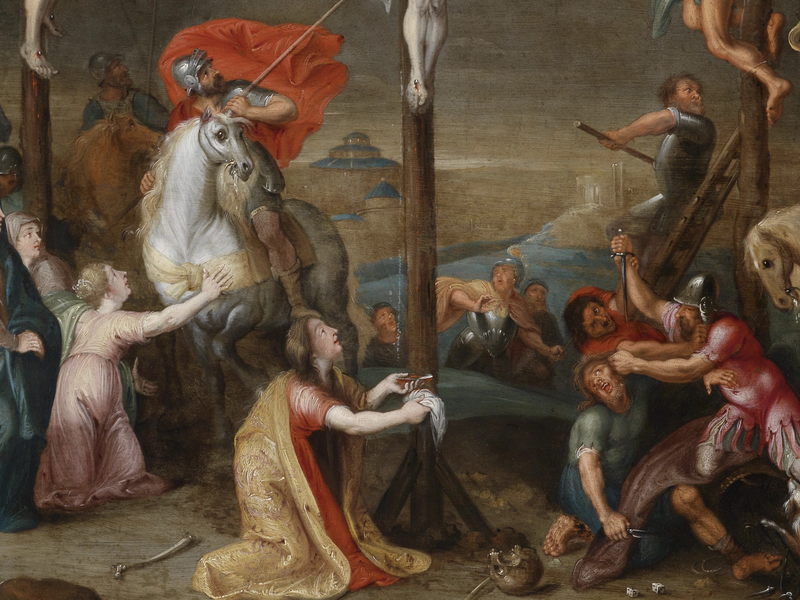
Women at the Cross

At His death, Jesus is surrounded by a Roman centurion and his cohort of Gentile solders. Matthew doesn't say that any disciples are there. But women are, and so is Joseph of Arimathea, identified as a “disciple” but, as John tells us, a “secret disciple for fear of the Jews,”…

by Peter LeithartMarch 31, 2014

Showing page 176 of 309

See all
See all

Clever Drudge

Drudge couldn’t care a whit for Hillary Clinton, but his increasingly provocative headlines (most recently, “Diss-Off”) for a story on how Obama never considered Hillary as a veep candidate can have only one result: To get Hillary’s supporters, already cool toward Obama, hopping mad.

August 22, 2008

Enlightenment and elementary principles

Kant regards positive religions or ecclesiastical faiths (including Christianity) as temporary moral crutches that we can shed as we approach the pure natural religion of reason. Christianity’s institutions, sacraments, dogmas, are the stoicheia leading us to enlightenment. Here we see the problematics of Christian sacramental theology, going back at least…

August 22, 2008
Philosophy

Changing past and realism

Weberman returns to Danto to advance his argument. He notes that Danto shies away from saying that past events change, and suggests that he did this in order to remain a realist about past events; Danto held that “past events are what they are in a mind-independent way.” He insists…

August 19, 2008
Philosophy

Nonfixity of past

In an article in the Review of Metaphysics (1997), David Weberman argues for the “nonfixity of the historical past.” He starts from Arthur Danto’s argument that historical inquiry and writing cannot be a reconstruction available to an “ideal chronicler” who knows everything that happens the moment it happens and sets…

August 19, 2008

Union card

E. Miner wrote, that “the ability to declare typology absent is a kind of proof of sound modern critical method.” Which translated means, Skepticism about typology is the union card of serious biblical scholarship.

August 19, 2008

Brick Hermeneutics

A. K. A. Adam offers a useful critique of what he calls “brick hermeneutics.” Taking a cue from George Herriman’s early 20th-century comic strip Krazy Kat, he describes brick hermeneutics as follows: “Most of our discourses take for granted the premise that we communicate by infusing ‘meaning’ into some expression,…

August 19, 2008

Showing page 1480 of 2212

Browse by Category

In Medias Res

Your weekly digest for all things Theopolis.

Donate

Theopolis is nearly 100% donor-supported. Consider joining us on our mission.