Theopolis Logo

Writing

Explore our collection of theological essays, biblical studies, and reflections on faith and culture.

See all
49980-nicolas_poussin_-_the_judgment_of_solomon_-_wga18330-800w-tn
Biblical Studies

Advice From a Sojourner, Part 2

In our first essay in this series ( part 1 ), we saw that Proverbs 30 opens with a puzzle, a cryptic sentence that challenges the reader to search out a matter in order to gain understanding. "It is the glory of God to conceal a matter, but the glory…

by James B. JordanOctober 26, 1989
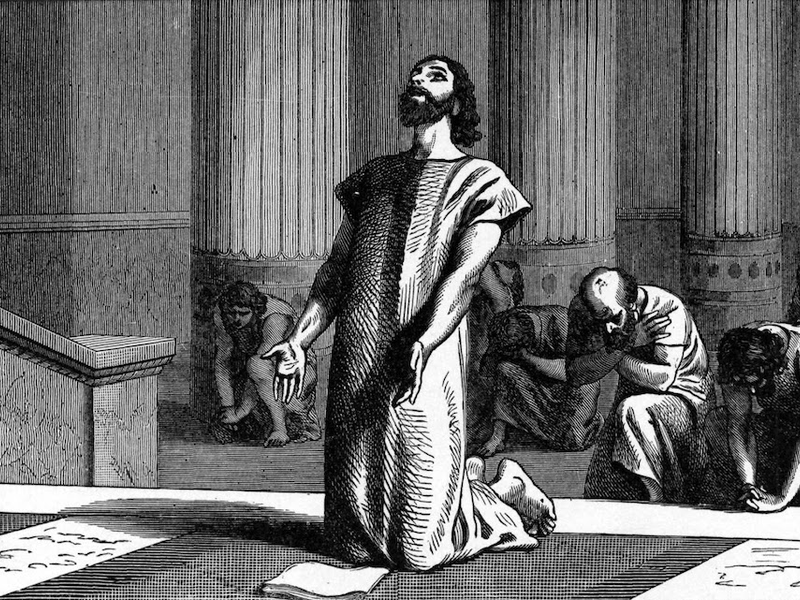
hezekiahs-prayer-2
Isaiah

Hezekiah’s Sign

The story of Hezekiah’s illness and recovery is familiar to every child who has attended Sunday School. Informed that he would die, faithful King Hezekiah pleaded in tears for a longer life. God heard his prayers and saw his tears, and promised fifteen more years. As a sign that He…

by Peter LeithartOctober 13, 1989
screen-shot-2021-08-12-at-2-57-54-pm
Proverbs

An Antidote for Yuppie Postmillennialism

1. The Blessed Hope "Looking for the blessed hope and the appearing of the glory of our great God and Savior, Christ Jesus." Titus 2:13 I was recently asked how I as a postmillennialist would preach on "The Blessed Hope." This is often a sticky question, because postmillennialists believe that…

by James B. JordanAugust 26, 1989
screen-shot-2022-01-10-at-5-52-39-pm
American Culture

Elijah’s War with Baal

1. Jeroboam and Ahab After Solomon died, the people came to his son, King Rehoboam, and asked for tax relief. Rehoboam refused to give it, and indeed told the people that he was going to tax them even more severely than his father had. At that point, with the blessing…

by James B. JordanJuly 26, 1989
screen-shot-2020-08-31-at-10-35-03-am
Biblical Horizons

The Love Feast

One aspect of truth is unity. It was Truth Incarnate who prayed for the unity of His people in John 17, which certainly makes unity a priority for them as well. In one sense, we know by faith that the Church is always invisibly unified in Christ, but there is…

by James B. JordanJune 16, 1989
screen-shot-2022-01-07-at-6-38-22-pm
Biblical Studies

The Son of Joseph, Revisited

Mr. Paul Miller of Vancouver writes that he is not persuaded by my remarks on Luke 4 on " The Son of Joseph ." He calls attention to Mark 6:1-6, where Jesus came "to His own part of the country," taught in the synagogue, and astonished many. The people said,…

by James B. JordanMay 16, 1989
See all
See all

Expression and content

Umberto Eco ( Limits of Interpretation ) criticizes Barthes’s notion that connotation occurs when “a sign function (Expression plus Content) becomes in turn the expression of a further content.” He argues that “in order to have a connotation, that is, a second meaning of a sign, the whole underlying first…

August 14, 2008

Fat Heart

Isaiah 6:10 says that Isaiah’s ministry will make the hearts of Israel “fat” and their ears “heavy” ( kabad ). The phrasing is unique to Isaiah 6, but the combination of heavy and fat conjures up Eli, who also was going blind. Isaiah 6 is a new Samuel, and like…

August 13, 2008
History

From Creator-creature to Subject-object

MH Abrams notes that at the heart of Romanticism was a transfer of Christian concepts into a new, subjectivist, context: “Much of what distinguishes writers I call ‘Romantic’ derives from the fact that they undertook, whatever their religious creed or lack of creed, to save traditional concepts, schemes, and values…

August 13, 2008

God-like Hirsch

Frank Lentricchia argues that there is “no unmediated historical knowledge,” and adds: “That is reserved for God, or for theorists like Hirsch who believe that objective knowledge can be acquired in a massive act of dispossessing ourselves of the only route to knowledge that we have: the historicized self. What…

August 13, 2008

Sacraments and texts

Roger Lundin notes that modern interpretation often seeks an unmediated encounter with the text, and then adds: “Both Keith Thomas and Charles Taylor trace it, in part, to the Reformation’s anti-sacramental impulses, which fed into the desacralizing of nature that seventeenth-century science and commerce eagerly promoted. The process accelerated through…

August 13, 2008

Another hermeneutical parable

For centuries, piano virtuosos had thrilled audiences with audacious performances of Liszt’s seventh Etude (in G minor, “Eroica”). Liszt scholars had written analyses of the music, and critics had compared various performances to one another and to what they believed was Liszt’s original intention for the music. An industrious Liszt…

August 13, 2008

Showing page 1482 of 2212

Browse by Category

In Medias Res

Your weekly digest for all things Theopolis.

Donate

Theopolis is nearly 100% donor-supported. Consider joining us on our mission.