Theopolis Logo

Writing

Explore our collection of theological essays, biblical studies, and reflections on faith and culture.

See all
screen-shot-2022-04-12-at-7-14-44-am
Biblical Horizons

Christ Is Risen! He Is Risen Indeed!

"Vanity of vanities", says the Preacher. "All is vanity". Life, we are told in the book of Ecclesiastes, is a repetitious, wearisome cycle; all that is and all that will be has already been. There is nothing new under the sun. What is crooked cannot be made straight, what is…

by Peter LeithartFebruary 23, 1991
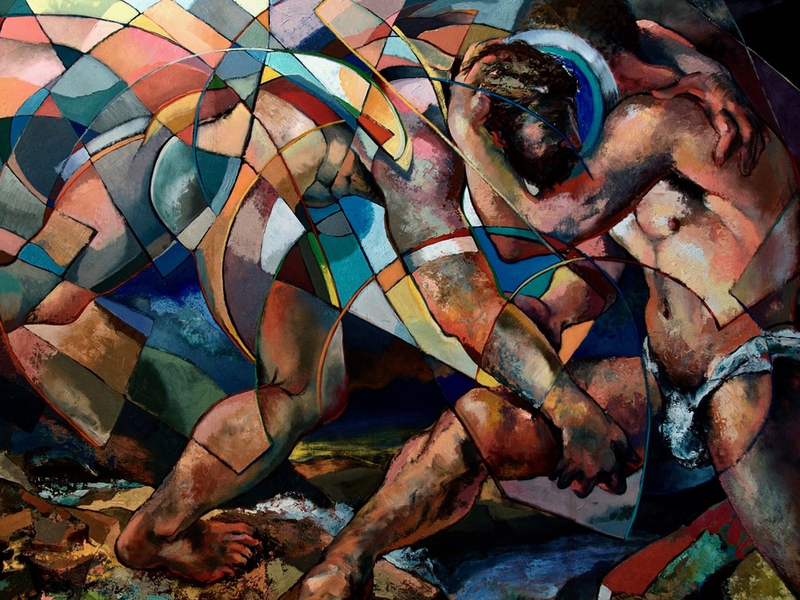
jacob-wrestling-the-angel
Biblical Studies

Three “Falls” and Three Heroes

The Bible tells us that when God created the earth, He set up three zones of life. The first was the world itself. The second was the holy land of Eden. And the third was the Garden in Eden, God’s sanctuary. God told Adam and Eve that every tree was…

by James B. JordanFebruary 22, 1991
mick-haupt-eq2z9ay9wws-unsplash
Biblical Studies

The Chronology of Ezra & Nehemiah, Part 1

In our survey of Biblical chronology we have arrived at the books of Ezra and Nehemiah, which provide chronological information for the period after the return from exile, the Restoration Period of Old Testament history. The question we begin to address in this essay is whether the Artaxerxes of these…

by James B. JordanFebruary 22, 1991
8226-sermon-on-the-mount-painting-2
Matthew

Pluck It Out!

These verses from the Sermon on the Mount are generally taken in connection with Jesus’ earlier statement concerning adultery in the heart (vv. 27-28); the eye and the hand have obvious relevance to the sin of adultery. At the same time, most commentators admit that the principle of avoiding occasions…

by Peter LeithartFebruary 2, 1991
49980-nicolas_poussin_-_the_judgment_of_solomon_-_wga18330-800w-tn
Proverbs

Advice From a Sojourner, Part 9

17. The eye that mocks a father, And despises to obey a mother, The ravens of the valley will pick it out, And the young eagles will eat it. 18. There are three things that are too wonderful for me, Four that I do not understand: 19. The way of…

by James B. JordanJanuary 30, 1991
screen-shot-2020-12-03-at-1-47-33-pm
Biblical Horizons

The Dominion Church

The modern Church in America and virtually everywhere else is ideology-centered, not geographical. This is because various Churches believe different things and have different customs of worship and sacraments. The ideological Church has gradually developed from the time of the Reformation, because accuracy of doctrine has become more important to…

by James B. JordanJanuary 30, 1991

Showing page 299 of 309

See all
See all
Theology

Barthes’s transcendental argument

That’s Barthes not Barth. As in Roland. Prickett suggests that Barthes’ proclamation of the death of the author, his manumission of interpretation from the obsession with the limited, final, “secret” meaning, and his hope for a liberated “anti-theological” and “revolutionary” reading that refuses “to fix meaning” in fact opens the…

August 5, 2008

Conservatism of Poststructuralism

Poststructuralism likes to think itself radical, but Stephen Prickett (Words and the Word) points out that it excludes the possibility of novelty. Barthes says that a text is “a tissue of quotations drawn from the unnumerable centres of culture.” And Kristeva’s notion of intertextuality, on Prickett’s reading, encloses a text…

August 5, 2008
Literature

Novelistic language

A few highlights from James Wood’s chapter on language in How Fiction Works . Early on, he mentions the “old modernist hope” that prose can be “as well written as poetry.” This will require readers and novelists to develop what Nietzsche called a “third ear”: “We have to read musically,…

August 4, 2008
Literature

Bad Books

Lewis remarks on the high difficulty of adverse criticism, noting that the difficulty lies partly in the fact that the defects of bad literature are found in good literature: “The novel before you is bad - a transparent compensatory fantasy projected by a poor, plain woman, erotically starving. Yes, but…

August 4, 2008

Terms of abuse

Lewis describes the process by which words that once expressed and aroused emotions by appealing to the imagination have been emptied of image-content and become purely emotional. “Damn you” used to be a real curse, because people believed in damnation. Now that fewer do, it’s a more or less purely…

August 4, 2008

Limits of language

In Lewis’s defense, he is trying to explain some of the limits of language, which are worth noting (this in the last chapter of Studies in Words ). One limitation has to do with language’s inability “to inform us about complex physical shapes and movements. Hence descriptions of such things…

August 4, 2008

Showing page 1485 of 2212

Browse by Category

In Medias Res

Your weekly digest for all things Theopolis.

Donate

Theopolis is nearly 100% donor-supported. Consider joining us on our mission.