Theopolis Logo

Writing

Explore our collection of theological essays, biblical studies, and reflections on faith and culture.

See all
screen-shot-2020-03-05-at-9-05-54-am
Family

Childbearing as Liminal Space

Notwithstanding she shall be saved in childbearing, if they continue in faith and charity and holiness with sobriety. (1 Timothy 2:15) Years ago, the wife of a prominent American theologian recognized that even in Christian circles mothers were under a kind of social pressure to justify the worthwhileness of their…

by Garrett SoucyMarch 24, 2020

pablo-merchan-montes-wyopqmtdd0w-unsplash
Motherhood

Parenting through Coronavirus

I caught my five year old washing his hands again. He had already washed them several times that hour, so I asked him if he was okay. He told me he didn’t want to get “the virus”. That was before I had told him anything about coronavirus, but we did…

by Lindsey TollefsonMarch 20, 2020
arturo-castaneyra-tpe60ik97qw-unsplash
Discipleship

Take a Walk

Very early in life, I developed the habit of walking and thinking and meditating. I came from a rather strict home, and the only way I could get out of the house at night was to walk the dog. So, I did. I would walk the dog for miles and…

by Richard BledsoeMarch 17, 2020
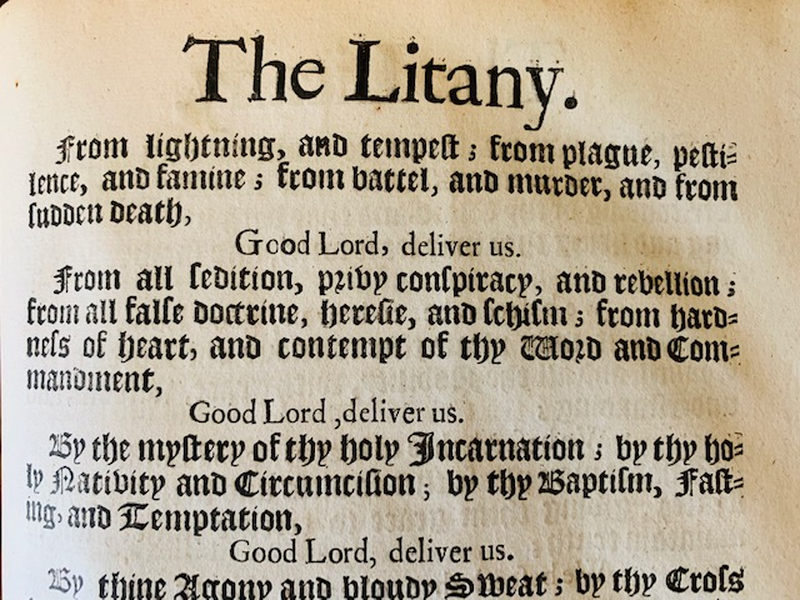
litany-1669-1
Coronavirus

Disease, Deprecations, and Deliverance in an Age of Safe Spaces | Reflections from a University President

From lightning and tempest; from plague, pestilence, and famine; from battle and murder, and from sudden death, Good Lord, deliver us. The Fourth Deprecation from Thomas Cranmer's 1544 Litany 1 A deprecation, such as that above, is a prayer to be spared from disaster, its Latin root deprecari meaning to…

by Alexander WhitakerMarch 16, 2020
lukasz-lada-q7z-aulhpaw-unsplash
Biblical Studies

The Son of Man in the Clouds | Part 2

In the previous essay in this series, we saw that Jesus’ words about coming on the clouds were spoken on more than one occasion, first to the disciples on the Mount of Olives (Matthew 24:30; Mark 11:36; Luke 21:27), then, a few days later, to the high priest and Jewish…

by Ralph Allan SmithMarch 10, 2020
screen-shot-2020-03-05-at-9-05-54-am
Epistemology

Voice and God’s Relational Biology

The following is excerpted from an essay first published at Church Life Journal . We are grateful to the editors for permission to repost here. The word “science” at its root means “to know” and the word “theology” at its root means “to think about God.” Can we know anything…

by Kristin M. Collier MDMarch 5, 2020

Showing page 69 of 309

See all
See all
Philosophy

Mead again

Mead says clock time and calendar time is time only “in a manner of speaking.” He also argues that clock and calendar time is not “absolute” but relative to one’s frame of reference. True that, as my kids say: “Monday” spells gloom within the framework of a certain organization of…

June 19, 2008
Philosophy

Abstract time?

George Herbert Mead focused his thought on temporality (especially in Philosophy of the Present ), and particularly on “time in” events and roles rather than time as a background of events. Time in the strictest sense is the moment of present emergence that reflects into the past and changes its…

June 19, 2008
Science

Scientific laws

Nobel chemist Ilya Prigogine’s work on dissipative structures, complex systems, and irreversibility, Barbara Adam argues, not only challenged particular scientific laws but the classical notion of a scientific law. In classical physics, to arrive at a law was to arrive at a timeless substructure of natural reality. Adam summarizes the…

June 19, 2008
Philosophy

Clock time

Barbara Adam says that the time of clocks is “an idea in practice,” and elaborates: “as a material expression of a particular understanding of the natural world, in which time is conceptualised through motion without change, as a spatial quantity which is infinitely divisible into units, which can be numerically…

June 19, 2008
History

Monastic time

Since Lewis Mumford and Max Weber, historians and sociologists have recognized the importance of the Benedictine monastery in the development of time-keeping, scheduling, and Western notions of time in general. Zerubavel notes that in developing their regulated common life, the Benedictines deliberately broke with the natural and temporal rhythms of…

June 18, 2008
History

Private and public time

We’re used to thinking of privacy in terms of protected spaces, and often hear comments about how isolated individuals and families are in modern society. A guy opens his garage door remotely so his Lexus can slip into the garage, and the door is closed before he’s out of the…

June 18, 2008

Showing page 1503 of 2212

Browse by Category

In Medias Res

Your weekly digest for all things Theopolis.

Donate

Theopolis is nearly 100% donor-supported. Consider joining us on our mission.