Theopolis Logo

Writing

Explore our collection of theological essays, biblical studies, and reflections on faith and culture.

See all
medievalilluminatedmanuscript
Biblical Studies

The Art of Why

“We have a God who hides things because He loves to be sought out, chewed out and found out.” As Christians, we are rightly taught that we must not question God’s Word. The problem is that the Scriptures record many things which appear to have been given to us for…

by Mike BullMay 12, 2015

last-supper
Revelation

Eucharistic Harvest

The book of Revelation is a liturgy. John begins “in the Spirit” on the “Lord’s day” (1:10). Jesus appears, and Jesus tells him to record messages to seven churches, words of encouragement and rebuke, like the call to worship and confession at the beginning of a Christian liturgy. In chapter…

by Peter LeithartMay 7, 2015
sunrise-2
Creation

Maker of Heaven and Earth, (Part 5)

In my previous posts, I looked at the theme of creation as it is found in a sequence of psalms devoted to Yahweh’s Kingship (Psalms 93-100). Among other matters, these psalms declare that when the Kingdom of Israel’s God comes, it is the Kingdom of the world’s own Creator .…

by Stephen LongMay 7, 2015
13071-probablyvalentindeboulogne-saintpaulwritinghi-1
Deuteronomy

Paul the Levir

The church in Corinth was a pastoral nightmare. Factionalism, sexual immorality, incipient syncretism, using the church as a stage for self-promotion, and denial of the final resurrection were just some of the problems. In Paul’s first letter to the Corinthian church, he confronts each of these problems directly and in…

by Bill SmithMay 5, 2015
creation-eve
Covenant

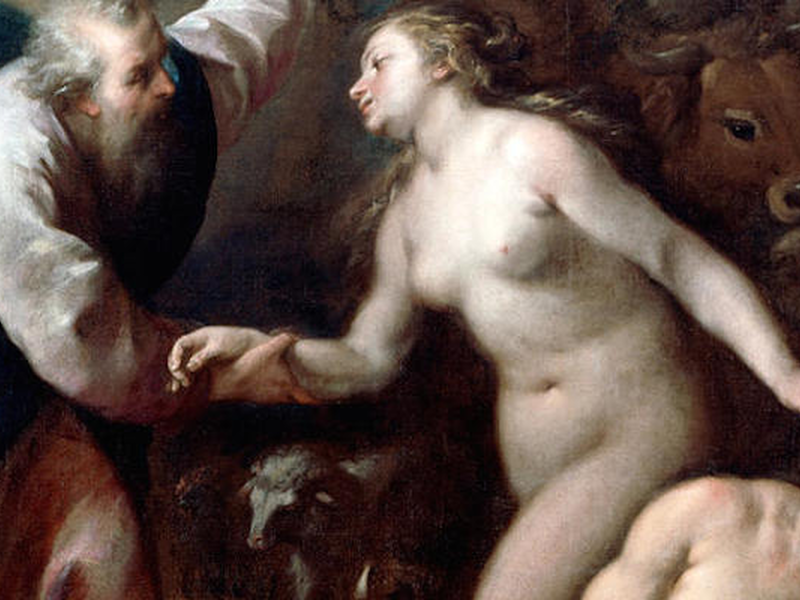
Covenant Structure in Genesis 2

The first chapters of the Word of God have a poetic rhythm. This is used to discredit their accuracy as historical narrative, but the truth is that these same rhythms continue far beyond the book of Genesis. In fact, the later texts shed light on the frustratingly succinct account of…

by Mike BullApril 30, 2015
light-bulb
Creation

Must A Light Bulb Be "Oriented Toward Illumination"?

Mr. Martian: What’s that there? Mr. Edison: (Edison holds up a standard, 60 watt lightbulb). It’s a lightbulb. Mr. Martian: A “lightbulb” you say? What exactly is a “lightbulb”? Mr. Edison: A lightbulb is an object used to illuminate a dark area, say a room. It’s made primarily of filament…

by Gerald HiestandApril 28, 2015

Showing page 154 of 309

See all
See all
Science

Sentient plants

R. Fischer says, “The relativity of our reference point can be demonstrated by taking a moving picture of a plant at one frame a minute and then speeding it up to thirty frames a second. The plant will appear to behave like an animal, clearly perceiving stimuli and reacting to…

June 17, 2008
History

Freud and the Steam Engine

Barbara Adam points out that the leading metaphors for nature in the seventeenth and eighteenth century were mechanical. Creation was a clock. By the nineteenth century, though, steam technology had taken over the European imagination, and metaphors of “letting off steam” and “safety valve” were applied to social and psychological…

June 17, 2008

Participatory Exegesis

My review of Matthew Levering’s latest book is up at First Things : http://www.firstthings.com.

June 17, 2008
Science

Replaceable parts

Behind much of today’s biotechnology is the (Newtonian?) notion that living organisms are machine-like. And living organisms can look like machines in some respects. But they aren’t. Barbara Adam points out that the cells of our bodies are incessantly self-renewing - our limbs aren’t like gears that stay the same…

June 16, 2008
Science

Dance of life

Summarizing findings in physics and biology that should inform social science, Barbara Adam writes, “All organisms, from single cells to human beings and even ecosystems, display rhythmic behaviour. Rhythmicity is a universal phenomenon. Scientists conceptualise atoms as probability waves, molecules as vibrating structures, and organisms as symphonies. Living beings, they…

June 16, 2008
Science

Real time

KG Denbigh wrote in 1981 that physics treats time as a simple continuum: “It knows of no means of picking out a unique moment, the now or the present. The t-coordinate is an undifferentiated continuum, and, if this coordinate is ‘taken for real’ as has been the tendency among many…

June 16, 2008

Showing page 1505 of 2212

Browse by Category

In Medias Res

Your weekly digest for all things Theopolis.

Donate

Theopolis is nearly 100% donor-supported. Consider joining us on our mission.