Theopolis Logo

Writing

Explore our collection of theological essays, biblical studies, and reflections on faith and culture.

See all
timothy-eberly-djj49s6ud2o-unsplash
Leviticus

Yahweh's War Against Death

Stories, frankly all human stories are practically always about one thing aren’t they? Death. The inevitability of death. . . . “There is no such thing as a natural death. Nothing that happens to man is ever natural, since his presence calls the whole world into question. All men must…

by Brian MarrApril 14, 2014

screenshot-2023-09-21-at-4-52-42-pm
Matthew

Inescapable Blood

Matthew is organized around 5 discourses, which trace out the history of Jesus as a recapitulation of the history of God and Israel in the Old Testament. Jesus first speaks as a new Moses, instructing His disciples on a mountain about a righteousness that surpasses the righteousness of the scribes…

by Peter LeithartApril 10, 2014
screen-shot-2022-05-12-at-12-07-23-pm
Angels

Did Angels Marry People? The Sin of Cultural Intermarriage

The fall of the Sethites in Genesis 6 is the third fall of mankind, or the third degree of Adam’s original fall. Adam sinned in a Garden against his Father by stealing something he was supposed to wait to obtain. (“Every tree shall be food for you” Genesis 1:29.) Cain…

by James B. JordanApril 7, 2014
sixteen-miles-out-al48tflf4e8-unsplash
Angels

Did Angels Marry People? The Sons of God in Genesis 6

The recent fantasy film Noah and a slightly related blog comment by my friend Douglas Wilson have stirred up again the question of whether the “sons of God” in Genesis 6 who married the “daughters of men” were fallen angels or the priestly line of Seth. Doug argues for angels,…

by James B. JordanApril 4, 2014
kiwihug-l4gw27xzn1i-unsplash
Angels

The Angels of Jude

The prophecy of Jude concerns apostasy. An illustration of apostasy and its consequences is found in verse 6, which the New American Standard Bible translates this way: "And angels who did not keep their own domain, but abandoned their proper abode, He has kept in eternal bonds under darkness for…

by James B. JordanApril 3, 2014
screenshot-2023-09-21-at-4-22-42-pm
Matthew

Women at the Cross

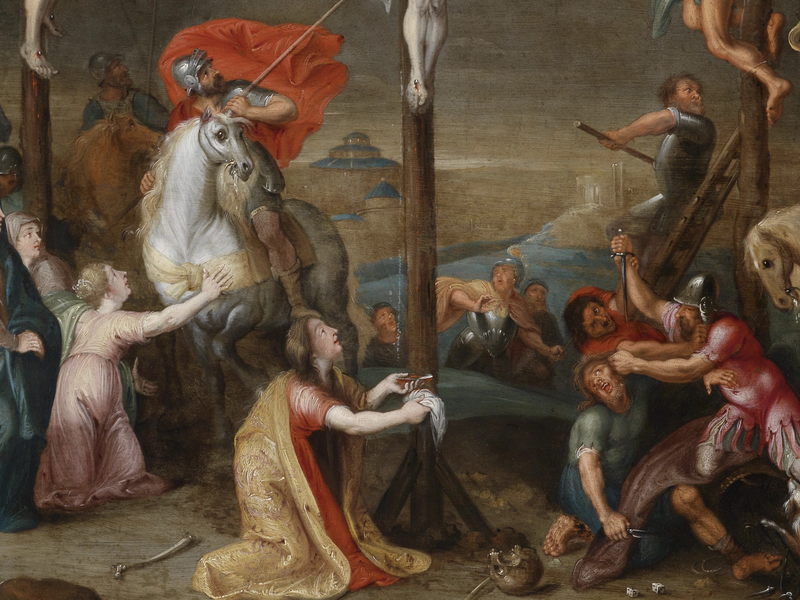
At His death, Jesus is surrounded by a Roman centurion and his cohort of Gentile solders. Matthew doesn't say that any disciples are there. But women are, and so is Joseph of Arimathea, identified as a “disciple” but, as John tells us, a “secret disciple for fear of the Jews,”…

by Peter LeithartMarch 31, 2014

Showing page 176 of 309

See all
See all

Incarnation and Eschatology

Barth insists, rightly, that the incarnation doesn’t express any “need” or lack on God’s part, but is rather His free gracious response to the “radical neediness of the world.” Taking on that neediness also means taking up our cause. He comes to maintain and carry through humanity’s cause to victory.…

April 4, 2008

Self-righteousness

Protestants often claim that our sinfulness is manifest in our efforts to earn God’s favor by our works. That is true, but it doesn’t quite get at the most grievous root of sin. Barth is more penetrating in saying that our sinfulness is manifest in our efforts to usurp God’s…

April 4, 2008
Economics

Markets and people

Charles Morris (in The Trillion Dollar Meltdown ) says that one of the dangerous trends emerging in the 80s and 90s, and lurking behind the current financial crisis, is the “increased dominance of investment decisions by mathematical constructs.” He admits that “Large securities portfolios usually do behave more or less…

April 3, 2008

Translation woes

Jesus spits on the ground, makes clay of the spittle, and “applies” the clay to the eyes of a blind man (John 9; NASB). The verb behind “apply” is epichrio . Its only other usage in the NT is five verses later, where the NASB translates the very same form…

April 3, 2008

John the linguist

John is aware of linguistic diversity, translating unusual Hebrew terms into Greek (e.g., “Messiah” into “Christ,” 1:42). This is perhaps for the convenience of Greek readers, but there is likely also a theological reason: John proclaims the incarnate Word, and describes the work and words of that Word with words…

April 3, 2008

Hebrew Latin Greek

John tells us that the inscription “Jesus the Nazarene, the King of the Jews” was placed above his head on the cross in Hebrew, Latin, and Greek (19:19-20). But this is just the culmination of a text that, though written in Greek, contains a number of cross-linguistic terms. Twice in…

April 3, 2008

Showing page 1540 of 2212

Browse by Category

In Medias Res

Your weekly digest for all things Theopolis.

Donate

Theopolis is nearly 100% donor-supported. Consider joining us on our mission.